Build an MVP From Scratch: Step-by-Step Startup Guide
- Updated: May 11, 2026
- 11 min

CEO
A few things happen when you launch your MVP.
- Some founders get a flood of signups and realize they’ve been sitting on a real problem.
- Others get silence and have to figure out whether the idea was wrong, the messaging was off, or they simply launched to the wrong people.
Most, though, never get to that moment at all. They spend months building before anyone outside their immediate circle has seen a single screen. By the time they launch, they’ve already made hundreds of decisions based on assumptions, and the market has no interest in correcting them gently. And, as the statistics say, most of them fail in the course of three years.
That’s a process problem.
Building an MVP from scratch doesn’t mean building a small version of your product fast. It means finding out whether your product should exist — before you invest serious time and money into making it real. And it turns out, you don’t need to write a single line of code to do that.
This guide walks you through the step-by-step MVP development: six stages, a clear tool for each one, and a reason why the order matters. The info I cover here is mostly based on our experience as an MVP development company with over 13 years of experience. It will be useful for non-technical
Key Points of the Article
- You can build an MVP from scratch without writing a single line of code if you use the right MVP tools in the right order.
- The process follows six stages: validation → prototype → landing page → build → launch → analytics.
- Tools like Typeform, Webflow, and Bubble.io cover most of what you need at each stage.
- A structured approach can reduce your MVP cost by up to 10x compared to jumping straight into development.
Quick Facts
| Typical MVP cost | $0–$10,000 (no-code route) |
| Time to launch | 1–4 weeks |
| Primary goal | Validate product-market fit |
| Core stages | Validate → Prototype → Build → Launch → Learn |
Develop your MVP to validate a product-market fit with our expert software developers — contact us today to get started!
What Does it Mean to Build an MVP From Scratch
There’s a common misconception that building an MVP means building a small version of your product. It doesn’t. So, what is an MVP?
An MVP (minimum viable product) is the smallest possible thing you can put in front of real people to learn whether your idea solves a real problem. The emphasis is on learning, not on building.
Eric Ries, who coined the term as part of the Lean Startup methodology, described MVP as a version of a new product that allows a team to collect the maximum amount of validated learning about customers with the least effort.
This reframe matters because it changes what you do first:
- Not: What’s the smallest product I can build?
- But: What’s the cheapest way to find out if anyone wants this?
That’s a problem-first approach, and it’s the foundation of every successful startup MVP.
Why most MVPs fail
| Mistake | What actually happens |
| Building before validating | You spend months on something nobody wants |
| Overbuilding features | Users get confused; core value gets buried |
| Skipping user research | You solve your problem, not the market’s |
| No analytics from day one | You launch blind and can’t course-correct |
Consider Uber. The original MVP wasn’t an app with surge pricing, driver ratings, and scheduled rides. It was a simple SMS-based system connecting a few drivers with a handful of people in San Francisco. The founders wanted to answer one question: Will people pay a stranger to drive them somewhere?
Everything else came later, and now, there are a lot of startups that want to build an app like Uber for their taxi service. Because Uber is the industry leader and an example of a high-quality mobile app.
That’s the mindset. Now let’s go through each stage.
Stage 1. Validate the Problem Before You Build Anything
Before you write a word of copy, design a screen, or choose a tool, you need evidence that three things are true:
- A real problem exists. It’s not just something people find mildly annoying, like websites that auto-play video, but something they actively want solved.
- A real audience has it: specific, reachable people who experience it regularly.
- They’re willing to pay or change behavior, or invest time, to solve it.
If you can’t confirm all three, no amount of good design or clean code will save your product.
How to Validate Fast (Without a Product)
The good news is that validation doesn’t require a finalized product. It requires conversations and a bit of structure.
Step 1: Run 10–20 customer interviews
Talk to people who could realistically be your users. Don’t pitch your idea, just ask about their current experience with the problem. Good questions include:
- Walk me through the last time you dealt with [problem].
- What have you already tried to solve it?
- How much time or money does this cost you right now?
If people struggle to remember a specific instance, the problem may not be painful enough to build around.
Step 2: Use surveys to scale your findings
Once you have a hypothesis from interviews, run a short survey to see if the pattern holds across a broader group.
| Tool | Best for | Cost |
| Typeform | Clean, engaging survey UX | Free / from $25/mo |
| Google Forms | Fast setup, no budget | Free |
| B2B outreach and targeting | Free (organic) |
Step 3: Test willingness to pay
One of the most reliable signals is whether someone will do something (sign up, pre-order, share their email) before the product exists.
A fake door test works well here: create a simple button or waitlist that simulates a purchase flow, then measure how many people click through.
Validation checklist before moving on:
- Completed at least 10 customer interviews.
- Identified a specific, recurring pain point.
- Confirmed the target audience can be reached.
- Collected at least one signal of willingness to pay.
Stage 2. Test Demand With a Simple Landing Page
A landing page is the cheapest form of market research available. Before you prototype or build anything, a single page with a clear value proposition and a call to action tells you:
- Whether your messaging resonates.
- How many people are interested enough to act?
- Which audience segment responds best?
Think of it as a controlled experiment. You’re not selling a product yet, just measuring intent. Just be transparent about it: a simple line like “We’re gauging interest before we build” or a “coming soon” framing keeps expectations honest and trust intact.
What Makes a High-Converting MVP Landing Page
You don’t need ten sections and a full brand identity. A focused landing page for MVP validation needs just a few things done well:
| Element | What it should do |
| Headline | State the core benefit in one sentence |
| Subheadline | Explain who it’s for and what problem it solves |
| CTA (Call to Action) | One clear next step — email signup, waitlist, demo request |
| Social proof | Even one quote, logo, or stat builds trust early |
| Minimal friction | No unnecessary forms, no distracting navigation |
A click-through rate (CTR) above 3–5% on your CTA is a positive signal. Below that, the messaging or the audience targeting likely needs work.
How to Build a Landing Page Without Developers
Here are a few tools that can help you deliver a solid landing page for your idea testing stage:
| Tool | Strengths | Best for |
| Instapage | High-converting templates, A/B testing built in | Speed and optimization |
| Strikingly | Simple drag-and-drop, fast to launch | First landing page with no experience |
| Webflow | More design control, scales with you | Founders who want flexibility |
The fake door test fits naturally here. Add a button that says “Get Early Access” or “Start Free Trial”, even if the product doesn’t exist yet.
Track how many people click. If you get meaningful traffic and a strong CTR, you have a real market signal before spending a cent on development.
Stage 3. Turn Your Idea Into a Prototype
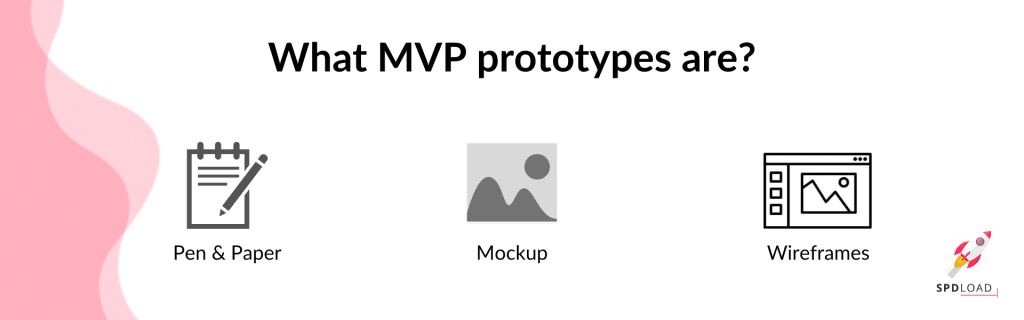
A prototype and an MVP are not the same. The first one is a visual representation of how your product would work, and it costs a fraction of the actual development to produce.
The ROI on prototyping is straightforward: finding a UX problem in a wireframe takes minutes to fix. Finding the same problem after three weeks of development takes days and real money.
Prototyping also helps you:
- Map the user journey before committing to any logic.
- Pitch to early investors with something tangible to show.
- Run UX testing with real users before a single line of code is written.
Here are a few types of prototypes:
| Type | What it is | When to use it |
| Low-fidelity wireframe | Basic layout sketches, no styling | Early ideation, internal alignment |
| High-fidelity mockup | Polished visual design, static screens | Investor pitches, design handoff |
| Clickable prototype | Interactive flow simulation | User testing, demo-ready presentations |
Most early-stage MVPs benefit most from a clickable prototype. It’s interactive enough to test with real users, but doesn’t require any backend work.
To create a prototype, you can use:
| Tool | Best for | Learning curve |
| Balsamiq | Fast low-fidelity wireframes | Low |
| Marvel | Clickable prototypes from static designs | Low |
| Figma | Collaborative UI design and interactive prototypes | Medium |
| Mockplus RP | More detailed interactive prototypes | Medium |
| Webflow | High-fidelity, browser-based design | Medium |
By the end of this stage, you should have something you can put in front of 5–10 potential users and ask: “Does this make sense? Would you use this?” Their answers will shape everything that comes next.
Stage 4. Build Your MVP Without Code
No-code development platforms have matured significantly. What once required a developer and several months can now be assembled visually in a fraction of the time, and for a fraction of the cost.
No-code is a good fit when:
- Your core logic isn’t deeply complex.
- You’re still in the validation phase.
- Speed to market matters more than technical optimization.
- You want to test before committing to a full development budget.
What You Can Build Without Developers
| Product type | No-code viability |
| SaaS web apps | ✅ Strong fit |
| Marketplaces | ✅ Possible with the right tools |
| Mobile apps | ✅ With limitations |
| AI-powered features | ⚠️ Partial — depends on integrations |
| Complex data pipelines | ❌ Usually requires custom development |
No-Code Stack for Fast MVP Development
| Tool | What it builds | Best for |
| Bubble.io | Full web apps with frontend and backend logic | SaaS, marketplaces, dashboards |
| Thunkable | Native mobile apps | iOS/Android MVPs |
| Webflow | Marketing sites and CMS-driven products | Content-heavy or landing-page-first products |
Limitations to keep in mind:
- No-code platforms can hit performance walls at scale.
- Customization has a ceiling. Some logic simply can’t be expressed visually.
- Migrating off a no-code platform, for example, migrating to a cloud, can be costly if not planned for.
A reasonable rule: use no-code to validate, then evaluate whether custom development is needed once you have real users and real data.
Stage 5. Launch Your MVP and Get First Users
Launching isn’t a single moment, but a coordinated push across the places where your early adopters already spend time.
| Platform | Audience | Best strategy |
| Product Hunt | Tech-savvy early adopters | Schedule a launch day, build upvote momentum |
| BetaList | Startup enthusiasts looking for new tools | Submit early for newsletter inclusion |
| Reddit (r/startups, r/SaaS) | Founders, builders, B2B buyers | Share your story honestly, invite feedback |
| B2B decision-makers | Founder-led content, direct outreach | |
| Your waitlist | People already interested | First email, exclusive early access |
Don’t try to be everywhere at once. Pick two or three channels where your target audience actually is, and focus your energy there.
In the first two weeks, you’re looking for three things:
- Signups — are people interested enough to register?
- Activation — do they complete the core action your product is built around?
- Retention — do they come back?
If signups are high but activation is low, your onboarding has friction. If activation is fine but retention drops, the core value isn’t sticking. Each signal points to a specific problem you can fix.
Stage 6. Analyze User Behavior and Improve
Not all metrics are equally useful at the MVP stage. Vanity metrics (total page views, social media followers, app downloads) feel good but don’t tell you much about whether your product works.
Focus on:
| Metric | What it tells you |
| Activation rate | Are users reaching your product’s core value? |
| Drop-off points | Where are users leaving the flow? |
| Conversion rate | How many move from free to paid, or trial to active? |
| Session depth | Are users exploring, or bouncing after one screen? |
| Retention (Day 1, Day 7, Day 30) | Is the product worth coming back to? |
Tools to Understand Your Users
| Tool | What it does | Best for |
| Google Analytics | Traffic sources, user behavior, conversion funnels | Broad behavioral data |
| Hotjar | Heatmaps, session recordings, feedback polls | Understanding why users behave a certain way |
The combination of both is particularly powerful. Google Analytics tells you what is happening. Hotjar shows you how users are actually interacting with your interface. Together, they give you enough signal to prioritize your next iteration intelligently. 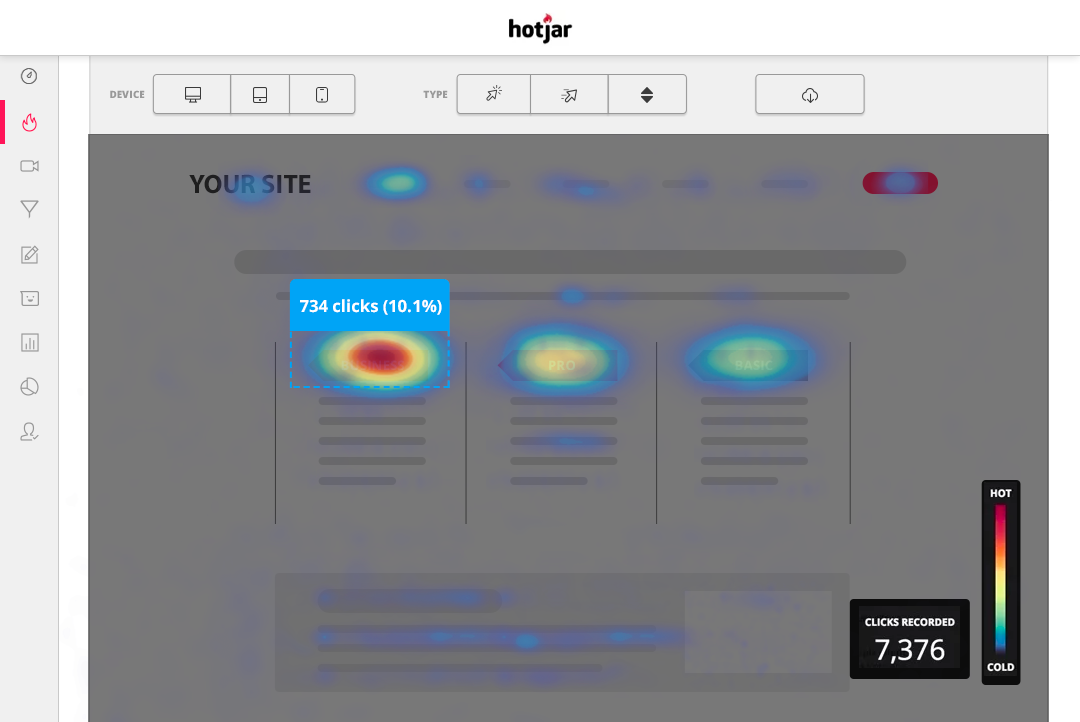
How to Choose the Right MVP Stack
Not every situation calls for the same toolset. Here’s a simplified decision guide based on your constraints:
| Your situation | Recommended stack |
| No budget, early idea | Google Forms + Webflow (free tier) + Bubble.io |
| Need to launch fast | Instapage + Webflow + Typeform |
| Idea validation only | Typeform + LinkedIn outreach |
| B2B SaaS MVP | Webflow landing page + Bubble.io app + Hotjar |
| Mobile-first product | Thunkable + Google Analytics |
Common Mistakes When Building an MVP From Scratch
After 13 years of helping startups build and launch products, we’ve seen the same patterns repeat. Not occasionally — consistently. These are the default path when there’s no structure in place.
Building before validating
This is the one that hurts the most to watch. A founder comes in with months of work done (design, development, the whole thing), and the core assumption was never tested. We’ve seen six-figure builds get shelved because nobody talked to ten customers first. No amount of good execution fixes a product nobody wants.
Overcomplicating the UX
Early users are forgiving. They’ll tolerate rough edges, missing features, and placeholder copy. What they won’t tolerate is confusion. If the core flow takes more than a minute to figure out, most people won’t give you a second chance to explain it.
Collecting feedback and doing nothing with it
This one is subtle. Founders set up a feedback form, get responses, and then get busy building. The responses sit in an inbox. A month later, the same issues users flagged are still there. Collecting feedback without a simple system to review and act on it is almost worse than not collecting it because you had the answers and missed them.
Launching without analytics
We’ve onboarded clients who had hundreds of users and no idea what those users were actually doing inside the product. No funnels, no event tracking, no session data. Starting analytics after launch means you’ve already lost the most valuable early behavioral data you’ll ever have. Set it up before the first user arrives, not after.
Treating launch as the finish line
There’s a real emotional pull to see launch as the moment everything pays off. In reality, launch is just when the learning starts. The founders who move fastest after launch are the ones who already knew that going in.
When Tools Are Not Enough to Develop an MVP
No-code platforms are genuinely powerful, but they have a ceiling. At some point, most growing products hit one of these walls:
- Scalability limits — platform performance starts degrading under real user load
- Custom feature requirements — logic that simply can’t be expressed through visual builders, like custom AI features for SaaS
- Integration complexity — connecting multiple third-party APIs with conditional flows
- Security and compliance needs — GDPR, HIPAA, and data residency requirements often need custom implementation
When that moment comes, transitioning to a custom-built product doesn’t mean starting over. A well-structured no-code MVP gives you validated assumptions, real user data, and a clear product direction. That’s exactly what a development team needs to build something that scales.
At SPDLoad, we work with founders at precisely this stage. We help take what you’ve validated and turn it into infrastructure that can grow without losing what made the MVP work in the first place.
If you are looking for developers who have experience building AI-powered solutions, explore our recent guide where we talk about benefits and costs of hiring AI development team.