How to Hire Startup Developers (Without Costly Mistakes)
- Updated: May 11, 2026
- 13 min

Head of Recruiting
If you’re a non-technical founder, you’ve probably been here before. You have the idea, maybe even the first users, and now everyone’s telling you: You need to hire developers.
So you post a job, get applications, and pick someone who sounds confident in the interview. Six weeks later, the code is a mess, the timeline has slipped, and you’re not sure what you paid for.
I’ve seen this happen way too many times. It’s honestly one of the fastest ways to blow through your funding before you even know if people want what you’re building.
The problem usually isn’t the developers themselves (even though sometimes it is, can’t deny that). But often founders jump straight to hiring before they’ve answered the harder questions: what exactly needs to be built, who should build it, and what good looks like in this context.
I wrote this for founders who don’t want to make the same expensive mistakes I’ve seen over and over (and even made some). My goal here is not to educate, but to share what worked for our dedicated team of developers, along with some lessons learned from previous projects.
Key points on how to hire developers for a startup:
- Hiring developers starts with defining the problem, not writing job descriptions.
- Most startup hiring failures come from moving too fast, not too slow.
- Your choice between in-house, freelance, or outsourcing should match your stage and runway.
- A small, focused team building a validated MVP beats a large team building the wrong thing.
Quick Facts
| Average developer cost | $25–$150/hr depending on region and model |
| Time to hire | 2–8 weeks |
| Best model for early-stage | Dedicated team or IT outsourcing |
| Biggest risk | Hiring before you’ve defined what you’re building |
What is Hiring Developers for a Startup?
Most founders think hiring developers means finding someone who can write code. That’s part of it, but only a small part.
What you’re actually doing is building execution capability. You’re finding people who can take an idea from a napkin sketch to something real users can touch, test, and pay for. That requires technical skill, judgment, communication, and the ability to work in conditions that change weekly.
This is where startup hiring differs fundamentally from enterprise hiring. A large company can afford specialists — one person who only writes API integrations, another who only handles database architecture. A startup can’t. You need people who are adaptable, curious, and comfortable with ambiguity.
Startup developers vs. enterprise developers — key differences:
| Factor | Enterprise Hire | Startup Hire |
| Specialization | Deep and narrow | Broad and flexible |
| Process comfort | Loves structure | Thrives in ambiguity |
| Risk tolerance | Low | High |
| Output focus | Maintain systems | Build new things |
| Communication | Works within hierarchy | Works directly with founders |
Another thing worth understanding early: if you’re a non-technical founder, you have a knowledge gap that needs bridging before you hire anyone. You don’t need to learn how to code. But you do need someone who can help you evaluate what you’re being told.
This is exactly where a Fractional CTO or technical advisor becomes valuable. A fractional CTO is an experienced engineering leader who works with your startup part-time — helping you define your Product Discovery process, choose the right tech stack, and vet candidates before you commit. Think of them as a translator between your vision and the technical execution.
Before your first hire, you should have clarity on at least three things:
- What problem are you solving? Not the feature list — the actual user problem.
- What does your Minimum Viable Product (MVP) include? What’s in scope, and what’s deliberately left out?
- What does success look like in 90 days? A working prototype? First paying users? A tested proof of concept?
Hiring without these answers creates confusion for the developers you bring in. And confused developers write code that solves the wrong problems. 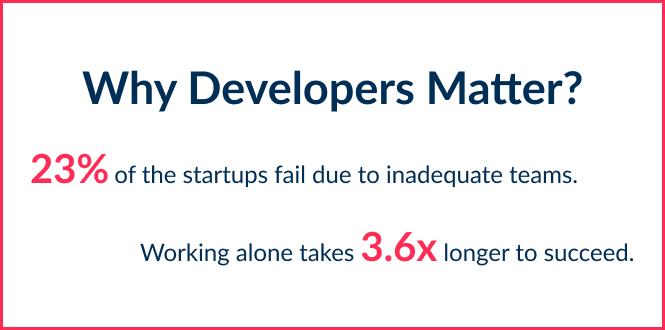
Why Most Startups Fail at Hiring Developers
Before we get into the steps, it’s worth spending a moment on what goes wrong. Because the same mistakes show up over and over, across industries and funding stages.
Hiring Too Early
You don’t need developers the moment you have an idea. You need them once you’ve validated that the idea is worth building.
Many founders skip the research phase entirely and go straight to building. The result is a product nobody asked for, built by a team that had no context on why they were building it. Hiring before you’ve done basic market validation, even lightweight interviews with potential users, is one of the most expensive mistakes you can make.
Hiring the Wrong Stack
Tech development trends move fast. Founders often get advice from well-meaning people who recommend whatever framework is currently popular, without considering whether it fits the product.
Choosing React developers for a content-heavy app makes sense. Using it for a real-time data processing tool might not.
The same logic applies to mobile: going cross-platform with Flutter might save you time and money early on, but if your product relies on deep iOS SDK integrations, you may end up rebuilding everything in native later.
The wrong stack doesn’t just slow you down. It creates Technical Debt — shortcuts and workarounds that pile up over time and eventually make the codebase painful to maintain or extend.
Hiring Without Validation
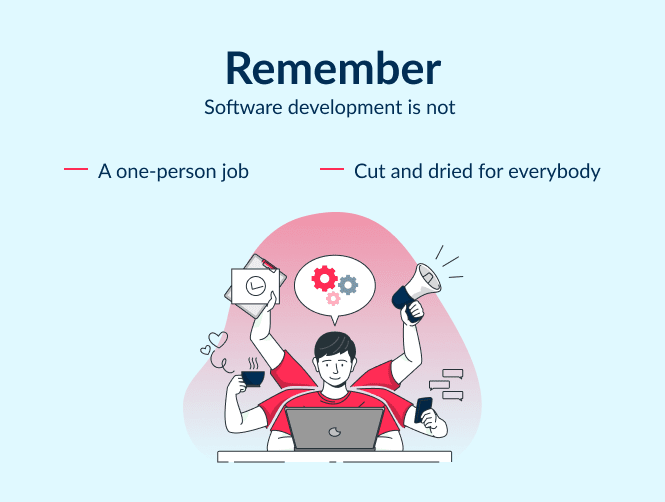
Bringing in developers before you’ve defined the product scope leads to a specific kind of chaos. Developers fill the gaps with their own assumptions. Features get built in isolation. Integrations don’t connect cleanly. Over time, the codebase starts to resemble what engineers quietly call Spaghetti Code — tangled, hard to follow, and nearly impossible to hand off to someone new.
Successful startups like Airbnb and Uber both started with tiny, scrappy teams who built focused, minimal products first. Airbnb’s first version was a simple website with photos and a contact form. Uber started in San Francisco only, with a handful of drivers. Neither company hired a large engineering team before they knew what they were building.
The lesson isn’t stay small forever. It’s more like stay focused until you know what you’re scaling.
Step 1. Define What You’re Actually Building
This step happens before you write a single job description. And it’s the one most founders skip.
What Type of Product Is It?
Different products require different skill sets. Be specific about what you’re building:
| Product Type | What You Need |
| Web Application | Frontend + backend developers, possibly full-stack |
| Mobile App | iOS, Android, or cross-platform specialists |
| SaaS Platform | Scalable architecture, API expertise, DevOps |
| Marketplace | Complex backend logic, payments, user management |
What’s Your Tech Stack?
You don’t need to make the tech stack decision alone. In fact, you shouldn’t. But you should understand the trade-offs before you hand it off to someone else.
Cross-platform vs. Native mobile:
- Flutter (cross-platform) — one codebase for iOS and Android, faster to build, slightly limited on device-specific features
- Native (Swift for iOS, Kotlin for Android) — better performance, deeper OS access, but requires two separate codebases
Web frontend:
- React — widely used, large talent pool, great for dynamic interfaces
- Node.js on the backend — fast, scalable, works well with React teams
Other considerations:
- Python for data-heavy or AI-adjacent products
- React Native if you need mobile and want code reuse with a React web team
The right stack is the one that fits your product requirements, your team’s existing skills, and your timeline, not the one with the most GitHub stars this month. 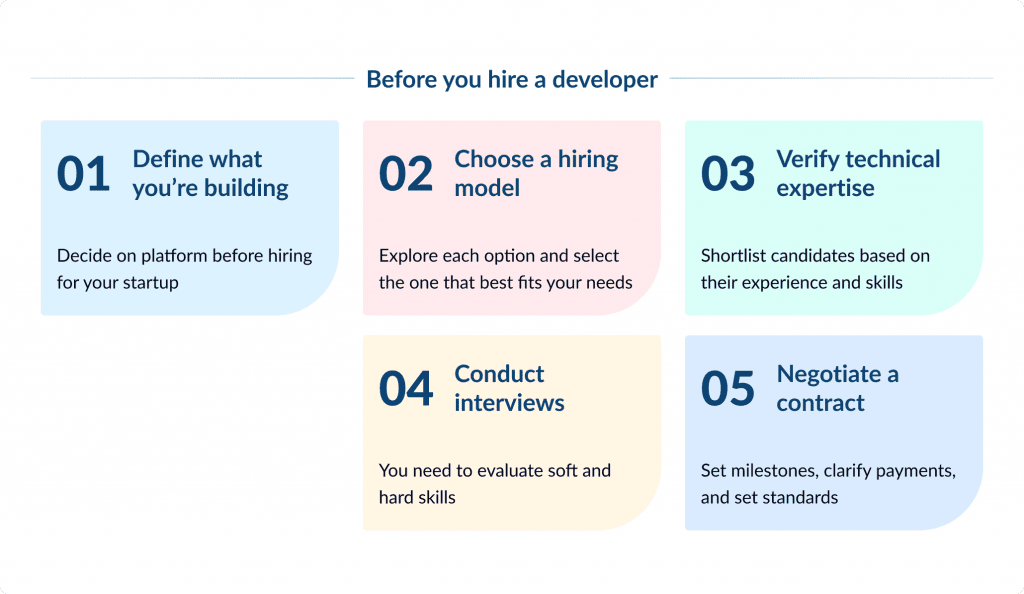
Step 2. Choose the Right Hiring Model
This is one of the most consequential decisions you’ll make as a founder. There’s no universally correct answer as the right model depends on your stage, budget, and how clearly you’ve defined what needs to be built.
In-House Team
You hire developers directly as employees. They work exclusively on your product, sit in your culture, and grow with the company.
Best for: Post-seed startups with a validated product and budget for salaries, benefits, and recruiting time.
Watch out for: Slow time-to-market, high fixed costs, and the challenge of attracting senior talent without strong brand recognition.
Freelancers
You hire individual contractors for specific tasks or short-term projects through platforms like Upwork or Toptal.
Best for: Well-defined, standalone tasks where the scope is clear and the timeline is short.
Watch out for: High management overhead, inconsistent availability, and scalability risks when your needs grow.
Outsourcing / Dedicated Team
IT outsourcing is when you work with a software development agency or partner that provides a pre-vetted team. Typically, a mix of developers, a project manager, and sometimes a designer are working exclusively on your product.
Best for: Early-stage startups that need to move fast, keep costs manageable, and access senior talent without the overhead of full-time hiring.
Watch out for: Choosing a partner without startup experience. Agencies that only work with enterprises often don’t adapt well to fast-changing product requirements.
Side-by-side comparison:
| Model | Cost | Speed | Control | Best For |
| In-House | High | Slow to start | High | Scaled startups, post-PMF |
| Freelancer | Low–Medium | Fast (for small tasks) | Medium | Defined micro-tasks |
| Dedicated Team | Medium | Fast | Medium–High | MVP development, early stage |
Staff augmentation services worth a separate mention. It sits between in-house and outsourcing — you bring external developers into your existing team under your processes and management. It works well when you already have a technical lead and just need to scale capacity quickly. 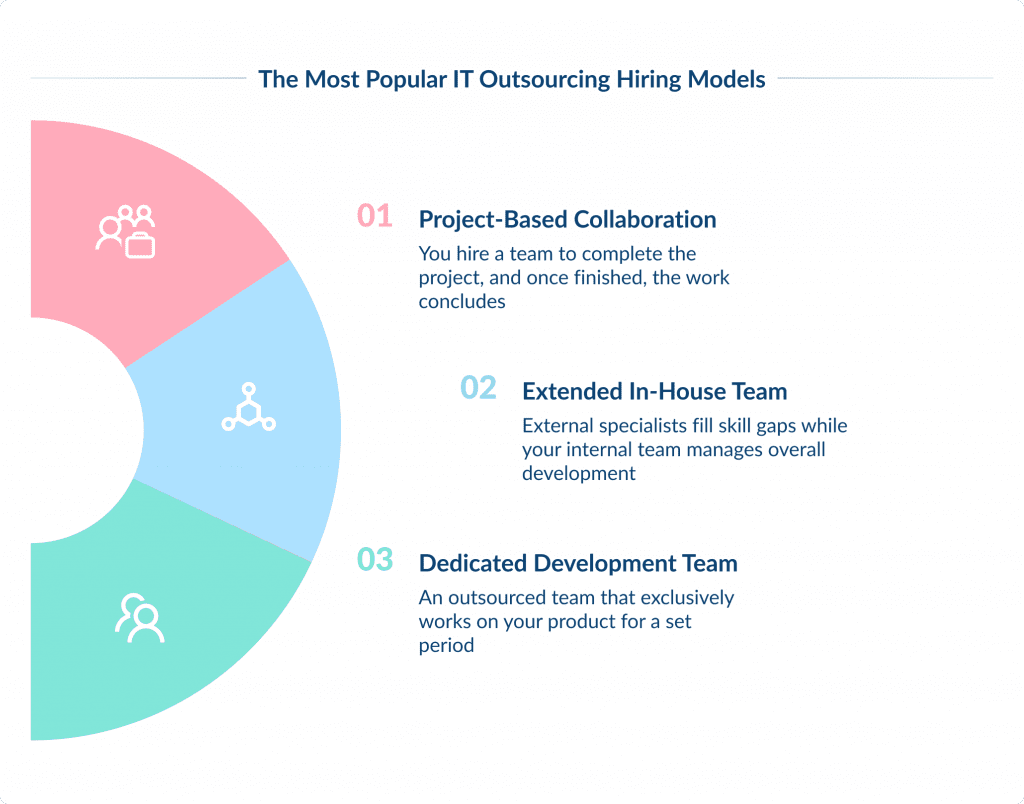
Step 3. Where to Find Programmers for Startup
Knowing where to look matters less than knowing when each channel makes sense.
Marketplaces (Upwork, Toptal)
Good for short-term, clearly scoped work. The talent pool is broad, but vetting takes time and quality varies significantly on general platforms like Upwork. Toptal claims to vet the top 3% of applicants, which raises the quality floor but also the price.
Use when: You need a specific deliverable: a landing page, a data script, a UI prototype, not an ongoing product partner.
Communities (GitHub, Stack Overflow)
These are where you find developers who are genuinely passionate about their craft. Sourcing from open-source contributors or active community members often surfaces people who care deeply about code quality.
Use when: You’re looking for a senior developer who’s hard to find through traditional channels and you have time to build a relationship before making an offer.
Agencies and Vetted Partners
A good software development agency brings more than developers. They bring process, experience across multiple product types, and the ability to scale your team up or down as your needs change. For startups specifically, look for agencies with a track record in MVP development, not just long enterprise contracts.
Use when: You need a full product team, want to move quickly, and don’t yet have the infrastructure to recruit and manage developers internally.
Step 4. How to Evaluate Developers
The way most startups evaluate developers: a resume review followed by a conversational interview, tells you very little about whether someone can actually build your product.
Here’s what actually works:
Portfolio and Code Review
Ask to see past work. Not just a list of projects. Ask for links to live products, GitHub repositories, or code samples. Look for:
- Clean, readable code — not clever, convoluted shortcuts
- Scalable code architecture — does the structure suggest they were thinking about growth?
- Consistency — are they applying the same standards across different parts of the project?
If you can’t evaluate the code yourself, this is another moment where a fractional CTO or senior technical advisor earns their fee.
Real-World Technical Task
Algorithmic whiteboard puzzles are largely useless for evaluating product developers. A better approach: give candidates a small, paid technical test that mirrors the kind of work they’d actually do for you.
Examples:
- Build a simple REST API endpoint with basic authentication
- Fix a bug in a provided codebase and document the fix
- Review a piece of code and explain what you’d improve and why
This tests both technical skill and communication — two things you need in equal measure.
Communication and Soft Skills
This matters more than most founders expect. Can this person:
- Explain a complex technical decision in plain language?
- Push back constructively when they disagree with an approach?
- Flag problems early rather than staying quiet until it’s too late?
Hard skills vs. soft skills — what to weight:
| Skill Type | Examples | Why It Matters |
| Hard Skills | Code quality, system design, debugging | Determines what gets built |
| Soft Skills | Communication, ownership, adaptability | Determines how well it gets built |
For early-stage teams especially, a developer with slightly weaker hard skills but strong ownership and communication will often outperform a technically brilliant but uncommunicative one.
Step 5. How to Interview Developers
A good developer interview has three parts: behavioral questions, problem-solving scenarios, and an honest conversation about how they work.
Behavioral questions to ask:
- Tell me about a time the requirements changed mid-project. How did you handle it?
- Describe a situation where you disagreed with a technical decision. What did you do?
- How do you prioritize when you’re working on multiple things at once?
Problem-solving scenarios:
Give them a real scenario from your product context. For example: “We’re building a feature that lets users invite teammates. Walk me through how you’d approach building this.” Listen for how they think, not just what they answer.
Red flags to watch for:
- Reluctance to write documentation or explain their code to non-technical stakeholders
- Dismissiveness toward testing or code review
- Overconfidence about timelines without asking clarifying questions
- Vague answers about past projects (“we built a platform” — what did you specifically do?)
Green flags:
- They ask questions before answering yours
- They talk about trade-offs, not just solutions
- They mention past failures and what they learned
- They’re curious about your users, not just the technical stack
Step 6. The Real Cost of Hiring Developers for a Startup
Let’s be specific, because vague cost ranges lead to bad budget decisions.
By Hiring Model
| Model | Typical Cost |
| Freelance | $20–$80/hr |
| Dedicated Team / Agency | $40–$150/hr |
| In-House (US market) | $8,000–$15,000/month per developer |
By Geography
Offshore outsourcing countries (Eastern Europe, Latin America, Southeast Asia):
- Strong talent pools, significantly lower rates
- Eastern Europe in particular has a well-established software engineering culture and strong English proficiency
- Typical range: $30–$70/hr for senior developers
Nearshore (similar time zones, neighboring regions):
- Easier real-time collaboration than far offshore
- Typical range: $50–$100/hr
Onshore (US, UK, Western Europe):
- Highest cost, most straightforward communication and legal alignment
- Typical range: $100–$200/hr for senior developers
Hidden Costs Most Founders Miss
These don’t appear on the invoice, but they’re real:
- Recruitment fees — agencies typically charge 15–25% of annual salary for placement
- Onboarding time — a new developer is rarely productive from day one; budget 2–4 weeks
- Hardware and tooling — laptops, software licenses, collaboration tools
- Taxes and benefits — for in-house hires, this can add 20–30% on top of base salary
- Rework costs — if the first hire doesn’t work out, you’re paying again to fix and rebuild
Step 7. How to Retain Developers in a Startup
Hiring is only half the problem. Keeping good developers, especially when you can’t compete with big tech salaries, requires a different kind of offer.
What motivates developers at startups:
- Meaningful work — they want to see their code ship and have a real impact
- Autonomy — micromanaged developers leave; trusted ones stay and grow
- Growth opportunities — access to new technologies, bigger responsibilities, technical leadership paths
- Equity and ownership — Employee Stock Options (ESOPs) give developers a stake in what they’re building, which changes the relationship entirely
- Startup culture — flat hierarchies, direct access to founders, and the feeling that their voice matters
According to LinkedIn’s Workplace Learning Report, career progress is the #1 motivation for employees to learn.
Opportunities in learning and growth strongly boost retention, with “career development champions” (36% of organizations) outperforming others in talent retention, profitability confidence, and AI adoption by 42%. For developers, this translates directly: give them hard problems, let them solve them their way, and recognize the results.
When You Should NOT Hire Developers
This is advice you won’t find in most hiring guides, but it might be the most useful thing in this article.
Don’t hire developers yet if:
- You haven’t validated your idea with real potential users
- You don’t have wireframes or even a rough product scope
- You can’t clearly explain what you need built and why
- Your runway doesn’t support at least 6 months of developer costs
- You’re still pivoting your core business model
Hiring in any of these situations doesn’t accelerate your startup. It accelerates your burn rate while the fundamental problems remain unsolved.
The Lean Startup methodology exists precisely for this reason. Validate before you build, build only what you’ve validated, and iterate based on real feedback. Developer time is expensive. Spending it on the wrong thing is one of the hardest mistakes to recover from.
The Fastest Way to Build Your First MVP
Once you’ve done the work above, here’s what an efficient MVP build actually looks like in practice:
The team:
- 2–4 developers (frontend, backend, and optionally a full-stack generalist)
- 1 designer (or a developer with solid UI sensibility)
- 1 product lead — often the founder in early stage
The timeline:
- 4–8 weeks for a focused, scoped MVP
- Longer if the scope isn’t defined before development starts (this is the most common delay)
The process:
- Use Agile Methodology — short sprints, frequent check-ins, and a bias toward shipping over perfecting
- Build the single most important user flow first
- Launch to a small group of real users as early as possible
- Collect feedback, iterate, repeat
The Lean Startup principle applies here directly: your MVP isn’t the final product. It’s the smallest thing you can build that lets you test your most important assumption. Every additional feature you add before that test is a waste, expensive, time-consuming waste.
Building a startup is challenging but rewarding. This guide shows how to start a startup from scratch.
How SPDLoad Helps Startups Hire Developers Faster
At SPDLoad, we’ve worked with early-stage startups long enough to know that the biggest bottleneck usually is finding the right ones, quickly, without the overhead of a full recruitment process.
Here’s how we approach it differently:
- Pre-vetted, senior-level developers — no trial and error, no ramping up juniors on your runway
- MVP-first mindset — we help you scope before we build, so the first sprint is always pointed in the right direction
- Flexible team structure — scale up when you need to move fast, scale down between milestones, without the fixed costs of in-house hiring
- Discovery phase included — we don’t just write code; we help you figure out what code is worth writing
If you’re at the stage where you know you need to move but aren’t sure where to start, that’s exactly the conversation we’re built for.
And you are looking for developers who have experience building AI-powered solutions, explore our recent guide where we talk about benefits and costs of hiring AI development team. That might be something worth looking at before you make any hiring decision.
Transform your ideas into reality with our top-tier software developers — contact us to get started!