
The most effective way to find investors for your startup is to start with your own network for warm introductions to angel investors and early-stage VCs. At the same time, focus on building a functional product and demonstrating user traction, as nothing attracts investment faster than tangible proof that your solution is gaining market validation.
The primary startup funding options are:
- Personal network.
- Angel investors.
- Venture Capital firms.
- Venture debt.
- Crowdfunding.
- Accelerators and incubators.
- Grants.
Let’s explore all these options in more detail.
7 Funding Options for a Startup
When raising funds, startup founders usually rely on these methods:
1. Personal Network (Bootstrapping)
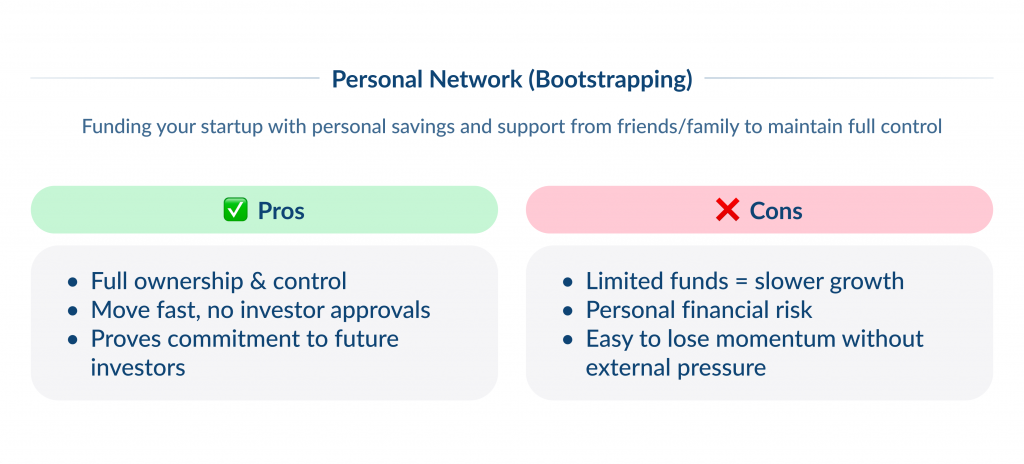
Many founders start their startups with a business idea, some personal savings, help from family, or small contributions from friends. It’s often called bootstrapping, which is basically building your product with your own resources before you seek outside investors.
Pros:
- You keep full ownership and control.
- You can move fast without needing investor approval.
- It proves to future investors that you’re committed and capable of executing.
Cons:
- Limited funds mean slower growth.
- You carry all the financial risk personally.
- Without external pressure, it’s easy to lose focus or momentum.
Mailchimp was completely bootstrapped for nearly two decades before being acquired by Intuit for $12 billion. The founders grew sustainably by reinvesting profits rather than raising capital.
This funding method works best when you’re building an MVP or validating an idea before needing to scale.
2. Angel Investors
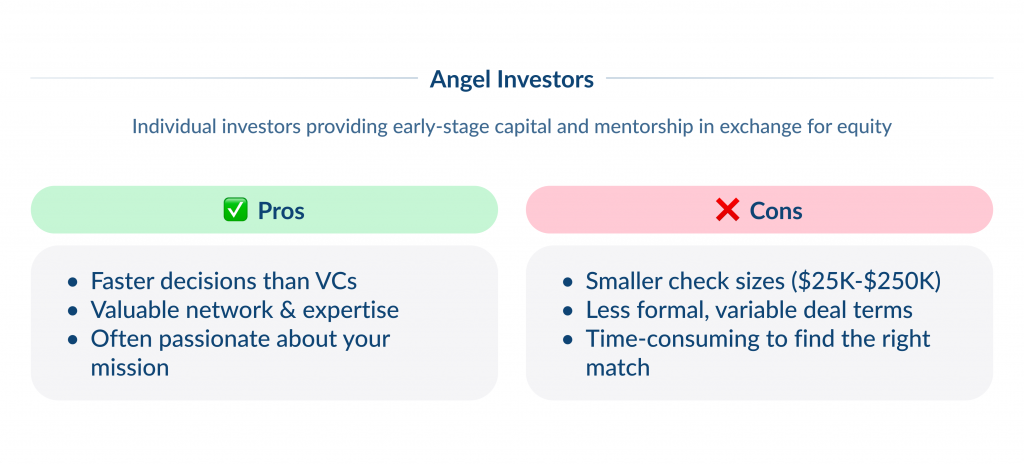
Angel investors are individual investors who put their own money into startups, usually at the pre-seed or seed stage. They often bring not only funding but also experience, connections, and mentorship.
Pros:
- Faster decisions compared to VCs.
- Angel investors can open doors to their networks.
- They’re often motivated by passion and impact, not just returns.
Cons:
- They usually invest smaller amounts (typically $25K–$250K).
- The process can be less formal, and deals vary widely in structure.
- Finding the right “fit” angel takes time and networking.
Airbnb’s first investment came from angel investor Paul Graham, who accepted them into Y Combinator and provided $20,000 in funding. That small start helped Airbnb gain early traction and attract future investors.
Reaching out to angel investors is the best way when you already have a working prototype or early users and need funds to test or scale it. But finding the angel investor is harder than it may seem. Grabbing an investor’s interest takes more than just sending a cold email.
Here’s how to do it effectively:
1. Identify the right angel investors
Not every angel investor is a fit for your startup. Start by looking for investors who:
- Have experience in your industry or market.
- Have invested in startups at a similar stage.
- Show interest in the type of product or problem your startup solves.
Tools like AngelList, Crunchbase, and LinkedIn are great for finding accredited investors. Many cities also have angel networks or startup hubs that host pitch events.
2. Warm introductions work best
Warm introductions dramatically increase your chances of getting a meeting. Consider reaching out to:
- Fellow founders who’ve raised funds.
- Mentors, advisors, or investors in your network.
- Industry connections on LinkedIn who can introduce you.
If you don’t have a direct connection, a personalized cold email can work, but make it specific, concise, and relevant. Mention why you chose them and what problem you’re solving.
3. Craft a clear and compelling pitch deck
Angels invest in both the business idea and the business owner. When you pitch, tell a clear story about the problem you’re solving and why it matters. Show early traction or validation, like users, feedback, or pilot results. Be transparent about how much you’re raising, how you’ll use the funds, and the expected milestones.
Keep your deck concise: 10–15 slides max, and prepare to answer tough questions about revenue, competition, and growth potential.
4. Build a relationship
Angels often invest because they believe in the founder, not just the product. Keep them updated, ask for advice, and show that you’re coachable. Even if they don’t invest immediately, a good relationship can lead to future funding or referrals to other investors.
3. Venture Capital (VC)
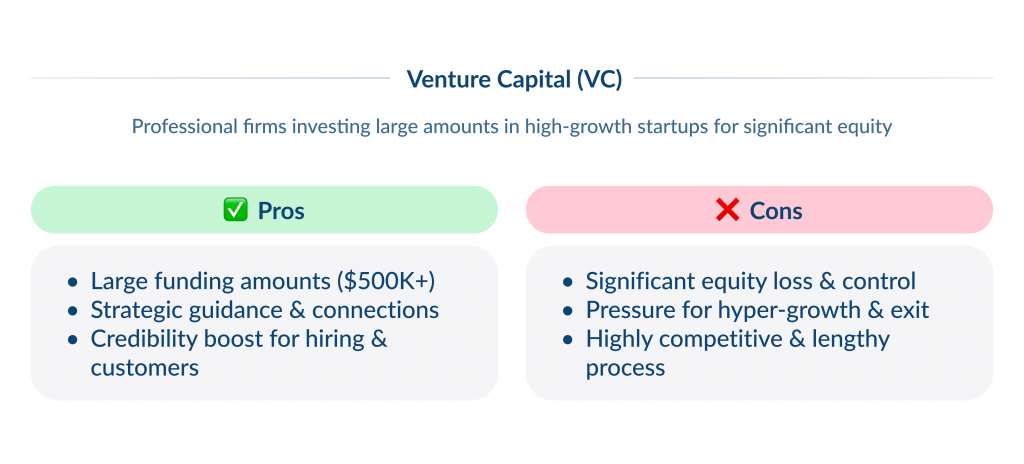
Venture capital firms invest pooled funds from institutions into startups with high growth potential. They typically come in during the seed, Series A, or later stages.
VC firms manage pooled funds from institutional investors, corporations, and wealthy individuals. Their goal is simple: they invest in early-stage companies with massive growth potential. Then, help them scale and eventually earn a return when the company goes public or gets acquired.
Unlike angel investors who often invest based on gut and passion, venture capitalists are data-driven. They look at your traction, product-market fit, market size, and how your team executes. It’s not enough to have a great business idea. You need to show that your business model works and can grow fast.
Pros:
- Access to large funding rounds ($500K to millions).
- Strong mentorship and strategic connections.
- Increased credibility. Being backed by a known VC can help attract customers and talent.
Cons:
- You give up equity and control.
- VCs expect aggressive growth and a clear exit strategy.
- The process is long and competitive. In fact, only a small percentage of startups get funded.
Stripe is one of the best examples of smart VC-backed growth. The founders, Patrick and John Collison, raised their first $2 million from Sequoia Capital and Andreessen Horowitz. Those funds allowed them to expand globally, hire top engineers, and refine their API-driven payments platform. Today, Stripe is valued at over $50 billion.
VC funding makes sense when you’ve validated your idea, built an MVP, and are ready to scale fast. If you’re still at the idea or early product stage, it’s usually better to start with angels or accelerators first, then approach VCs when you have something measurable to show.
4. Traditional Business Loans
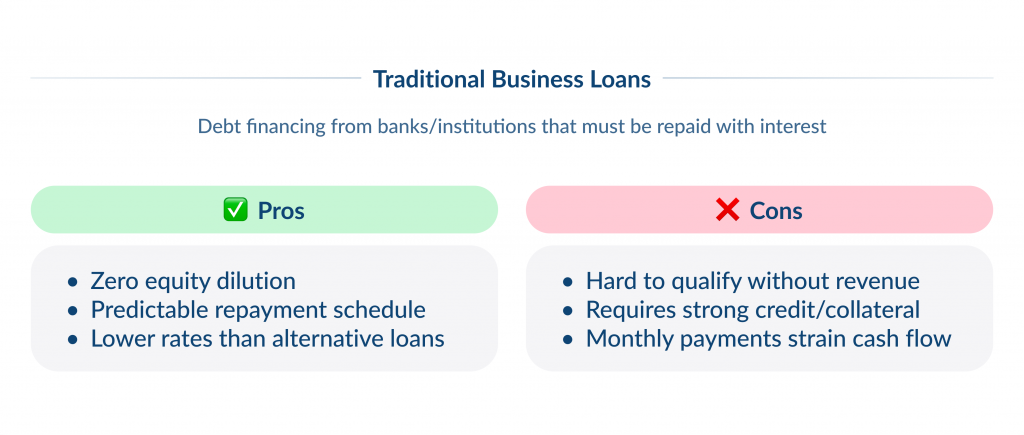
A business loan lets you borrow money from a bank or financial institution and repay it over time with interest, just like any other loan. Unlike equity financing, you don’t give up ownership of your company.
How business loans work
When you apply for a business loan, the lender assesses your startup’s financial health and risk level. They’ll look at things like:
- Your business plan and how you’ll use the funds. Here is how to create a tech startup business plan.
- Revenue and profit history (or forecasts if you’re early-stage).
- Your credit score and any collateral you can provide.
If you meet their criteria, you receive a lump sum of money that you repay through monthly installments (typically over 2–10 years), plus interest.
The interest rate depends on factors like your creditworthiness, loan amount, repayment period, and whether the loan is secured (backed by assets) or unsecured (no collateral required, but higher interest).
There are several types of traditional loans startups can consider:
- Term loans: Fixed amount, fixed repayment period, and fixed interest rate.
- Lines of credit: You can borrow up to a limit when needed, similar to a credit card, and only pay interest on what you use.
- SBA loans (in the U.S.): Government-backed loans with more flexible requirements, designed to help small businesses grow.
Pros of business loans
- You keep full ownership, no equity dilution.
- A predictable repayment schedule helps with financial planning.
- Lower interest rates compared to some alternative financing options.
Cons of business loans
- Harder to qualify for if you’re a very early-stage startup without steady revenue.
- Requires a strong credit history or collateral.
- Monthly repayments can strain cash flow during slow months.
Many successful companies, like Ford and McDonald’s, used traditional business loans from banks and lenders in their early stages. Once revenue became stable, those loans were paid off, and the companies still owned all their equity when larger investors came in.
A traditional loan makes sense if your startup is already generating consistent income or if you need funds for working capital, equipment, or expansion, not high-risk experimentation.
If your startup is pre-revenue or still testing its product-market fit, loans can be risky because repayment starts immediately. In that case, it’s better to focus on angels, accelerators, or seed VCs first.
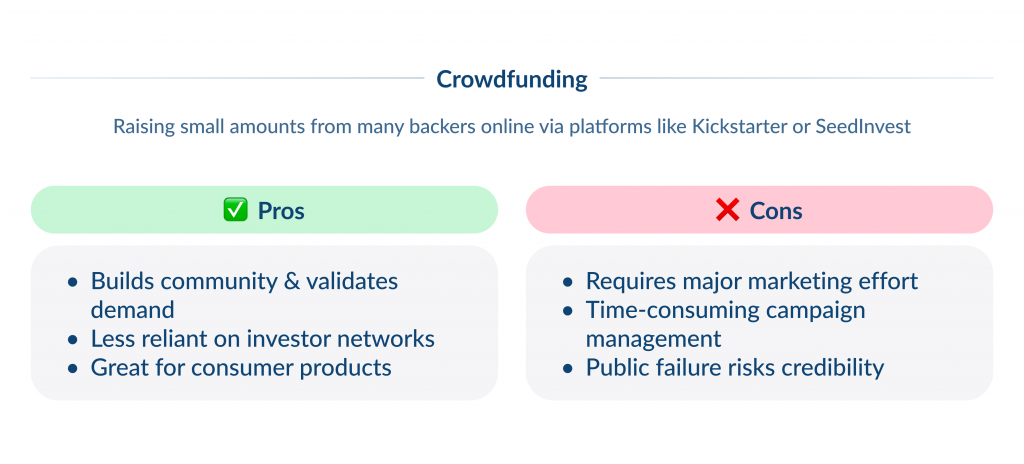
5. Crowdfunding
Crowdfunding allows startups to raise smaller amounts from a large number of backers online. It can be reward-based (Kickstarter, Indiegogo) or equity-based (SeedInvest, Republic).
Pros:
- Builds a community of early supporters.
- Great for validating demand before large-scale production.
- Less dependent on investor networks.
Cons:
- Campaigns require strong marketing and storytelling.
- Time-consuming setup and fulfillment.
- Public failure can hurt credibility.
Pebble Watch, a smartwatch startup, raised over $10 million on Kickstarter. This was one of the most successful campaigns ever. Their early success proved market demand and helped attract later investors.
Crowdfunding works best when your product appeals to consumers and you can tell a visual, emotional story, just like in the case of the Pebble Watch.
6. Accelerator and Incubator Programs
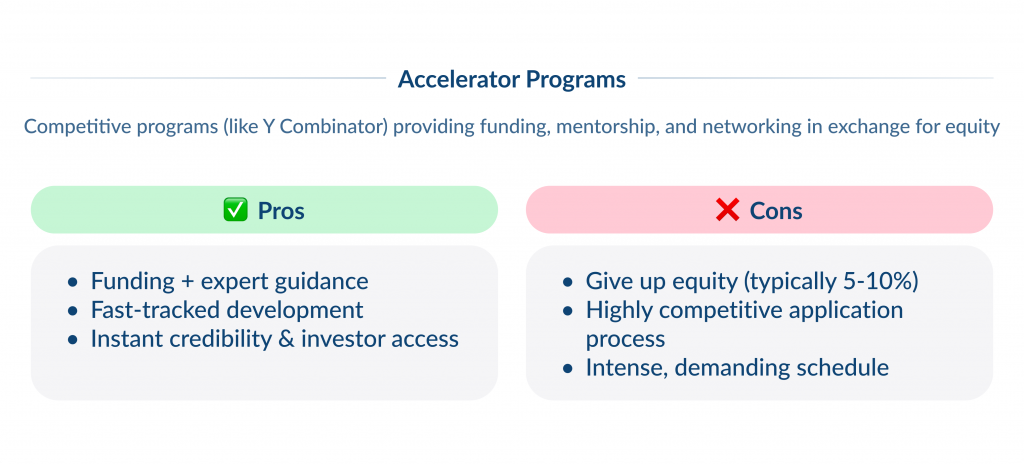
If you’re just getting started and want both funding and expert guidance, joining a startup accelerator or incubator can be one of the smartest moves you make. These programs are designed to help early-stage founders refine their ideas, build MVPs, and connect with investors, all in a few intense months.
Accelerators typically run 3- to 6-month programs where selected startups receive:
- Initial funding (usually $20K–$150K) in exchange for a small equity stake.
- Mentorship from experienced entrepreneurs and investors.
- Access to a powerful network of founders, advisors, and potential customers.
- A chance to pitch at Demo Day, where you present your startup to dozens or even hundreds of investors.
Incubators, on the other hand, are slightly different. They focus more on nurturing very early ideas, often without a strict time limit or initial funding. Incubators help founders validate concepts, build early prototypes, and find co-founders or early hires.
Pros:
- Access to expert guidance and early-stage funding.
- A structured environment to develop your startup fast.
- Networking opportunities that can open doors to angels and VCs later.
- Strong credibility — being part of a well-known program can boost investor trust.
Cons:
- You’ll give up a small equity share (typically 5–10%).
- The programs are highly competitive. Only a small percentage of applicants get in.
- Intense pace. You’ll need to move quickly and adapt constantly.
There are many accelerators and incubator programs for startups. Some of the most popular ones are Techstars, Seedcamp, 00 Global, and Startupbootcamp.
Accelerators are ideal if you’re an early-stage founder with a clear idea or MVP but need help refining your product, validating the market, and building investor connections.
It’s also a great way to gain credibility, as investors often trust startups that come out of reputable programs because they’ve already been vetted and supported by experts.
7. Grants
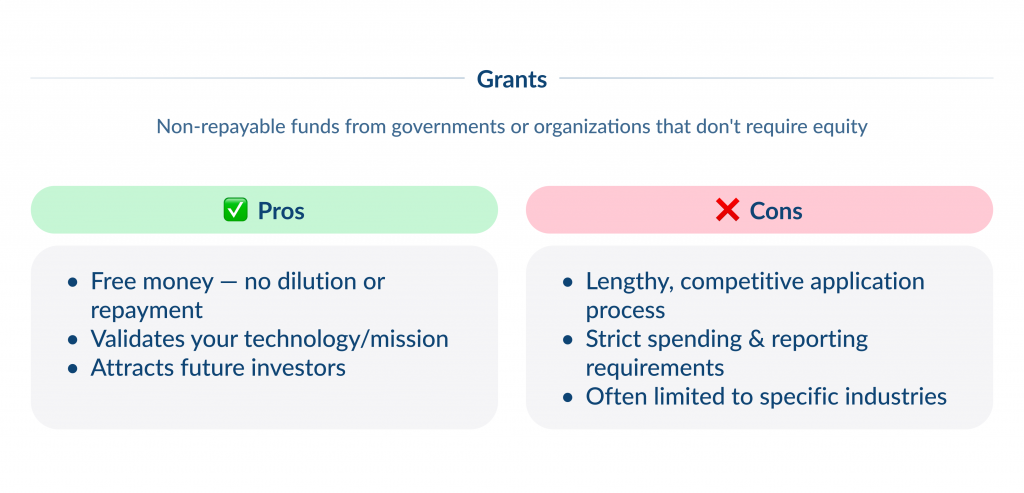
Grants are non-dilutive funding sources that are usually provided by governments, nonprofits, or corporations. Unlike investors, grant providers don’t take equity. They fund startups that align with their mission, industry focus, or research goals.
Pros:
- You keep full ownership of your startup and don’t owe repayment.
- Winning a grant also boosts your credibility with future investors.
Cons:
- The application process can be lengthy and competitive.
- Many grants come with strict eligibility rules or require detailed reporting on how the money is used.
Startups like Zipline, known for its medical delivery drones, received early funding from the U.S. Agency for International Development (USAID). Similarly, Impossible Foods benefited from government-backed research grants that supported its work in food innovation.
To find a grant for your startup, search through official government portals and local startup networks. In the US, programs like Grants.gov or SBIR.gov list open opportunities across industries.
In Europe, startups can explore the Funding & Tenders Portal (for Horizon Europe and EIC programs) or Innovate UK’s website. Many startups also hire grant consultants or use platforms like Grantify, F6S, or EU-Startups to find relevant, time-sensitive programs.
Investor Research Checklist
This is a simple checklist for looking for investors as a startup.
1. Check out the main databases
These are:
☐ Crunchbase
☐ PitchBook
☐ AngelList
☐ OpenVC
2. Set your filters
Make sure you are looking for investors in your niche. Pay attention to:
☐ Industry focus (e.g., fintech, healthtech, SaaS)
☐ Investment size (how much they typically invest)
☐ Investment stage (pre-seed, seed, Series A, etc.)
☐ Geography (where they invest)
3. Review investor fit
Check if this is the right fit for your company:
☐ Read the fund’s investment thesis
☐ Check portfolio companies for relevance
☐ Verify if they lead or follow in rounds
☐ Note typical deal frequency and timelines
4. Build your investor list
Based on the data you’ve gathered, create a list of investors. Include:
☐ Contact details or submission forms
☐ LinkedIn profiles for personal outreach
☐ Stages and goals they invest in
Email Templates for Warm & Cold Investors Outreach
After you’ve narrowed down your options, it is time to reach out to potential investors.
Here are a few email templates you can use. These templates are for early-stage startups (pre-seed to Series A). At this point, you likely have a validated idea and an MVP or first users. Now, you’re raising your first institutional or angel round to scale.
Email templates for outreach
Adjust these emails for a personal touch, but keep them short and to the point to avoid confusion or ignorance.
Warm introduction (to your contact):
Subject: Quick Intro to [Investor’s Name]?
“Hi [Connector’s Name], Hope you’re well!
I’m reaching out because we’re starting to raise our seed round for [Your Startup], and I saw you’re connected to [Investor’s Name] at [VC Firm].
They’ve invested in [Portfolio Company], which is adjacent to our space, and their focus on [Specific Thesis] perfectly matches what we’re building.
Would you be open to making a quick intro?
Thanks, [Your Name]”
Polite cold outreach:
Subject: [Your Startup] – [Your Tagline/Achievement]
“Hi [Investor’s Name],
My name is [Your Name], founder of [Your Startup].
We’re building [One-sentence description of what you do]. Since launching [our beta/our product], we’ve achieved [Your best metric, e.g., 20% MoM growth for 3 months].
Given your investment in [Their portfolio company] and focus on [Their industry], I thought we’d be a relevant fit for your portfolio.
I’ve attached our brief deck for your review. Would you be open to a 15-minute chat next week? Best, [Your Name]”
Building Your Investor Data Room
As your investor conversations get more serious, you’ll inevitably hear the phrase, “Can you send over your data room?” This is a sign of genuine interest.
A data room is a secure online space where you should keep all your confidential documents to safely share them with potential investors.
For early-stage startups, the goal is simplicity and professionalism. You don’t need a costly, complex platform. A well-structured DocSend or Box folder is the perfect tool. It’s secure, easily accessible, and shows you’re organized.
Your Startup Data Room Checklist
When an investor enters your data room, they should find a clear, logical story. Here’s how to build that “Proof” Folder:
- Your beautiful, up-to-date pitch deck.
- A compelling one-page overview for executives.
- A clean, logical spreadsheet with your 3-5 year projections and key assumptions.
- A clear summary of your core KPIs: MRR, LTV, CAC, Burn Rate, and user growth.
- Past statements or tax returns, if applicable.
- Certificate of incorporation. This is proof that your company exists legally.
- Cap table showing who owns what (founders, employees, previous investors).
- IP & founder agreements.
- Product roadmap (3, 6, and 12 months out).
- A link to your live product or a demo login.
- Team bios & resumes.
Deal Instruments: SAFE vs. Convertible Note
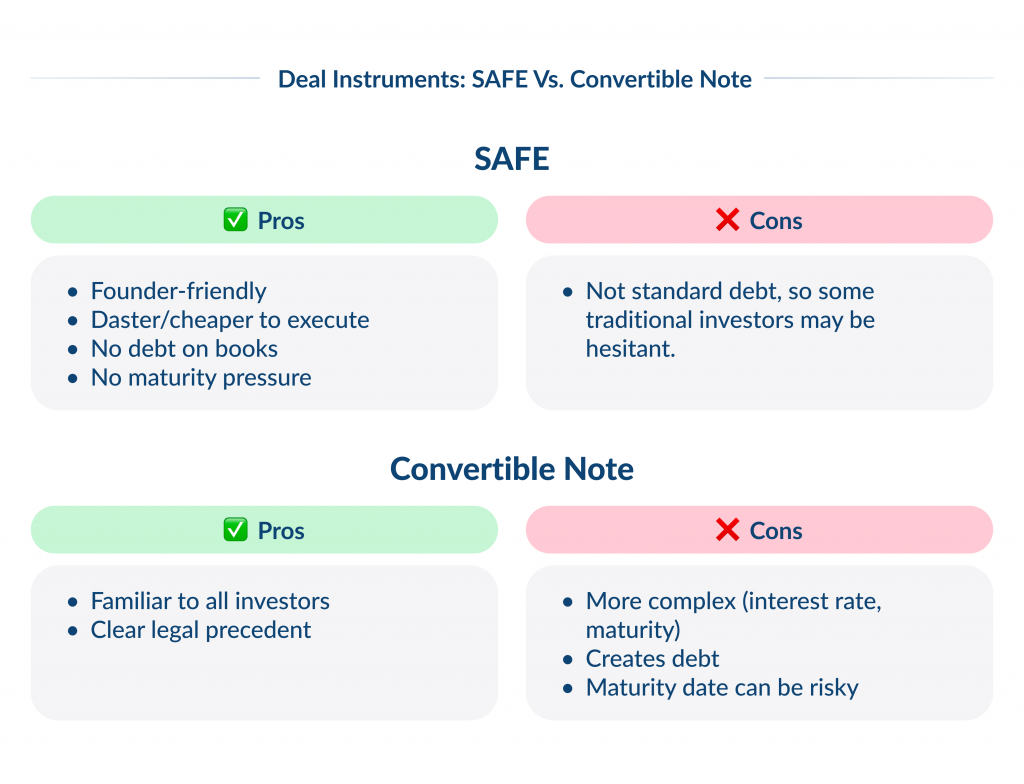
For early-stage funding, SAFEs and Convertible Notes allow you to raise capital without setting an immediate valuation. This is a way to delay that complex negotiation until you have more traction.
Let’s explore what each one means.
SAFE (Simple Agreement for Future Equity)
SAFE is basically a warrant to purchase stock in a future priced round. It is not a debt instrument.
It’s fast, simple, and founder-friendly. Created by Y Combinator, it’s become the modern standard for pre-seed and seed rounds.
Key features:
- No interest rate and no maturity date (unlike a loan)
- Converts to equity upon a “triggering event” (typically your next equity round)
- Uses a Valuation Cap and/or Discount to reward early investors
Convertible Note
This is a short-term debt instrument that converts into equity. It was the standard before the SAFE. Some older investors or specific scenarios (like bridge rounds) may still use it.
Key features:
- Has an interest rate (typically 2-8%) and a maturity date (usually 18-24 months)
- Converts to equity upon a “qualifying financing”
- Also uses a Valuation Cap and/or Discount
We hope that this information will help you find the right investors for your business venture.