Where to Outsource Software Development in 2026
- Created: Mar 26, 2026
- 10 min

CEO
The global IT outsourcing market is on track to surpass $400 billion by 2027. Yet the majority of companies that go offshore still make the same foundational mistake: they choose a country before they define their actual requirements.
That’s exactly what we’re going to tackle here. Whether you’re evaluating your first offshore development team or reconsidering an existing vendor relationship, I’ll walk you through a practical decision framework instead of just ranking countries.
What This Guide Will Tell You
- The best country for software outsourcing in 2026 depends entirely on your project’s complexity, budget, and need for real-time collaboration.
- Eastern Europe provides the best balance of complex engineering quality and cost.
- Asia excels in rapid scalability and low rates.
- Latin America offers perfect time zone alignment for US-based nearshoring.
- The single biggest mistake companies make is choosing a country before defining what they actually need and optimizing for hourly rates instead of outcomes.
Key Facts About IT Outsourcing Destinations
| Factor | Detail |
| Average hourly rates | $20–$100+/hour depending on region and tech stack |
| Best for complex engineering (AI, SaaS) | Eastern Europe — Ukraine, Poland |
| Best for rapid scale & Low cost | Asia-Pacific — India, Philippines |
| Best for US real-time collaboration | Latin America — Mexico, Argentina |
| Average time to hire | 2–6 weeks via a vetted agency |
| Top risks to mitigate | Poor vendor vetting, security gaps (SOC 2, GDPR), misaligned communication |
What Best Countries to Outsource Software Development Mean in 2026
Every year, a new ranking lists the cheapest or most popular offshore software development countries. And every year, hundreds of companies follow those rankings, hire the wrong team, and end up with a codebase full of technical debt and a project six months behind schedule.
The honest answer is that geography does not guarantee an outcome — execution capability does.
A brilliant developer in Manila and an average one in Warsaw will produce completely different results at almost identical price points. What matters is matching the right outsourcing model to your specific business context.
Factors That Define a Top Outsourcing Destination
These aren’t equal factors — some will immediately eliminate entire regions for your specific situation. Work through them in this order.
Time Zone
This is the filter most companies apply last. It should be first.
If you’re in active product development (daily standups, evolving requirements, sprint ceremonies) and your vendor has less than 3 hours of overlap with your working day, you will feel that gap in every single sprint. Apply this filter before evaluating anything else.
| Overlap | Collaboration style | Best for |
| 6–8 hours | Fully synchronous Agile sprints | Active product development |
| 3–5 hours | Hybrid sync/async | Mature products with defined sprints |
| 0–2 hours | Async-only | Maintenance, QA, defined spec builds |
Cost vs. Value: Total Cost of Engagement (TCE)
The hourly rate is often the most misleading number in any outsourcing decision. Before comparing regions on rate, estimate your true cost of a 6-month engagement:
Base rate × hours + onboarding time + expected rework cycles + management overhead = actual cost
Most clients who do this honestly find that the cheapest region is rarely the cheapest option.
A $45/hour developer who delivers a feature in 3 hours is vastly cheaper than a $15/hour developer who takes 15 hours and introduces a vulnerability that costs $50,000 to fix six months later.
When you calculate TCE honestly, the IT outsourcing cost comparison between regions often flips from what the headline rates suggest.
Cultural Fit
English proficiency scores are a starting point, but they are not the full picture. The more meaningful variable is whether the team thinks alongside you or simply executes what they’re told.
The fastest way to test for this during vendor evaluation: give them a vague spec and ask what’s missing. A team with a genuine engineering mindset will come back with questions that reveal they understood the problem. A team that will just take orders will come back with a quote.
Compliance
For any B2B product, compliance is not a box to check after the vendor is hired. It should be a filter applied before the shortlist is made.
| Framework | Applies to | Cost of getting it wrong |
| GDPR | Any product handling EU user data | Fines up to 4% of global annual revenue |
| CCPA | Products with California users | Up to $7,500 per intentional violation |
| HIPAA | Healthcare and medical platforms | $100–$50,000 per violation |
| SOC 2 Type II | SaaS with sensitive customer data | Lost enterprise deals, failed security audits |
| NDA + SLA | Every engagement, without exception | No legal recourse if things go wrong |
Also, IP ownership clauses must be explicit in the contract and enforceable under the vendor’s local jurisdiction.
Global Outsourcing Hubs in 2026: Matching Regions to Your Tech Needs
These regions are popular outsourcing destinations due to their unique strengths. They are attractive for various business functions like IT services, customer support, and more.
Eastern Europe → The Engineering Excellence Hub
Key countries: Ukraine, Poland, Romania, Czech Republic
Typical senior rate: $40–$80/hour
Eastern European countries put a big emphasis on education, especially in STEM (Science, Technology, Engineering, and Mathematics) fields.
Ukraine, Poland, the Czech Republic, and Romania produce a lot of IT graduates every year.
There is a culture of continuous learning and professional development in IT. Many professionals have certifications and advanced degrees.
Best for:
- Custom SaaS development
- AI and machine learning development
- FinTech platforms
- Complex API architecture
- Technical debt reduction
- Long-term dedicated development team engagements
Time zone advantage: GMT+1 to GMT+3 — natural overlap with Western Europe and significant overlap with the US East Coast.
Latin America (LATAM) → The Nearshore Collaboration Hub
Key countries: Mexico, Brazil, Argentina
Typical senior rate: $35–$70/hour
For US-based companies, Latin America offers something no other region can match: genuine, full-day time zone alignment. Developers in Mexico, Brazil, and Argentina work in time zones ranging from EST to PST, enabling fully synchronous Agile sprints and real-time code collaboration.
Proof of concept:
- Globant — LATAM-born technology company listed on the NYSE with $2B+ in annual revenue
Best for:
- US-headquartered startups and scaleups
- Integrated Agile product teams
- Companies that have had communication failures with distant offshore teams
- IT staff augmentation services plugging into existing US-based teams
Asia-Pacific (APAC) → The Scale & Cost Efficiency Hub
Key countries: India, Philippines, Taiwan
Typical senior rate: $15–$45/hour
The Asia-Pacific region offers the world’s largest pool of software engineering talent and its lowest baseline costs. India alone graduates over one million engineering students annually. Taiwan stands apart for hardware engineering excellence, uniquely valuable for IoT and embedded systems.
Best for:
- Large-scale, well-defined development projects
- QA and testing operations
- Maintenance of mature codebases
- Rapid team scaling where software development budget is the primary constraint
Risks to manage deliberately:
- Time zone gaps of 10–13 hours from US locations require rigid async processes
- Higher quality variance than Eastern Europe — vendor vetting is critical
- Requires well-documented specifications and strong project management discipline
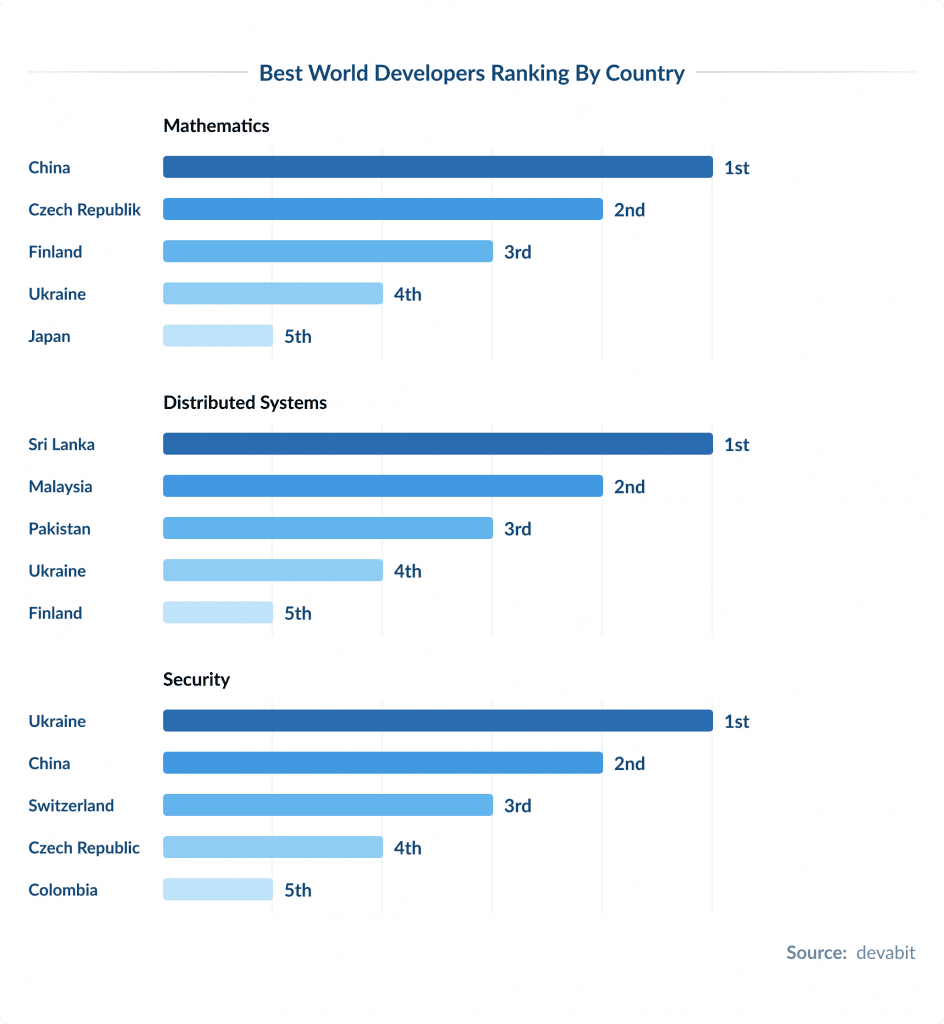
2026 Developer Rates: Cost Comparison
Before you look at the numbers below, one thing worth keeping in mind: the hourly rate is the least reliable predictor of actual project cost.
A senior engineer at $65/hour who solves a critical architecture problem in two hours costs less than a junior at $20/hour who takes three days and introduces a flaw that takes weeks to unwind.
The total cost of Engagement is what determines whether outsourcing was actually cheaper.
That said, rates matter for budgeting. Here’s where regions stand in 2026:
| Region | Avg. hourly rate | Core strength | Ideal for |
| Eastern Europe | $40–$80/hr | Engineering quality, AI/ML, complex architecture | SaaS products, FinTech, long-term dedicated teams |
| Latin America | $35–$70/hr | Real-time US collaboration, Agile integration | US startups, staff augmentation, MVPs |
| Asia-Pacific | $20–$45/hr | Scale, volume, cost efficiency | Large defined builds, QA, maintenance |
How to Choose the Right Outsourcing Country: A Practical Self-Diagnostic
Before evaluating any vendor, get clear on what you actually need. Most outsourcing decisions go wrong because the client hasn’t answered these two questions first.
What is your technical complexity?
- Low (simple CRUD app, internal tool, marketing site). Almost any region and engagement model works. Prioritize speed and cost.
- Medium (custom SaaS, e-commerce platform, API-heavy product). Engineering quality starts to matter significantly. Eastern Europe or LATAM are the safer bets.
- High (FinTech, HIPAA-compliant healthcare platform, AI/ML system). This is non-negotiable territory. You need deep compliance experience and senior engineering judgment. Eastern Europe is the default answer here.
What does a good vendor selection process look like?
Most checklists tell you to read Clutch reviews and audit GitHub repositories.
That’s fine as far as it goes, but it tells you almost nothing about whether a vendor can think alongside you (! which is what really determines whether the engagement succeeds).
When clients come to us, we don’t pitch them right away. We start with a discovery conversation about the product, the stage, and the real constraints like timeline, compliance requirements, internal technical leadership, and previous vendor experience.
That conversation tells us whether we’re the right fit. It should tell you the same thing about any vendor you’re evaluating.
The questions worth asking before signing anything:
- Does this vendor push back on your assumptions, or just agree with everything?
- Can they explain past technical decisions, not just deliverables?
- Do they have experience with products at your specific compliance or complexity level?
- What does their onboarding process look like, and does it start with understanding your product or with signing a contract?
A vendor who asks good questions before the engagement starts is almost always a better partner than one who moves straight to a proposal.
Outsourcing Risks and How to Mitigate Them
After working with dozens of companies as a technology partner, we hear the same fears come up in almost every early conversation. Here’s what clients actually worry about, and how we approach each one in practice.
How do we know the code will be good?
Quality anxiety is the most common concern, especially from founders who’ve been burned before. Here’s what we do to eliminate this concern:
- Every engagement runs mandatory peer code reviews, automated testing coverage requirements, and CI/CD pipelines from day one.
- Quality standards are defined in the SLA before a single line of code is written, not negotiated after something breaks.
What happens when communication gets messy?
Communication breakdown often ruins trust in outsourcing. We address this structurally:
- Mandated daily overlap hours.
- A defined async toolstack (Jira, Notion, Loom, Slack).
- Weekly written status summaries that create a paper trail.
We had a fixed quote, and now the budget is blowing up
Fixed-price contracts on complex, evolving products are almost always a setup for conflict. That’s why we work exclusively on a time and materials model, which means you pay for what’s actually built.
- There are no surprises buried in a fixed contract.
- You see exactly where the hours go, every sprint.
- If priorities shift (and they always do on complex products), the engagement adjusts with them instead of turning into a change-order negotiation.
How do we know our IP is protected?
This one matters most for early-stage companies with a core technical differentiator.
- Before any discovery conversation begins, we execute comprehensive NDAs.
- All code lives in repositories under the client’s ownership from day one.
- For SaaS and healthcare clients, we verify SOC 2 Type II and HIPAA compliance requirements upfront.
Check out our recent article
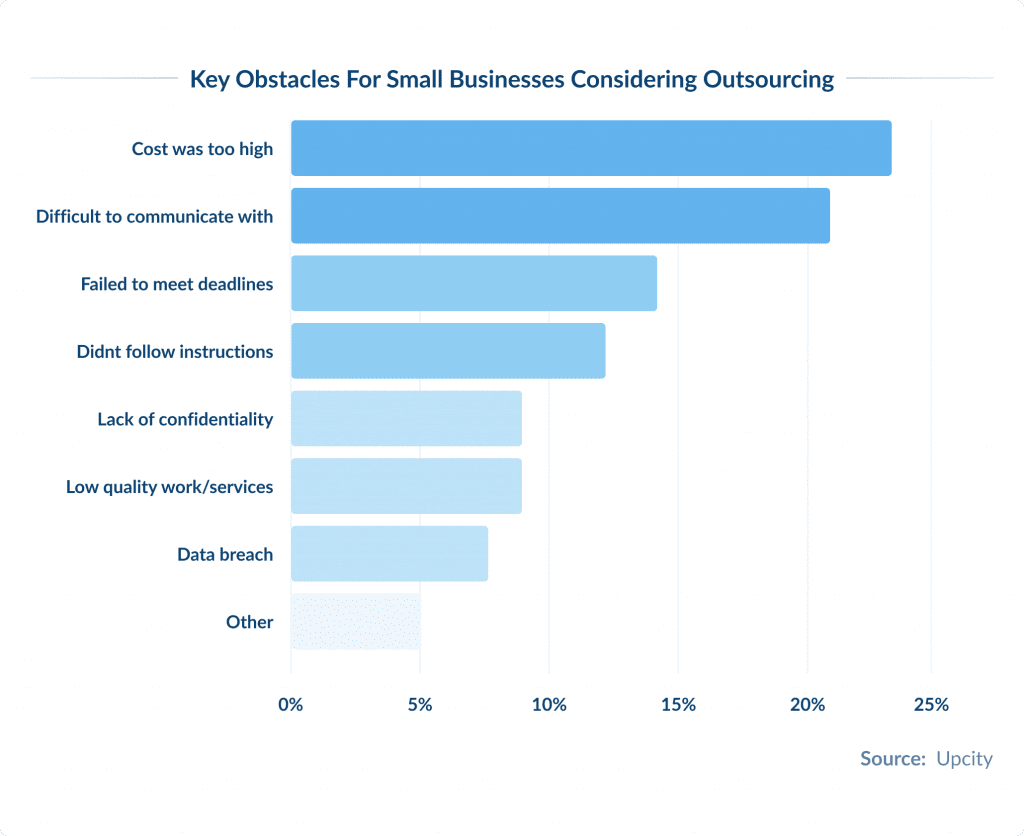
In-House vs. Outsourcing vs. Hybrid Team Models
Pure outsourcing fails most predictably when a company has no internal technical leadership.
Without an in-house CTO, lead architect, or experienced product owner, there is no one to evaluate code quality, challenge architectural decisions, or translate business requirements into actionable specifications.
When each model wins:
| Model | Best xcenario |
| Pure outsourcing | Well-defined project, experienced product owner in-house, mature spec |
| Hybrid (recommended) | In-house CTO or Fractional CTO + offshore dedicated team; best of both worlds |
| Staff augmentation | Existing team with specific capacity gaps (e.g., 2 senior backend engineers for 6 months) |
| Pure in-house | Core IP development, highly regulated work, deep institutional knowledge required |
The hybrid model, an in-house technical lead paired with an offshore dedicated development team, consistently delivers the best outcomes.
The internal lead owns strategy and product ownership. The offshore team executes with speed and cost efficiency.
Scrum and DevOps practices embedded in your existing team extend naturally to augmented engineers.
Future Trends in Software Outsourcing: 2026–2028
If you are planning to outsource software development, these are the trends I would recommend paying attention to:
AI-augmented teams replace headcount-based pricing
The traditional “10 developers, $X/month” model is breaking down.
AI coding tools (GitHub Copilot, Cursor, Claude) are compressing the time senior engineers need for routine implementation work by an estimated 30–55%, according to McKinsey’s 2024 State of AI report. Vendors are beginning to price on outcomes and milestones rather than seats.
Practical advice: Stop anchoring contracts on headcount. Negotiate milestone-based or output-based pricing, and ask vendors directly how they’re integrating AI tooling into their workflow. A vendor who can’t answer that question is already behind.
Eastern Europe’s talent pool is fragmenting and redistributing
The post-2022 displacement of Ukrainian engineers accelerated a talent redistribution across Poland, Romania, Portugal, and Germany. This created new hybrid clusters — engineers working for Eastern European agencies but living across the EU.
Practical advice: Don’t treat Eastern Europe as a monolithic region anymore. Evaluate at the city and agency level.
Compliance and data sovereignty are becoming vendor selection filters
GDPR enforcement has matured. The EU AI Act took effect. US state-level privacy laws multiplied. Companies outsourcing to non-EU vendors for EU-facing products are now running into real legal friction, not theoretical risk.
Deloitte’s 2025 Outsourcing Survey found that 61% of enterprise buyers now list compliance capability as a top-three vendor selection criterion, up from 38% in 2022.
Practical advice: Build a compliance requirements matrix before you evaluate vendors. For EU products, shortlist vendors with existing GDPR data processing agreements and SOC 2 Type II certification. Treat compliance as a filter. 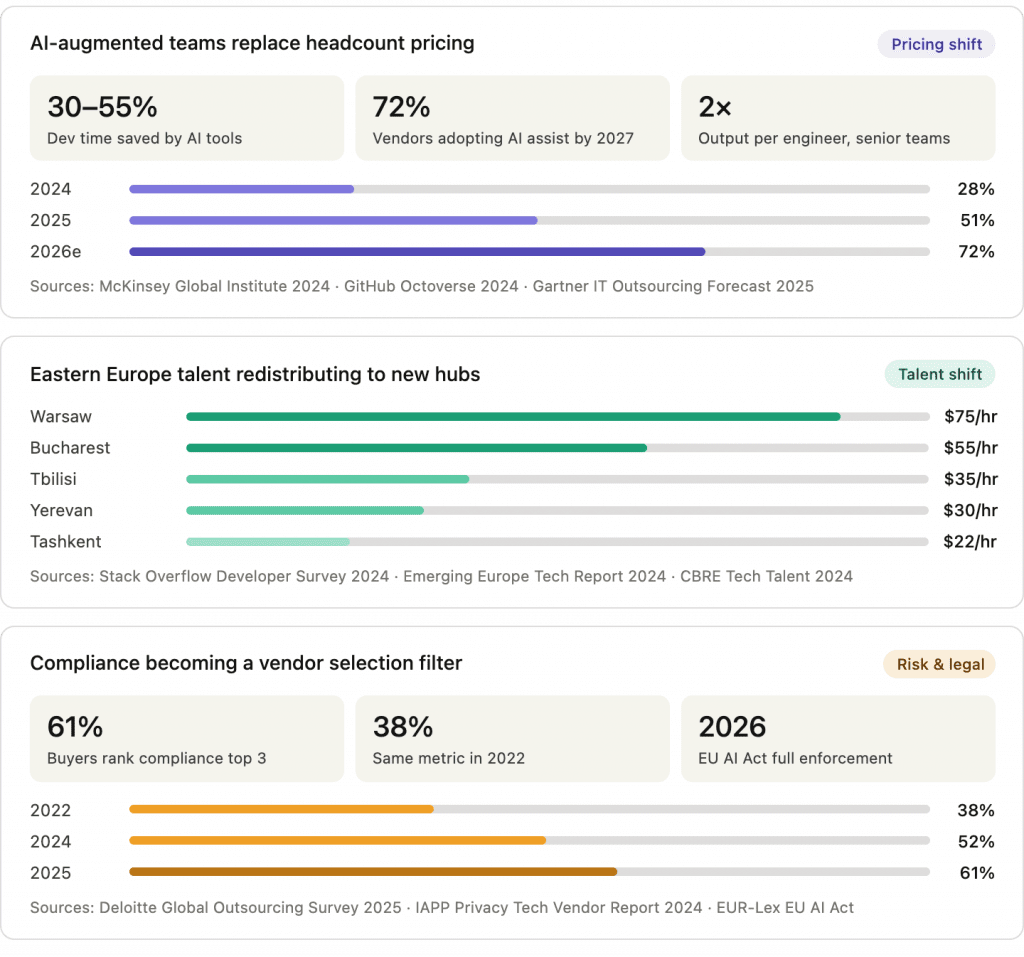
Conclusion: Optimize for Fit, Rather Than Geography
There is no best country for outsourcing software development. There is only the best fit for your product stage, your collaboration needs, and your technical complexity.
In practice, that usually means:
- Eastern Europe for engineering depth and complex builds
- Latin America for seamless US time zone integration
- Asia-Pacific for budget-constrained scaling at volume
The region is the easy part. The harder part — and the part that determines whether the engagement actually works — is finding a partner who treats your product as their own responsibility, not just a billable engagement.
That’s the conversation we start with every client. If you’re evaluating your options, it’s a good place for you to start too.
Not sure where to start? We offer a free 45-minute technical discovery call. You walk away with a clear recommendation on which engagement model fits your product stage — whether that’s us or not. No pitch, no obligation.