Guide to Blended Learning: Types, Benefits, and Strategies
- Updated: Mar 18, 2026
- 10 min

Senior Mobile Developer
Traditional learning environments do not work for modern learning needs anymore.
Organizations want to train employees in a way that is more effective, fast, and cost-efficient.
Blended learning, which is also known as hybrid education, can do just that.
This learning methodology is getting traction now as it helps to seamlessly integrate digital resources and virtual engagement with the conventional in-person experience to reach ultimate training results.
In fact, the blended learning market reached $28.13 billion in 2025 with a CAGR of 13.3%
If you want to learn more about what blended learning is and how elearning software development services can help you elevate your employee training, keep reading.
Here, we explore blended learning terminology, models, benefits, implementation strategies, and more.
Get a strategic MVP to mitigate risks.
What is Blended Learning?
Blended learning, also known as hybrid learning or b-learning, is an educational approach that combines traditional in-person classroom methods with digital and online learning activities,offering valuable writing help for students alongside academic instruction.
It integrates face-to-face (synchronous) and online (asynchronous) experiences to enhance learning outcomes.
The goal of the blended learning format is to unite the strengths of both remote and in-person teaching to create a more effective learning environment.
Blended learning methods are handy not only for educational organizations but for corporate learning as well.
These new methodologies provide a flexible and comprehensive learning experience that caters to diverse learning styles and preferences.
Blended Learning Models
There are several blended learning models.
This study on the use of blended learning models identifies six blended learning models for schools and these models can also be applicable to corporate training blended learning:
- face-to-face driver
- enriched virtual model
- rotation
- flipped classroom
- flex
- online driver model.
Each model offers a unique approach to combining online and in-person learning components.
Let’s explore them all.
Face To Face Driver Model
This model offers what is most similar to traditional classroom instruction.
Learners join a live webinar or meeting (like Zoom or Google Meet), receive live instruction, and, at the end of each session, are given homework or assignments to complete before the next session.
The seamless integration of technology not only supports a range of student learning styles but also prepares students for the digital literacy required in the modern world.
Flipped Model
The flipped classroom model is a learning model that involves students rotating between the following activities: working with a teacher in the classroom (on projects and practical tasks) and studying online outside of school after regular classes.
Students study theoretical material mainly online at a convenient place and time and solve practical tasks together with the teacher in the classroom.
Students can work on the material independently for as long and as many times as they need to understand and master it.
Thus, the model realizes the main purpose of the blended learning approach: to give students the opportunity to set and control the time, place, program, and pace of learning.
Rotational Model
The rotation model is a model in which students move from one learning station to another within a classroom lesson according to a set schedule or at the teacher’s discretion, changing the type of interaction.
An obligatory component is an online learning station.
Other formats of work during the lesson include lectures, group projects, individual consultations, and self-testing.
The rotational model is the most dynamic and effective, as it successfully combines elements of traditional and online learning during the lesson.
Enriched Virtual Model
The enriched virtual model is primarily an online learning experience with periodic face-to-face sessions.
In this model, students work primarily online, attending school only on certain days to submit projects or individual lessons in a particular subject as needed.
In contrast to the flipped classroom model, students spend most of their time outside of school, receiving instructions and completing assignments online.
The model successfully provides students with uninterrupted access to learning materials, the ability to choose their own convenient time for studying, and online teacher consultations.
Flex Model
This is a blended learning model in which online learning is the basis of the educational process.
Within this model, students study according to an individual schedule approved by the teacher, online, on the school premises.
In case of any difficulties, students can contact the mentor teacher at any time for additional clarification.
Having gained basic knowledge on a new topic, the student joins pair or group work on planned projects to improve and deepen the knowledge gained.
The use of this model allows you to personalize the learning process, allowing students who are lagging behind on a particular topic to work longer on a particular task and those who learn the material faster to move further.
Online Driver Model
The online driver learning model offers the maximum amount of learner autonomy.
Participants make their way through the learning models at their own pace and according to their own drive and motivation.
While learners are still given the opportunity to communicate with trainers as needed, such communication is not a requirement for completing the training.
Just as the enriched virtual learning model can be effective for experienced, self-motivated learners, the online driver learning model takes this level of autonomy and turns it to the maximum level.
Because of this, the online driver learning model requires the least amount of instructor time and energy.
Unmotivated or tentative learners, however, might find themselves confused or simply going through the motions without achieving a deep understanding of the course material. 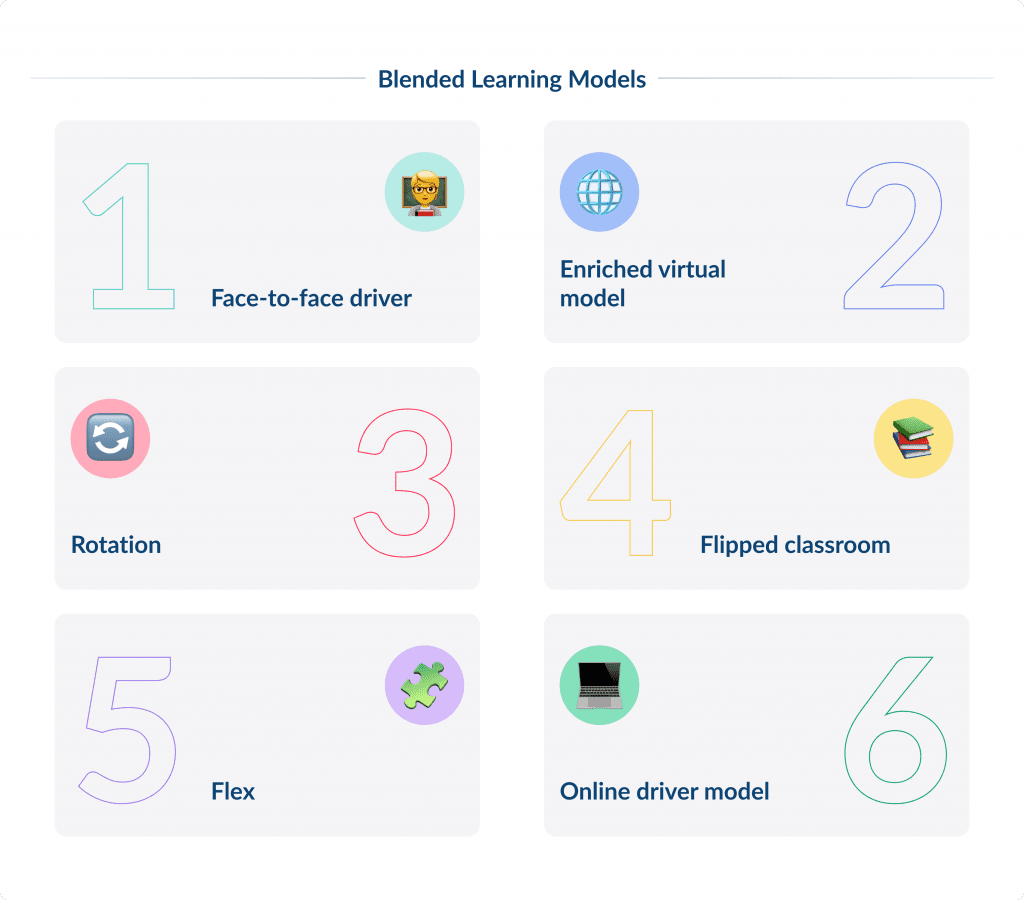
Benefits of Blended Learning for Organizations
Here is how blended learning can benefit the learning and development strategy of your organization:
More flexible and scalable learning process
With online training and mobile learning, employees can complete their courses at their own pace.
It becomes much easier to fit corporate learning around work schedules and personal commitments.
On top of that, blended learning methods allow companies to distribute training content to a large number of employees across different locations without additional costs.
Cost efficiency
Blended learning strategies often involve online courses.
Learning online can help your company save costs on travel, venue rentals, and printed materials.
This way, you can achieve higher returns on investment as digital content can be reused and updated at a lower cost.
Learn more about how to calculate LMS ROI in our recent article.
Enhanced employee engagement and retention
Blended learning encourages a much higher rate of student engagement.
In fact, many teachers report that blended learning allows for more flexibility and independence in the classroom.
Students can work at their own pace and understand concepts more thoroughly.
Personalization of the learning path
Blended learning programs come in various forms.
This means they can be tailored to meet different learning needs and job roles.
For example, a sales team might receive interactive scenario-based training to improve customer interactions. And a developer team gets hands-on coding exercises to practice new skills. That way, everyone gets training that actually fits their job.
Real-time feedback
Digital tools for blended learning enable immediate feedback and assessment.
Let’s say an employee misses a question in a compliance course. They can get instant feedback to understand what went wrong.
Meanwhile, a manager in leadership training might receive real-time coaching tips based on their answers.
This keeps learning engaging and helps everyone improve on the spot. 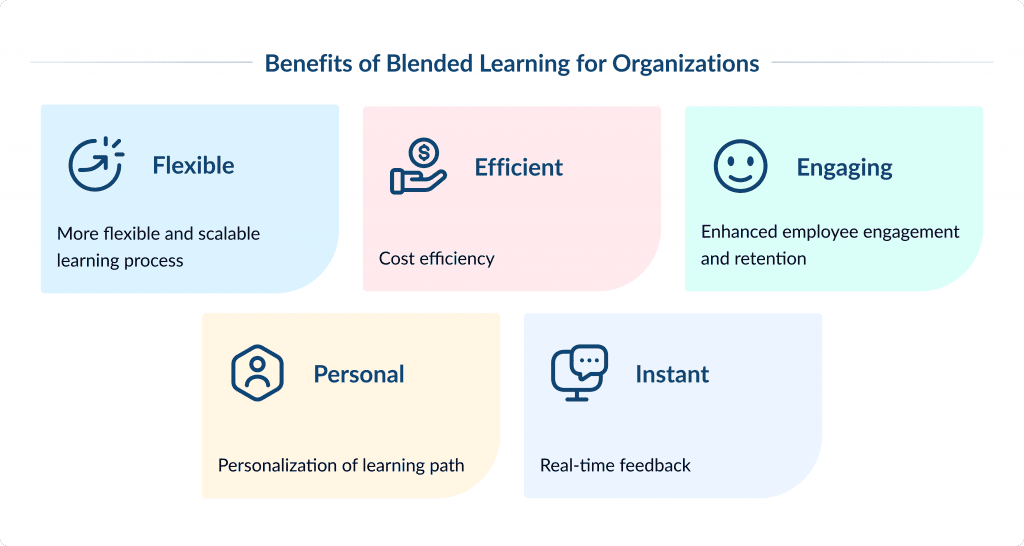
How to Implement a Blended Learning Model for a Company?
Many big companies successfully implemented blended learning experiences to enhance their corporate training.
Some of the best examples are Boeing and Deloitte.
To improve its Capture Team Leader (CTL) training, Boeing implemented a blended learning solution that included eight web-based training lessons to be completed before a four-day live course.
This approach allows participants to gain foundational knowledge online and practice skills before attending in-person sessions. The learning experience became even more engaging and interesting.
Deloitte launched its 12-week in-person boot camps, eLearning modules, and peer learning communities called “guilds,” where employees can learn from each other.
These initiatives are great for upskilling employees, filling the knowledge gaps, and improving employee performance.
For its non-technical courses, like soft skills development, Deloitte uses an employee-generated content model that enhances self-paced learning.
They even experiment with a generative AI tutor within their blended learning strategy to enhance real-time learning experiences through interactive dialogue.
If you want to implement a blended learning approach into your employee training, here are some tips on how you can do that:
Step 1: Identify Learning Objectives and Outcomes
First, you need to clearly articulate what you want learners to achieve by the end of the program.
Your objectives should align with business needs and educational standards.
Set specific, measurable, achievable, relevant, and time-bound goals.
For example, your general blended learning implementation goal can sound like “Improve employee engagement through a blended learning program.”
Then, you need to determine the specific actions needed to achieve this goal, such as “Develop a comprehensive curriculum” or “Implement a new learning management system.”
Establish metrics to measure your progress. For instance, “Increase employee participation in training sessions by 20% within six months.”
Summing up, your SMART goal may sound something like
“I will increase employee participation in blended learning sessions by 25% within the next nine months by implementing a new LMS and offering at least two in-person workshops per quarter. Progress will be measured through quarterly surveys and LMS analytics.”
Step 2: Understand Your Audience
Once the goals are set, know who you create blended learning programs for.
Let’s say your target audience is your employees and / or stakeholders.
What are their roles? Education levels? Age? Location?
Collect this data to better understand the diversity of your audience.
Also, understand what drives learners’ performance and what they aspire to achieve.
Step 3: Select the Right Blended Learning Model
Now that you know why you need blended learning and who you need it for, you can choose the learning model.
Here, we break down what each of the blended learning models is good for:
- Flipped classroom is ideal for subjects requiring hands-on practice or group discussions, such as science labs or language classes.
- Rotation is suitable for environments where learners need to experience different learning modalities, such as in vocational training.
- Flex is for learners who need to manage their time effectively or prefer self-paced learning, such as in corporate training settings.
- Enriched virtual is a fit for learners who prefer online learning but occasionally need face-to-face support, such as in higher education.
- Face to face driver is used for subjects requiring regular in-class discussions or hands-on activities, such as in traditional classroom settings.
- Online driver is for environments where learners need to focus on online course content but require some oversight.
Step 4: Develop Assessment Strategies
Identify the assessment strategies that will help you measure the success of your blended learning programs.
First, define what learners should know or be able to do. Then, design assessments that measure these outcomes.
Some of the blended learning assessment tools you can utilize are quizzes, tests, projects, presentations, discussions, and self-assessments.
No need to limit yourself to only one assessment method. You can use all of them to capture a comprehensive picture of learner performance.
For a data-oriented approach, there are platforms like Google Classroom, Kahoot!, and Edmodo.
These can help you facilitate assessments, collect data, and provide feedback. 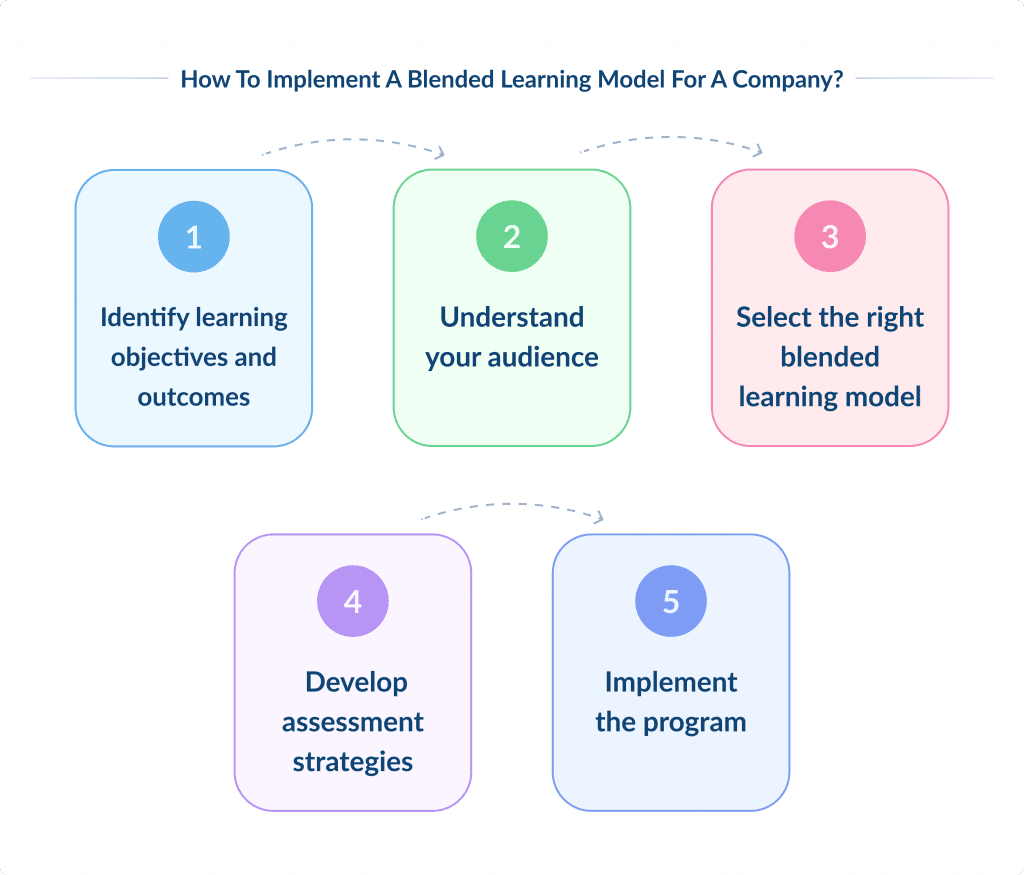
Step 5: Implement the Program
Before you launch the program, you want to conduct a pilot run with a small group of learners.
This is a great way to identify any issues or areas for improvement.
Provide instructors with training on the blended learning model, technology tools, and curriculum.
Then, collect feedback from participants and instructors to refine the program.
You can use data from assessments and feedback to adjust the program in the future.
Blended learning program implementation is an ongoing process, and the timeframes will depend on the type of your organization, the number of participants, the complexity of the program, and other factors.
Here is an approximate implementation timeline:
| Activity | Timeline |
|---|---|
| Pilot Run | Week 1-4 |
| Training for Educators | Week 5-6 |
| Launch Preparation | Week 7-8 |
| Program Launch | Week 9 |
| Ongoing Support and Evaluation | Ongoing |
Emerging Tools and Technologies in Blended Learning
Higher Education institutions worldwide have started using Web 4.0 tools and technologies for various academic and administrative purposes.
Information and communication technology tools are being used to impart education at different levels of education across both educational entities and corporations.
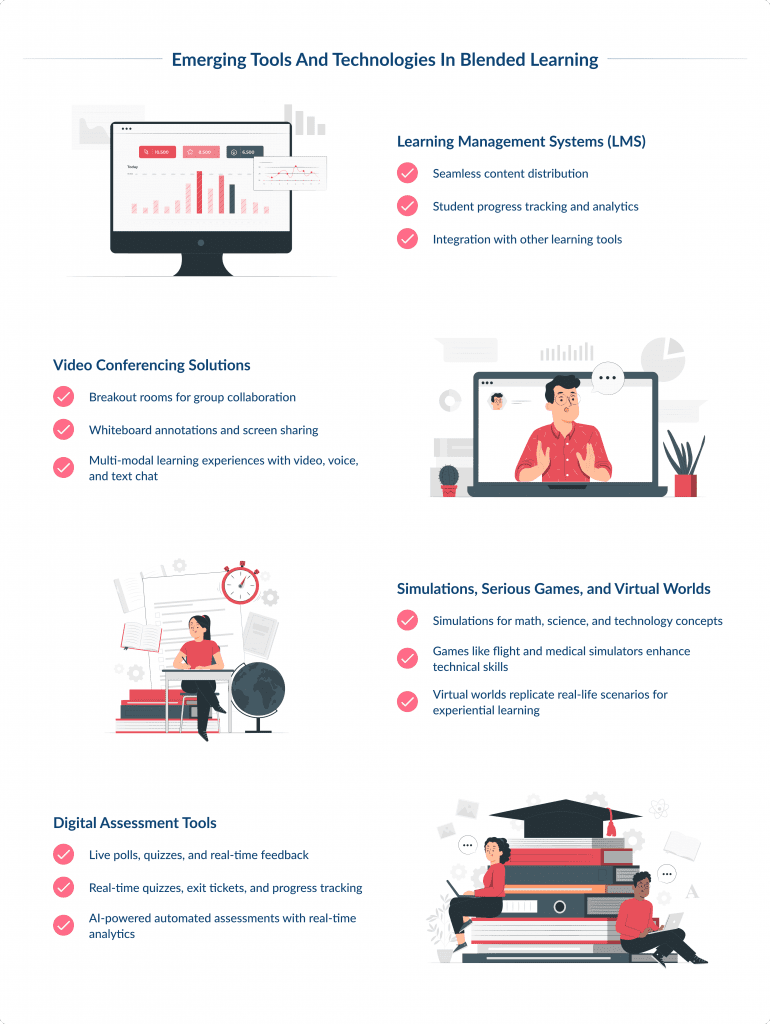
Here are some key emerging tools and technologies in blended learning:
Learning Management Systems
An LMS is an integrated software application that delivers content and resources online, provides interaction or collaborative workspaces, and manages complete student, course, and programmer administrative functions, including registration, assessment, and analytics.
LMS platforms offer robust analytics for tracking student progress and integrate well with other educational tools.
Centralized training resources, multimedia support, and custom LMS development and integrations are crucial for blended learning environments.
Video Conferencing Solutions
Real-time discussions and interactive lectures are a no-brainer now with platforms like Zoom, Microsoft Teams, and Cisco Webex.
These platforms support features like breakout rooms and screen sharing to level up collaborative learning experiences.
Web conferencing tools are usually highly multi-modal, with simultaneous video lectures, voice, text chat, whiteboard annotations, and screen sharing.
These are rich and dynamic learning environments.
Simulations, Serious Games and Virtual Worlds
Simulations, serious games and virtual worlds are more advanced forms of educational technology.
Simple simulations can often be incorporated into blended learning as open educational resources to help illustrate mathematical, technical, or scientific concepts.
Khan Academy, for example, offers a number of such simulations.
Some educational platforms offer flight or medical simulations. They immerse learners in three-dimensional settings and begin to take on the characteristics of virtual worlds.
One of the projects we’ve been working on is an elearning management system for future pilots.
This is a complex learning management system that is aimed at enhancing the learning experience for aviation students worldwide through a seamless, interactive, and efficient platform.
To reach this goal, we have developed a comprehensive application with customizable displays that show student progress in various metrics, a well-organized library with advanced sorting and searching capabilities for quick access to training materials, video interaction tools, and event lists, a notification system, and user-friendly admin pages for efficient content management.
Digital Assessment Tools
Digital assessment tools are designed to facilitate the evaluation of students’ knowledge, skills, and performance in an online or digital learning environment.
Here are some assessment tools organizations utilize:
- Mentimeter. This is an interactive presentation platform that uses live polls, quizzes, and word clouds to engage students and gather real-time feedback.
- Socrative offers quizzes, exit tickets, and games, allowing teachers to create and deliver assessments in real-time and track student progress.
- Kahoot is a game-based learning platform that makes assessments more engaging through interactive quizzes and challenges.
- Dictera utilizes AI/ML to automate assessment creation, providing real-time collaboration and analytics.
Blended Learning Implementation
Blended learning offers multiple benefits for organizations.
From enhanced productivity and employee retention to cost-efficiency and learning flexibility.
Many companies are starting to invest in blended learning experiences, and if you are one of them and are ready to invest in an e-learning solution development, let’s have a chat.
During a brief call, we can discuss everything you want to know about the development of a hybrid learning system: terms, costs, features, scaling opportunities, and much more.
Contact us and we will get back to you in less than 24 hours to schedule an intro call.