Employee Performance Appraisal Systems: How They Work
- Updated: Mar 18, 2026
- 10 min

Head of Recruiting
Employee performance appraisal systems are digital tools that help HR teams and managers track and improve employee performance practices. These systems turn evaluations into an ongoing process, not just an annual formality. This gives everyone a clear overview of what’s working, what’s not, and how each person’s efforts connect to the bigger picture.
When I first started managing performance reviews, like seven years ago, the performance appraisal processes were in spreadsheets and one-to-one meetings that felt more stressful than useful.
Employees dreaded reviews, and managers struggled to give fair feedback because so much of it relied on memory. It wasn’t until we implemented a structured performance appraisal system that things changed. Feedback became part of everyday work, not a once-a-year event. Plus, employees started setting their own goals, which helped them better understand their role and contribution to the company’s goals. And managers had real data to back up their decisions.
That’s why choosing the right performance appraisal system matters. It can completely reshape how your company approaches feedback and employee engagement.
As a company specializing in HR software development services, we know how challenging it can be to design and implement performance appraisal systems that actually work for people. In this article, we’ll break down what makes an effective performance appraisal system, how these tools work, and why they’re worth the investment.
Develop your MVP to validate a product-market fit with our expert software developers — contact us today to get started!
What is Employee Performance Appraisal?
An employee performance appraisal (also known as a performance review, performance evaluation, or career development discussion) is a formal and systematic process in which a manager evaluates an employee’s job performance and productivity against a set of pre-established standards and goals.
Think of it as a “report card” for work, but with a crucial twist: instead of just looking back at past performance, you also look forward into future growth and development.
Why Do Companies Measure Employee Performance?
Performance appraisals serve several critical functions for both the organization and the employee. Let’s explore them all:
For the organization:
- To objectively assess how well an employee is contributing to the company’s goals.
- Provides a documented basis for key decisions about pay raises, bonuses, promotions, transfers, or terminations
- Highlights skill gaps across the organization, helping plan training and employee development programs.
- Helps identify high-potential employees for future leadership roles.
For the employee:
- It’s a dedicated time to receive constructive feedback on what they are doing well and where they can improve.
- Reinforces or clarifies their job duties, goals, and what is expected of them.
- Opens a dialogue about their career aspirations, training interests, and potential growth paths within the company.
- When done fairly, it can be a powerful motivator, making employees feel valued and invested in.
The Key Components of a Typical Appraisal Process
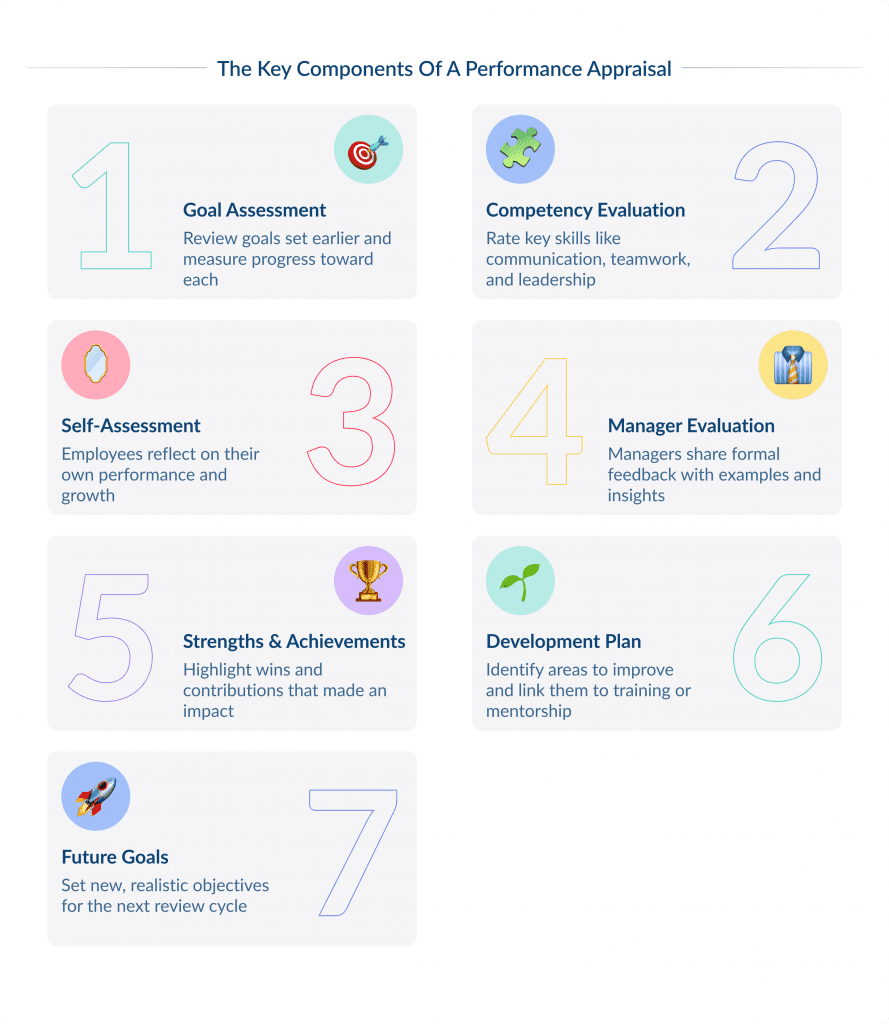
While formats vary, most performance appraisals cover these areas:
- Goal assessment: Reviewing the goals (often set at the beginning of the year or quarter) and evaluating the extent to which they were met.
- Competency evaluation: Rating the employee on key behaviors and skills required for their role (e.g., communication, problem-solving, teamwork, leadership).
- Employee self-assessments: The employee assesses their own performance, which encourages self-reflection and ownership.
- Manager’s evaluation: The manager provides their formal assessment, often with specific examples of performance.
- Summary of strengths & achievements: A section dedicated to recognizing what the employee excelled at.
- Areas for improvement (development plan): A constructive outline of where the employee can grow, often linked to specific training, mentoring, or new responsibilities.
- Setting future goals: Establishing new, mutually agreed-upon objectives for the next review period.
What Are Performance Appraisal Methods
With the right performance appraisal method, organizations can enhance employee performance within the organization. A good employee performance review method can make the whole experience effective and rewarding.
Here’s a close look at the five most-used methods to evaluate employee performance:
1. Management by Objectives (MBO)
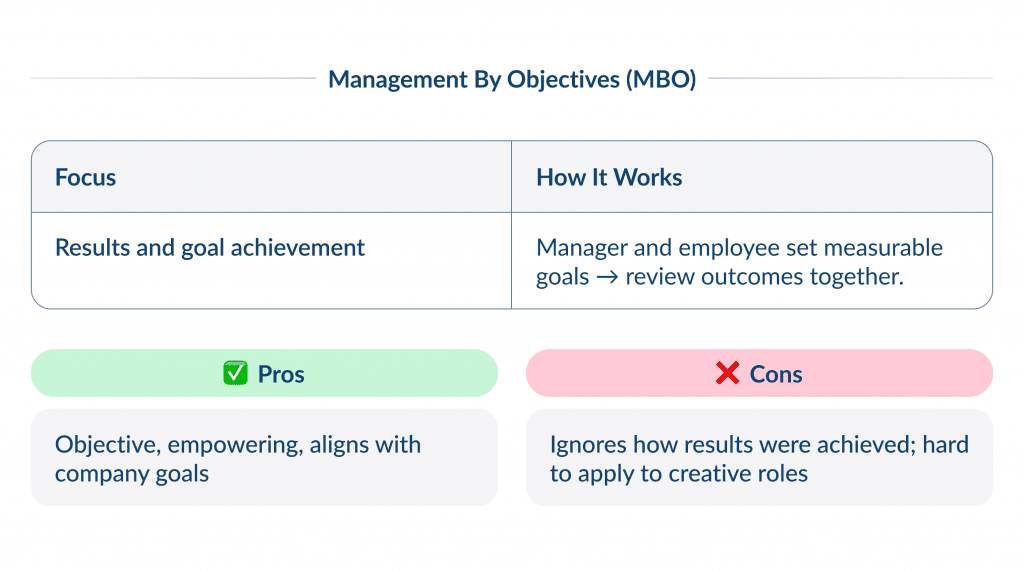
This method is entirely focused on results and outcomes. The employee and manager set specific, measurable goals at the beginning of a period. The appraisal is then a straightforward review of whether those objectives were met.
Here is how it works:
Manager and employee collaboratively define SMART objectives aligned with company goals. The employee then works independently or with minimal supervision to achieve these goals. At a certain time, the manager and employee meet to review the results against the pre-set objectives.
This discussion is data-driven and may sound something like this:
“You exceeded the traffic goal by hitting a 35% increase, which is excellent. However, the lead generation goal was missed; we only got 400 leads. Let’s analyze why and set a new, more realistic target for next year.”
Pros:
- Highly objective
- Empowers the employee
- Clearly links individual performance to company goals
Cons:
- Can ignore how the results were achieved (e.g., burned-out team, unethical shortcuts)
- Less useful for roles where goals are hard to quantify
2. 360-Degree Feedback
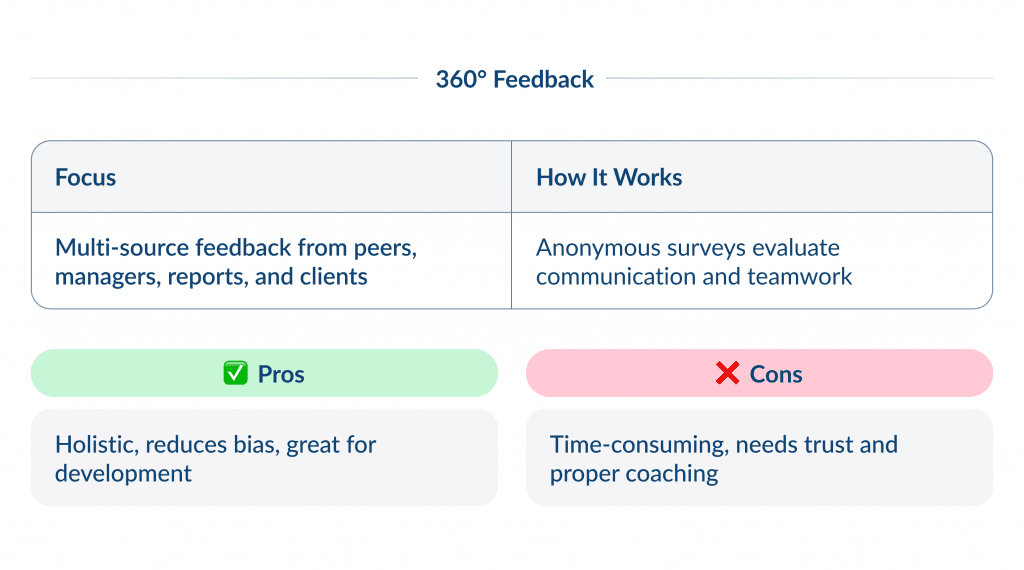
This method gathers feedback about an employee from a full circle of people who interact with them. It provides a holistic view of their performance and focuses on behaviors and soft skills.
Here is how it works:
HR specialists send confidential questionnaires to the employee’s manager, peers, direct reports (if applicable), and sometimes even customers. The surveys rate the employee on competencies like communication, teamwork, leadership, and reliability.
Then, the performance feedback is compiled into a report that highlights areas of consensus (strengths and weaknesses). The results are then discussed with the employee, often by their manager or an HR professional.
Example:
The report reveals a clear pattern: while the employee is technically competent and meets goals (manager view), their interpersonal and leadership skills need development. The focus becomes: “How can you become more inclusive in meetings and improve your delegation?”
Pros:
- Provides a well-rounded perspective
- Reduces manager bias
- Excellent for developmental purposes
Cons:
- Can be time-consuming and expensive
- Requires a culture of trust to be effective
- Can be overwhelming if not delivered with proper coaching
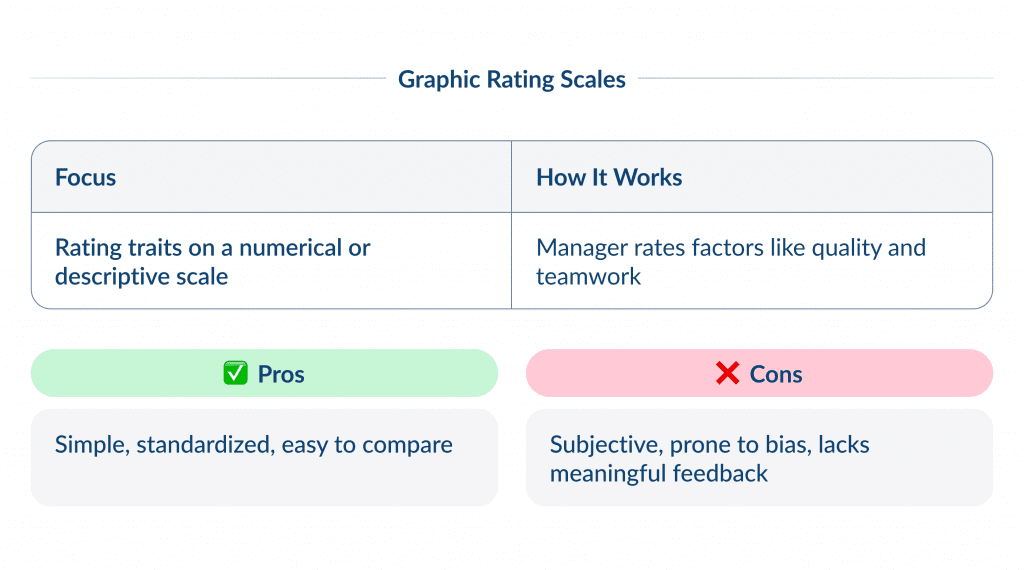
3. Graphic Rating Scales
This is the classic, often dreaded, “check-the-box” form. It’s a simple list of traits or performance factors, each with a numerical or descriptive scale.
The manager is given a form with criteria like “Quality of Work,” “Initiative,” “Punctuality,” and “Teamwork.” For each criterion, the manager selects a rating on a scale (e.g., 1-5, or “Poor” to “Excellent”). The ratings are often tallied for a total score.
Pros:
- Standardized
- Easy to use and administer
- Allows for easy comparison between employees
Cons:
- Highly subjective
- Prone to manager bias (e.g., “halo effect”, liking one thing about a person and rating them highly on everything)
- Provides very little useful feedback for development
4. Behaviorally Anchored Rating Scales (BARS)
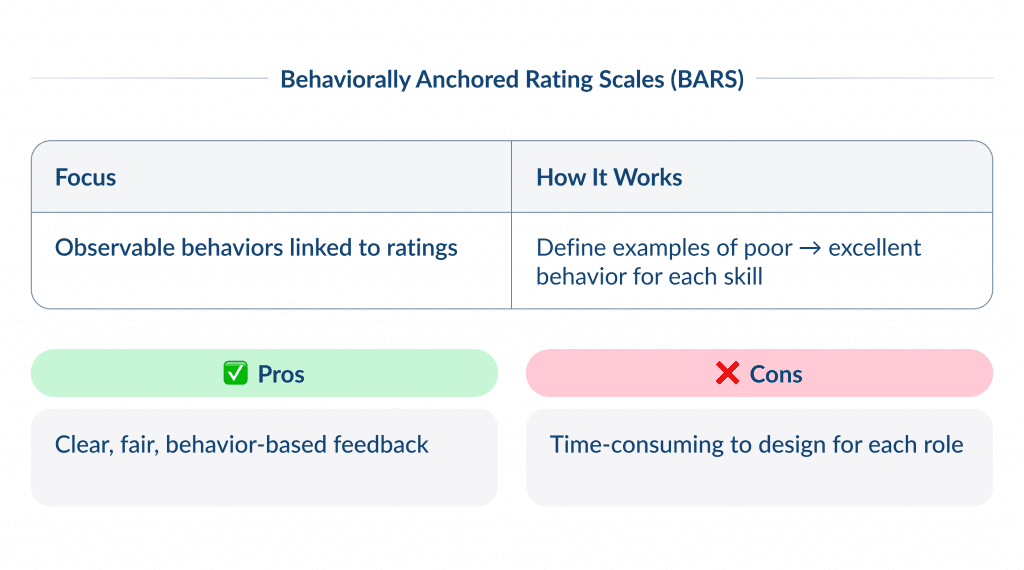
This is a much more sophisticated version of the rating scale. It combines the quantitative nature of a scale with specific, behavioral examples of what good and poor performance looks like.
First, you need ot define behaviours for each performance dimension. These behavioral examples “anchor” the rating, making it clearer and more objective for the manager.
Here is a simple example of how it can look like:
Role: Sales Representative
Performance dimension: “Handling Customer Objections”
- Rating 1 (Poor): Becomes defensive, argues with the customer, or gives up immediately.
- Rating 3 (Average): Listens to the objection but offers a standard, scripted response without tailoring it to the customer’s concern.
- Rating 5 (Excellent): Actively listens, acknowledges the concern, and creatively adapts the value proposition to directly address the customer’s specific objection, often leading to a sale.
Pros:
- More accurate and fair than graphic scales
- Reduces bias
- Provides clear behavioral feedback that the employee can understand and act upon
Cons:
- Extremely time-consuming
- Difficult to develop for every role in an organization
5. Check-ins & Continuous Feedback (The Modern Approach)
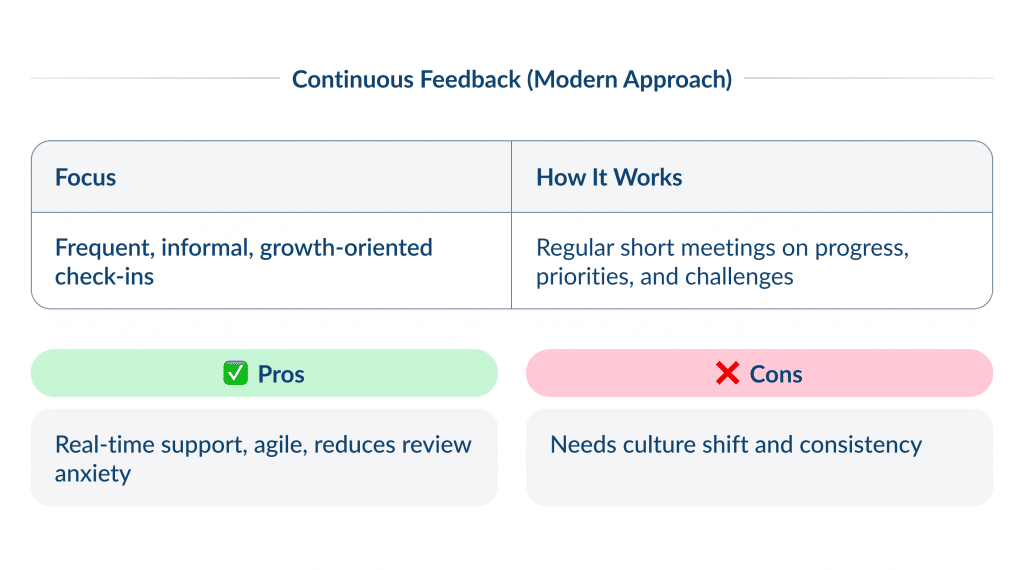
This modern performance appraisal method abandons the single, high-stakes annual review in favor of frequent, informal, and future-oriented performance conversations.
The manager and employee have brief (15-30 minute) meetings weekly, bi-weekly, or monthly.
The conversation is guided by a few simple questions:
- What went well since we last spoke?
- What are your top priorities for the next period?
- What challenges are you facing, and how can I help?
- Do you have the resources you need?
Goals can be updated and adjusted in real-time based on changing priorities.
Pros:
- Highly agile
- Provides real-time coaching and support
- Reduces the anxiety of a once-a-year review
- Strengthens the manager-employee relationship
Cons:
- Requires a significant cultural shift and discipline from managers
- Can feel like “micromanagement” if not done correctly
Technology in Appraisal Systems
The use of technology has changed how we evaluate employee performance, and it’s the key step towards digital HR transformation. From a dreaded, once-a-year administrative task, this practice has evolved into a dynamic, integral part of talent management. At least, I believe that it happens in the majority of companies.
Traditionally, appraisals were manual processes involving paper forms, spreadsheets, and filed-away documents. This was:
- Time-consuming for both HR and managers.
- Prone to error and version control issues.
- A “snapshot in time” Based on recent events or recency bias.
- Disconnected from other business data.
For all the effort that goes into performance reviews, most employees still see them as a yearly chore rather than something that helps them grow. I once came across a post on Reddit that perfectly summed up the frustration:
“Laughing to myself at work imagining performance reviews formatted like Spotify Wrapped.
You log in at the end of the year and it’s like:
‘You gave 84 pieces of feedback (2 were actually constructive)’
‘You survived 3 system migrations and 47 manager Slacks’
‘Your top skill this year: forcing a smile on Monday morning standup’
‘Most played phrase: “Can we push review due dates one more week?”’Every December we’re out here running the same sprint to get everyone to click ‘submit,’ and it’s literally like pulling teeth. Meanwhile, Spotify’s like ‘You listened to 700 hours of breakup songs,’ and somehow that feels infinitely more validating than our entire review process.”
Here is something it could look like if someone would actually add this wrap-up feature: 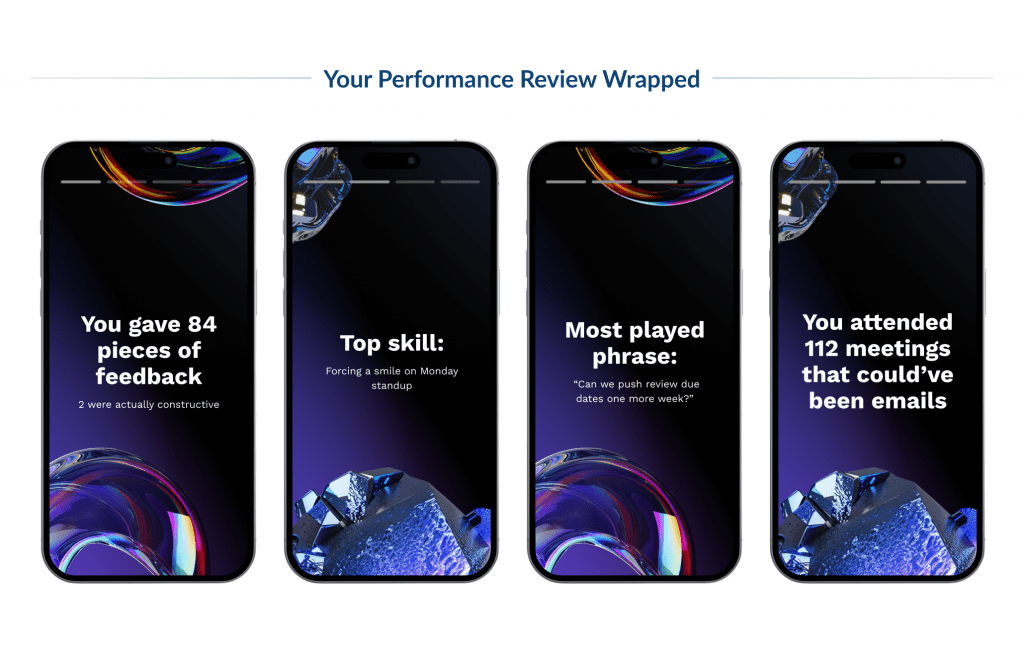
Humor aside, this captures a real issue: traditional reviews often feel disconnected, delayed, and demotivating. That’s exactly where modern performance appraisal systems come in: they aim to make feedback continuous and actually useful.
Key Technologies and Their Uses in Appraisal Systems
Even though the processes became more convenient, there is still room for improvement. In fact, a Gallup survey found that only 2% of managers are satisfied with their organization’s review system. That’s a wake-up call for companies to rethink how they use technology in performance appraisals.
Here are some key software that can elevate the performance management process for both managers and employees.
1. Dedicated Performance Management Software
This is the core technology. Platforms like Lattice, 15Five, BambooHR, Culture Amp, and Leapsome are built specifically for this purpose.
How they are used:
- All review cycles (annual, semi-annual), check-ins, and feedback are housed in one secure, accessible place.
- The system automatically notifies employees and managers of due dates, sends reminder emails, and routes completed forms for approval.
- Pre-built, customizable templates for different review types (e.g., 360-degree, self-evaluation) ensure consistency.
- Employees can set, track, and update goals in real-time. Managers and peers can comment, providing continuous alignment.
2. Integration with Core Business Systems
The real power comes from connecting the appraisal software to other tools, such as
- HRIS (Human Resource Information System) to link individual and organizational performance data directly to compensation, succession planning, and learning management.
- Project Management Tools (Jira, Asana, Trello) to pull in real-time data on tasks completed and projects delivered.
- Communication Tools (Slack, Microsoft Teams) to provide for instant, informal feedback and praise to be given and logged directly within the flow of work.
3. Data Analytics and Reporting
HR analytics and reporting is where technology turns subjective opinions into actionable insights. Performance appraisal software provides real-time dashboards where HR and leaders can see organization-wide trends at a glance.
Some employee appraisal systems, such as Lattice, Culture Amp, 15Five, also offer sentiment analysis to analyze written feedback to gauge the overall sentiment (positive, negative, constructive) of a review.
Here is how it works:
A manager writes in a performance review: “Jamie is a dedicated employee who never misses a deadline. However, their communication with the team could be more proactive to avoid last-minute surprises.”
The sentiment analysis tool would break this down as:
- Positive sentiment: “dedicated employee,” “never misses a deadline.”
- Constructive/negative sentiment: “communication… could be more proactive,” “avoid last-minute surprises.”
It would then provide an insight like:
- Overall sentiment: Mixed, leaning positive.
- Key strengths: Reliability, diligence.
- Development areas: Proactive communication.
This helps HR and leaders quickly identify if a manager’s feedback is consistently harsh or ineffective, and helps the manager themselves understand the tone of their own communication.
Benefits of Using Technology in Appraisals
The benefits of such systems are:
- Automates administrative tasks, saving hundreds of hours for HR and managers.
- Integrating with productivity tools, reviews are based more on data and less on memory or recency bias.
- Makes the process more transparent, collaborative, and development-focused. Employees can access their goals and feedback anytime.
- Provides leaders with clear insights into workforce capabilities, enabling better strategic planning for talent development, compensation, and succession.
- Technology embeds feedback and recognition into the daily workflow. Employee recognition programs make it a natural part of the company culture rather than a once-a-year event.
Potential Pitfalls and Considerations
However, there are a few things to keep in mind:
- The performance management tool should facilitate the conversation, not replace it. The human element of coaching is still critical.
- Too much data can be paralyzing. The focus should be on the most relevant metrics.
- Employees may be wary of constant monitoring if not implemented transparently.
- Appraisal systems for employees require a financial investment and a change management plan to ensure adoption.
How to Take the Most Out of Performance Appraisal Systems
If you’re thinking of implementing a performance management program or building one from scratch, start small. Pick one or two areas to improve, like setting clearer goals or making feedback more regular, and test them before rolling out a full system.
Talk to your managers and employees. Ask what frustrates them about the current performance review process and what would make reviews more meaningful. Next, choose the HR software solution that fits your workflow, not the other way around. Look for tools that make it easy to track progress.
And if you’re looking for a partner to help you create a custom performance appraisal solution that fits your company’s structure and goals, our team at SpdLoad can guide you through the entire process, from the project discovery stage and design to development and implementation.