HR Analytics and Reporting: Tools and Key Metrics
- Updated: Mar 18, 2026
- 11 min

Head of Recruiting
Without data, HR decisions often rely on assumptions. That usually leads to wasted time and resources. For example, Gallup found that companies with high employee engagement are 21% more profitable, and you can’t measure or improve engagement without the right metrics. That’s what HR analytics & reporting are for.
HR analytics helps spot patterns, like why people leave, what drives performance, or which teams need support. This data allows companies to act early instead of reacting too late. Reporting takes those insights and translates them into clear stories leaders can understand and act on. Without it, HR risks being seen as an administrative function rather than a strategic partner.
At Spdload, we provide HR software development services. When working on the project, we pay specific attention to analytics and reporting dashboards. The goal is to give HR teams clear, actionable insights that help them make better workforce decisions.
This is a short guide to HR analytics and big data, and how they work in the context of digital HR transformation.
Explore our SaaS services today
What is HR Analytics and Reporting
Gartner identifies HR analytics as the process of collecting and applying data from HR systems and employee records for data-driven insights using analytics software. HR data analytics is also called people analytics or workforce analytics.
The collected insights help HR professionals notice trends and measure key HR metrics. They analyze data to create a more effective and robust HR strategy.
Companies use data analytics when they need to make critical decisions about their hiring, development, and retention strategies. They can also use data to see the real reasons employees are quitting, like a bad manager or poor work-life balance. This allows businesses to optimize the recruitment process, as well as work on job satisfaction and retention.
The Role of HR Analytics Tools in Decision-Making
If you think about HR just a decade ago, a lot of decisions were made based on gut feeling. Managers would say, “This person seems like a strong performer,” or “Turnover feels higher this year.” The problem is, gut feelings are rarely accurate. That’s where HR analytics tools step in.
What Do HR Analytics and Reporting Tools Do
HR analytics tools, often part of Human Capital Management (HCM) software, help HR teams collect and organize employee data. Instead of just storing employee information in spreadsheets, these tools pull all information together, including:
- attendance
- performance reviews
- training records
- recruitment data, and more.
All these data points are turned into easy-to-read dashboards and reports.
For example, instead of guessing why turnover is high, an HR leader can see that most exits happen within the first 6 months of employment or that a specific department has a 20% higher attrition rate than the rest of the company. That’s the kind of clarity raw data can’t give you without the right HR software solution.
Here is an example of an analytics dashboard we’ve created for one of our clients. The goal was to make HR data easy to understand at a glance while still allowing deeper exploration for decision-making.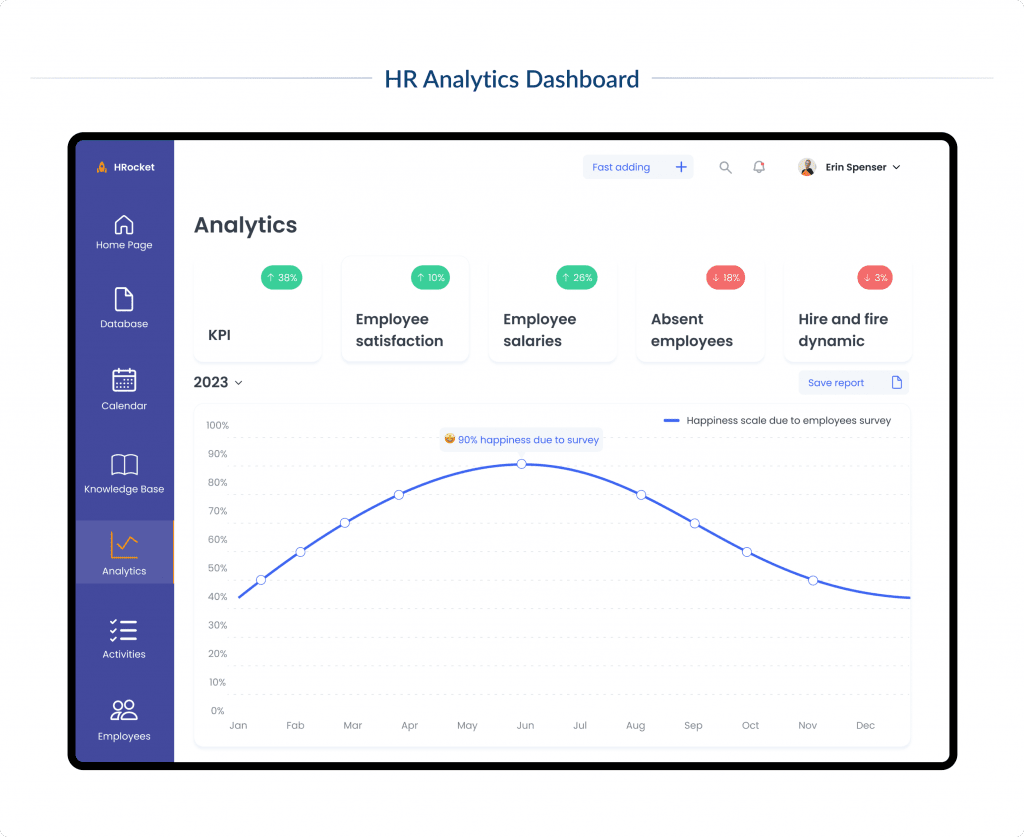
Check out this HR software development case study if you’re interested in how we’ve tackled the challenges that slowed down HR processes and made it difficult to track employee performance effectively.
Why Does HR Data Analytics and Reporting Matter for Companies
When HR teams use data analysis tools, they can:
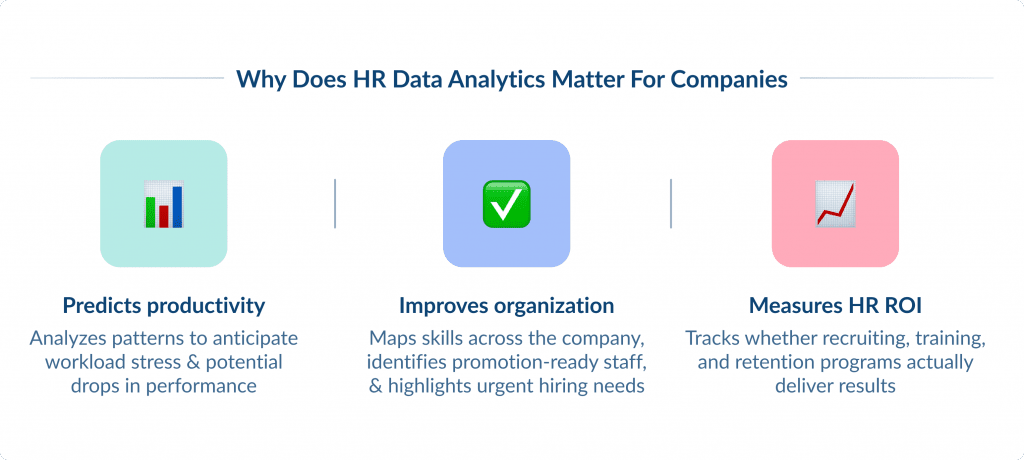
- Improve employee organization. Tools can map out skills across the company, showing who’s ready for promotion or where new hires are urgently needed.
- Predict productivity. By analyzing patterns, HR can anticipate when workloads might overwhelm teams or when productivity tends to drop, for example, after major product launches.
- Measure HR ROI. Recruiting, training, and retention programs are expensive. Analytics tools make it possible to show whether a new a really reduces turnover or if that pricey leadership course is improving performance.
How Does HR Analytics Help With Decision-Making
Imagine two HR managers. One has a feeling that their training budget isn’t being used effectively. The other has an analytics tool that shows only 35% of employees complete optional courses, and those who do stay 12 months longer on average. Who do you think will get approval to expand the development program?
When HR suggestions and ideas are backed by relevant data, leaders can make business decisions more quickly and actually measure the results.
Of course, not every HR analytics tool has the same functions. Some focus on talent acquisition, others on employee engagement, and the more advanced ones cover the full employee lifecycle. The right one depends on your company’s priorities.
For example:
- A fast-growing startup might need tools that help them track recruitment funnels and time-to-hire.
- A large enterprise may want comprehensive dashboards that measure retention, diversity, and workforce productivity across global offices.
The key is aligning the tool with your goals. Otherwise, you’ll just end up with a lot of numbers instead of clear insights.
Types of HR Reporting and Analytics
The main types of HR Analytics are Descriptive, Diagnostic, Predictive, and Prescriptive analytics. Each one serves its own purpose within HR decision-making and strategy.
Descriptive Analytics
Descriptive HR data analytics focuses on analyzing historical HR data to understand trends and patterns, such as turnover rates, absenteeism, and hiring statistics. This type forms the foundation by answering, “What happened?”
An organization calculates its employee turnover rates for each department over the past year to spot which areas experience the most attrition.
Diagnostic Analytics
Diagnostic analytics is about digging deeper to find out why something is happening at work. Descriptive analytics might show you the numbers, for example, that turnover is high in one department. But diagnostic analytics goes further and asks: What’s causing this?
Let’s say HR notices many people are quitting from a single team. By checking exit interviews and comparing the data, they see a pattern: the spike started right after a new manager came in and workloads increased. That tells HR the turnover is likely tied to leadership changes and heavier pressure on employees.
Predictive Analytics
Predictive analytics is about looking ahead. It uses past data and patterns to make educated guesses about what might happen in the future. Instead of just asking “What happened?” or “Why did it happen?”, predictive analytics asks “What’s likely to happen next?”
For example, if an employee starts missing work more often and their survey responses show they feel disengaged, the system might flag them as someone at risk of leaving soon. This gives HR the chance to act early, maybe through a conversation, offering more support, or adjusting their workload, before that person actually decides to quit.
Prescriptive Analytics
Prescriptive analytics is like the “action plan” stage. While predictive analytics tells you what’s likely to happen, prescriptive analytics goes further and suggests what to do about it. It answers the question: “How can we fix this or make it better?”
For example, if the system predicts that certain employees are at risk of leaving, prescriptive analytics might recommend specific steps, like offering a raise, giving them more career growth opportunities, or allowing flexible work arrangements. The goal is to take the right action early so people stay, instead of waiting until they decide to quit. 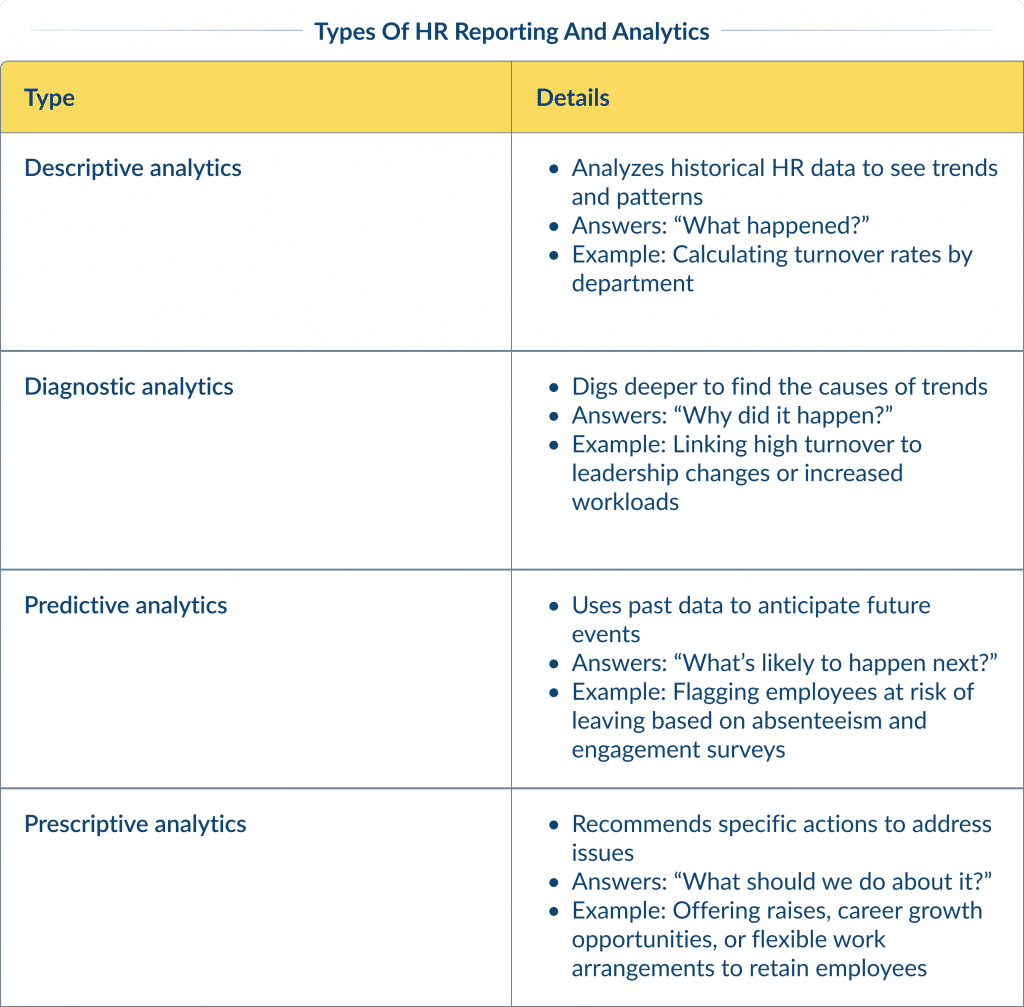
Benefits & Challenges of Using AI Analytics in HR
Recently, I stumbled upon an interesting Reddit thread that hasn’t grown into a discussion yet, but still caught my eye. The post was about the current state of AI in HR, specifically using HRIS data to forecast attrition. The author wrote:
“AI in HR never ceases to surprise us… The most prominent example is using data to predict how many employees might leave and see who it might be. This data can be used to train managers to notice subtle cues of disengagement.”
This is the “wow” factor of HR analytics tools in a nutshell. They are the engine that can process a sea of data and point to a potential storm on the horizon. But as one astute commenter quickly pointed out, the real magic, and the real challenge, isn’t in the prediction itself:
“I’ve seen a few companies try predictive analytics for attrition, and it’s a mixed bag. The models can be pretty good at spotting patterns, but the bigger challenge is what managers actually do with that info. If it’s just treated like a ‘score,’ people end up distrusting it.”
This comment hits the nail on the head. These tools aren’t about slapping a “flight risk” score on an employee’s forehead. That’s a surefire way to breed anxiety and distrust. So, what’s the alternative? How do we use these powerful tools to build, rather than just to forecast?
The old, fear-based approach would be to show the manager a list of “at-risk” employees. The new, human-centric approach is to use that data to start a supportive conversation.
- For the HR leader: instead of saying, “Your team is about to quit,” you can say, “The data suggests the Alpha Team is feeling stretched thin and doesn’t see a clear path for growth. Let’s talk about how we can equip you with better delegation techniques and create a career mapping workshop for your team.” The tool has moved the conversation from blame to empowerment.
- For the manager: armed with this insight, they can stop guessing and start connecting. They can have honest, one-on-one conversations, not based on a scary score, but guided by the data: “I’m looking at ways to better support the team, and I want to check in, how are you feeling about your workload and your opportunities for growth here?” This transforms the data from a surveillance tool into a catalyst for genuine human connection.
Beyond Attrition: The “Upside” of Predictive Insights
As the Reddit commenter wisely noted, the most exciting applications often lie beyond attrition. When we stop focusing solely on risk, we can start focusing on growth.
Think about the tools that map skill gaps and recommend personalized learning paths. Here, predictive analytics is a career coach. It can analyze an employee’s skills, career aspirations, and the company’s strategic direction to say, “To reach your goal of becoming a Senior Designer, here are the three most relevant courses for you to take next.” This feels positive and supportive because it’s designed for the employee’s benefit, creating a powerful win-win.
The ultimate test for any AI in HR isn’t its algorithmic complexity. It’s a simple question: Do employees feel they benefit from it?
When a tool helps a manager be more supportive, or helps an employee build a brighter future inside the company, it stops being a “big brother” and starts being a foundational part of a thriving workplace. The data provides the “what,” but our humanity must always guide the “so what?”.
Key HR Analytics to Track
Each key HR analytics metric provides a unique lens on workforce health and organizational effectiveness. Here are the most important HR analytics to track, how they are measured, and what they reveal.
When these metrics are looked at together, they give companies a full picture of what’s happening with their people. This helps leaders understand the real issues, make smarter decisions, and take action that supports both employees and long-term business goals.
| Category | Metric | What it measures | Why it matters |
|---|---|---|---|
| Acquisition & Hiring | Time to fill | The total number of days from opening a job requisition to the candidate accepting the offer. | Long times can mean your hiring process is inefficient, you’re losing top candidates to competitors, or your salaries aren’t competitive. |
| Quality of hire | The value a new hire brings, often measured by their performance ratings, productivity, and retention after 1 year. | This tells you if your hiring process is actually successful. Are you bringing in people who succeed and stay? It’s the ultimate measure of hiring effectiveness. | |
| Cost per hire | The total cost (recruiter fees, advertising, time) invested to bring on a new employee. | Helps you optimize your recruitment budget and understand the financial impact of your hiring strategy. | |
| Performance & Productivity | Revenue per employee | Total company revenue divided by the current number of employees. | A key measure of overall workforce productivity and efficiency. It shows how effectively you’re leveraging human capital to drive growth. |
| Employee performance rating distribution | How performance ratings (e.g., “Exceeds,” “Meets,” “Needs Improvement”) are spread across the organization. | Helps identify if managers are rating fairly, spot high-potential talent, and see if there are pockets of underperformance that need support. | |
| Retention & Engagement | Voluntary turnover rate | The percentage of employees who leave by their own choice (not laid off or fired). | This is a critical pulse check on company health. A high rate is a clear signal of underlying issues like poor management, lack of growth, or uncompetitive pay. |
| Regretted vs. non-regretted attrition | Regretted: When high performers leave. Non-Regretted: When low performers leave. | This is a game-changer. It helps you focus your efforts. Are you losing the people you desperately want to keep? That’s a major red flag requiring immediate action. | |
| eNPS (Employee net promoter score) | Measures employee loyalty by asking: “On a scale of 0-10, how likely are you to recommend this company as a place to work?” | A simple, powerful snapshot of overall employee satisfaction and engagement. It’s a leading indicator of your retention risk. | |
| Company Health | Internal mobility rate | The % of open roles that are filled by existing employees versus external candidates. | High internal mobility is linked to higher retention and engagement. It shows employees have a future and can grow within the company. |
| Diversity, equity & Inclusion (DEI) metrics | Representation rates (diversity) and promotion rates (equity) across different demographic groups (gender, ethnicity, etc.). | Ensures fair and equitable practices. A lack of diversity in promotions, for instance, can signal bias and lead to talent loss and legal risk. | |
| Absenteeism rate | The rate of unscheduled employee absence from work. | A sudden spike can be a sign of burnout, disengagement, or poor management within a specific team or department. |
HR Reporting
HR reporting is basically how HR teams turn all the data they collect about employees into something useful for decision-making. Think of it as storytelling with numbers: instead of just having raw data in spreadsheets, HR organizes it into reports, dashboards, or presentations that leaders can actually use.
For example, instead of saying “We hired 50 people last quarter”, an HR report might show:
- Where those hires came from (job boards, referrals, recruiters).
- How long it took to fill roles.
- How many are still in the company six months later.
This way, leaders see what’s working in the hiring process and what needs fixing.
Imagine a company notices through HR reports that turnover among junior developers has jumped by 20% in the past year. The report also shows these employees usually leave within their first 8 months. With that insight, HR digs deeper and finds that onboarding is inconsistent, and career growth isn’t clear at that level.
Armed with this historical data, HR can recommend fixes: a structured onboarding program backed by a modern digital onboarding solution, mentorship opportunities, and clearer promotion paths. Six months later, they collect the data to see if the offered solutions worked.
Common Types of HR Reports
HR teams usually bring together metrics and trends like:
| Report Type | Description |
|---|---|
| Recruitment Report | Tracks time-to-hire, cost-per-hire, candidate sources, and offer acceptance |
| Turnover & Retention Report | Details rates and reasons for departures and retention trends |
| Performance Report | Shows employee output, goal attainment, and review scores |
| Training & Development Report | Monitors completion of learning programs and skill acquisitions |
| Compensation Report | Analyzes salary, bonus, and benefits data |
| Attendance & Leave Report | Tracks absence patterns, leave balances, and frequency |
| Workforce Demographics Report | Breaks down the composition by age, gender, tenure, and job level |
Summary: HR Analytics and Reporting Strategies
Having the right tools is only half the story. The real impact comes from how HR teams use them. That’s where analytics and reporting strategies come in.
It’s easy to drown in HR data. From recruitment numbers to absenteeism rates, the possibilities are endless. But not every number tells a story that matters. That’s why the best HR analytics strategies start by aligning with business objectives.
- If the company is struggling with high turnover, tracking retention rates and early-exit trends should be front and center.
- If leadership wants to improve performance, HR might focus on engagement scores and productivity metrics. They can also incorporate a performance management system or an employee performance and appraisal system into the HR strategy.
- If scaling quickly, key performance indicators, such as time-to-hire and cost-per-hire, become crucial.
Good reporting highlights what needs fixing and shows whether changes are working.
If you need reliable software for HR analytics and reporting, our team can create it for you. We build custom dashboards that make complex data easy to understand and act on, whether you need to track turnover, measure engagement, or forecast future staffing needs.
With our expertise in talent acquisition software development, you’ll get tools tailored to your company’s goals. Contact us to discuss your HR data analytics needs.