AI in Manufacturing: Implementation Opportunities and Costs
- Created: Mar 18, 2026
- 11 min

CEO
In the manufacturing industry, AI mostly means three things:
- Analyzing equipment data to catch failures before they happen.
- Using computer vision to inspect products faster and more consistently than manual checks.
- Processing operational data to make smarter decisions around production planning and supply chains.
Each of these sounds straightforward until you try to implement one in a manufacturing process. Then, one might realize that the data is messier than expected and the systems don’t talk to each other the way they should. Plus, getting a team to trust a new tool takes more than a good demo.
At SpdLoad, we work with manufacturing companies to build and integrate software solutions that solve exactly these challenges. As a company that provides AI development services, we know the common pitfalls to avoid when integrating AI and, most importantly, how to identify if your company needs it in the first place.
Here, I will share our experience on this topic and cover things like where AI delivers real value in manufacturing and what it costs to implement. I will also share some tips on how to start without putting the whole initiative at risk.
Quick Overview
Artificial intelligence in manufacturing improves efficiency, reduces downtime, and automates quality control. Key facts:
- AI helps manufacturers reduce machine downtime by up to 40%.
- Computer vision systems can detect defects faster than manual inspection.
- AI implementation typically costs $30,000–$500,000+, depending on scope.
- Most manufacturers start with a Proof of Concept ($20k–$50k) before scaling.
- AI adoption is growing rapidly as factories move toward smart manufacturing.
What AI in Manufacturing Means
When most people say AI in manufacturing, they mean one of three things:
- Software that predicts equipment failures before they happen.
- Vision systems that inspect products on the line.
- Models that help teams make better decisions around production processes and supply planning.
Why is it even a topic for discussion?
The thing is that manufacturing environments produce enormous amounts of data. From sensors, machines, production software, quality logs, and supply chain systems. For a long time, most of this data was stored but not fully used. Human workers would review reports after issues happened, but there was rarely enough time or capacity to analyze everything in a way that could influence day-to-day decisions.
This is where AI changes the picture.
Instead of data sitting in dashboards or reports, it can now be analyzed continuously and used in real time. What used to be historical information becomes something teams can act on immediately.
A system can flag early signs of equipment failure, detect defects as products move along the line, or suggest adjustments to production plans based on current conditions.
And that can provide visible benefits. According to McKinsey, AI-driven predictive maintenance alone can reduce machine downtime by 20–40% and cut maintenance costs by up to 25%.
Industries Already Seeing Results from Implementing AI Solutions
Deloitte survey found that 86% of manufacturers believe AI will be critical to their competitiveness within the next five years: 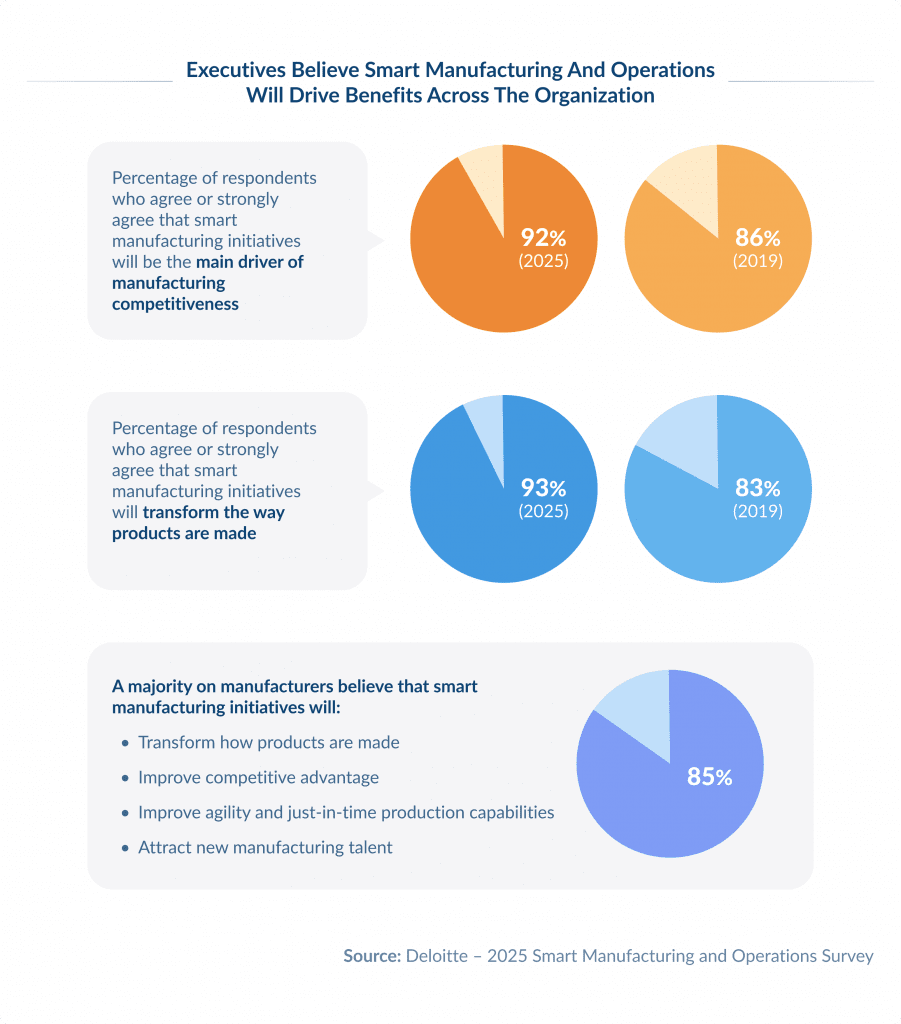
AI adoption in manufacturing isn’t evenly distributed, but it’s no longer limited to tech-forward outliers like the automotive industry or electronics, even though these still are at the forefront of AI adoption.
Here are the sectors seeing the most traction:
| Industry | AI use case | Reported benefit |
|---|---|---|
| Automotive | Defect detection, predictive maintenance | Up to 50% reduction in defect rates |
| Electronics | Computer vision quality control | 99%+ inspection accuracy |
| Pharmaceuticals | Process consistency, compliance monitoring | Reduced batch failures, faster QA |
| Food & Beverage | Demand forecasting, contamination detection | Less waste, more consistent output |
| Heavy machinery | Equipment health monitoring | 20–40% downtime reduction |
Where AI Creates the Most Value in Manufacturing
Not every part of a manufacturing operation benefits equally from generative AI. The areas where it tends to deliver the most are the ones where:
- Data is already being generated consistently.
- The cost of errors is high.
- The gap between what’s happening and what your team can realistically monitor is widest.
Here’s where most manufacturers find the clearest return.
Predictive Maintenance
This is the most common entry point for AI in manufacturing. And for good reason. Every piece of equipment on your floor (vibration patterns, temperature readings, cycle times, error codes) is already telling you something. The problem is that interpreting all of that in real time, across dozens or hundreds of machines, is beyond what any maintenance team can do manually. 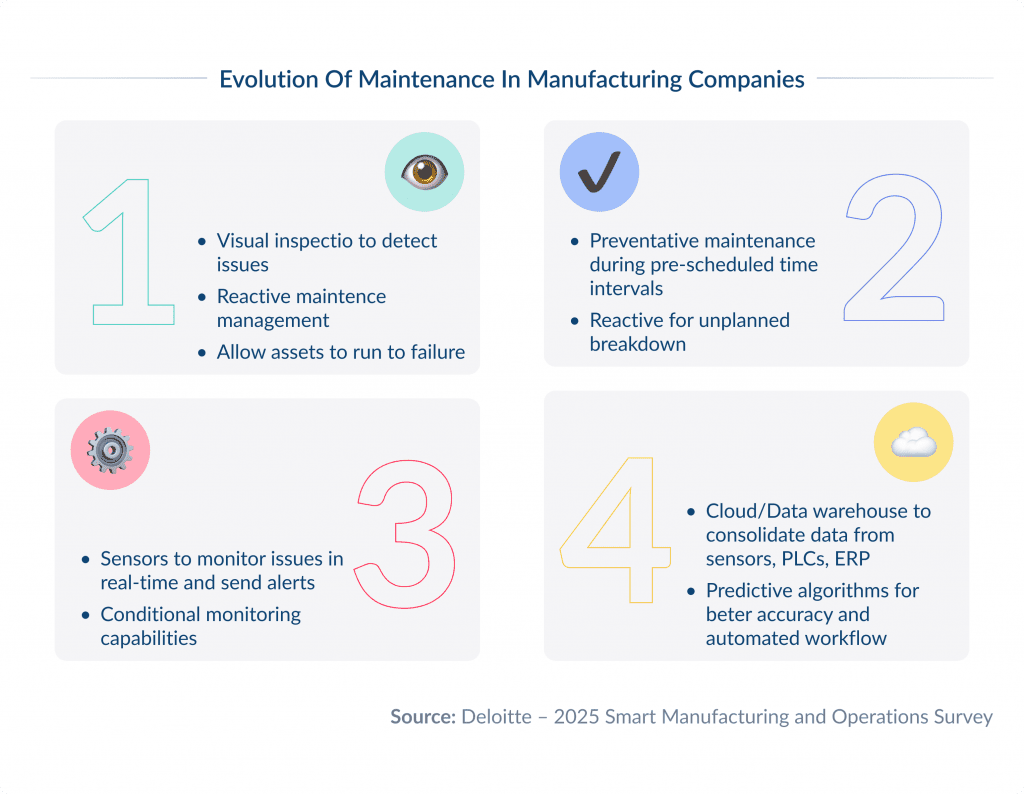
AI models can monitor that data continuously and flag anomalies before they turn into failures. So, instead of scheduling maintenance on a fixed calendar or waiting for something to break, your team gets specific, timely warnings about which equipment needs attention and why.
Quality Control with Computer Vision
Manual inspection has a ceiling. Even experienced inspectors miss defects at high production speeds, late in a shift, or when defects are subtle. That’s just a physical limitation of human attention under production conditions.
Computer vision systems don’t have that ceiling. They inspect every unit, at line speed, with consistent accuracy. And because they log every decision, they also generate data that helps you understand where defects are coming from in the first place.
Once, we built an AI computer vision system for a manufacturer with 5,000+ employees working across high-risk environments. The system runs on the facility’s existing camera infrastructure and delivers:
- ~5 second PPE checks at every entry point with automated pass/fail validation.
- 24/7 monitoring of hot zones, emergency exits, and PPE compliance in real time.
- Automatic incident logging with timestamps and footage, no manual documentation needed.
- EU AI Act compliance that is built into the architecture from day one.
And the impact is quite measurable. According to Deloitte, unplanned downtime costs industrial manufacturers an estimated $50 billion annually. In industries where consistency is non-negotiable, this kind of system pays for itself quickly.
Supply Chain and Demand Forecasting
Demand forecasting has always been part of manufacturing planning. The problem is that traditional forecasting methods rely heavily on historical patterns, and the last few years have made clear how quickly those patterns can stop being reliable.
AI-driven forecasting incorporates a much wider range of signals: past orders, real-time market data, supplier lead times, logistics disruptions, seasonal patterns, and more. The result is a forecast that’s more responsive to what’s actually happening, not just what happened before.
According to McKinsey, AI-enabled supply chain optimization can reduce forecasting errors by 20–50% and decrease lost sales due to stockouts by up to 65%. For manufacturers managing complex, multi-tier supply chains, even modest improvements in forecast accuracy translate directly into lower inventory costs and fewer production disruptions.
Energy and Resource Optimization
Energy is one of the highest operating costs in manufacturing, and it’s one of the least optimized in most facilities.
AI models can analyze consumption data across your facility, identify inefficiencies, and suggest operational adjustments. Often without any change to production output.
The savings can be significant. Industry experts estimate that AI-driven energy optimization in industrial settings can reduce consumption by 10–20%. In heavy manufacturing, where energy costs can represent 20–40% of total operating expenses, that’s a meaningful line item.
Cost of AI in Manufacturing
How much will it cost us to implement AI in our facility?
This is one of the first questions clients ask me during our first call. And, usually, the answer to this question either moves a conversation forward or stops it entirely.
My honest answer is: it depends, but in ways that are predictable enough to plan around.
AI implementation costs in manufacturing typically range from $30,000 to $500,000+, depending on the scope of the project, the complexity of the use case, and the state of your existing data infrastructure. That’s a wide range, and it’s intentional.
A focused proof of concept to validate predictive maintenance on one production line looks very different from a facility-wide computer vision rollout integrated with your ERP and MES systems.
What matters more than the headline number is understanding what drives the cost, because that’s where most budgets get surprised.
AI in Manufacturing Cost Drivers
The key cost drivers include:
Data availability and preparation
This is consistently the most underestimated part of any AI project. Before a model can learn anything useful, the data it trains on needs to be clean, consistent, and properly structured.
In many manufacturing environments, data exists but isn’t in a usable state. It’s siloed across systems, inconsistently labeled, or missing critical context.
Data preparation and cleaning typically account for 40–60% of the total project cost. If your facility already has well-maintained sensor data and production logs flowing into a central system, you’re starting from a much better position than a company that needs to build that foundation first.
Integration with existing systems
AI doesn’t operate in isolation. For it to be useful on a production floor, it needs to connect with the systems your team already uses: your MES, ERP, historian databases, and potentially your SCADA infrastructure. That integration work is often where projects become more complex and more expensive than initially anticipated.
The challenge is that manufacturing environments tend to run a mix of legacy systems and newer platforms, and getting them to communicate reliably requires careful planning and experienced development work.
Infrastructure and model complexity
Not all AI use cases require the same computational infrastructure.
A predictive maintenance model running on cloud infrastructure is a very different technical footprint from a real-time computer vision system processing high-resolution image data at line speed, which may require edge computing hardware deployed directly on the production floor.
The table below gives a realistic picture of how cost scales with scope:
| Project type | Typical cost range | What’s included |
|---|---|---|
| Proof of Concept | $20,000 – $50,000 |
|
| Pilot Project | $50,000 – $150,000 |
|
| Full Implementation | $150,000 – $500,000+ |
|
| Ongoing Maintenance | 15–25% of initial cost annually |
|
The Hidden AI Integration Costs Most Budgets Miss
Beyond the AI product development work itself, there are several cost categories that don’t always make it into the initial project estimate — but absolutely should. These include:
Sensor installation and hardware
If your equipment isn’t already instrumented with the sensors needed to collect relevant data, that’s an additional infrastructure investment before the AI work even begins. Depending on the scale, sensor installation alone can run $10,000–$100,000+.
Employee training
An AI system that your team doesn’t trust or know how to use delivers no value. Budget for proper onboarding, both for operators interacting with the system daily and for the engineers or analysts responsible for maintaining it.
Model retraining
Production environments change. New equipment gets added, processes get modified, and product lines shift. AI-powered systems need to be retrained periodically to stay accurate. This isn’t a one-time cost — it’s an ongoing operational expense that typically runs 15–25% of the initial development cost annually.
Change management
This one rarely appears in a vendor quote, but it’s real. Getting a production team to change how they respond to maintenance alerts, or convincing quality managers to trust an automated inspection system, takes time and deliberate effort. Skipping this step is one of the more common reasons AI projects deliver less than expected, even when the technology works perfectly. 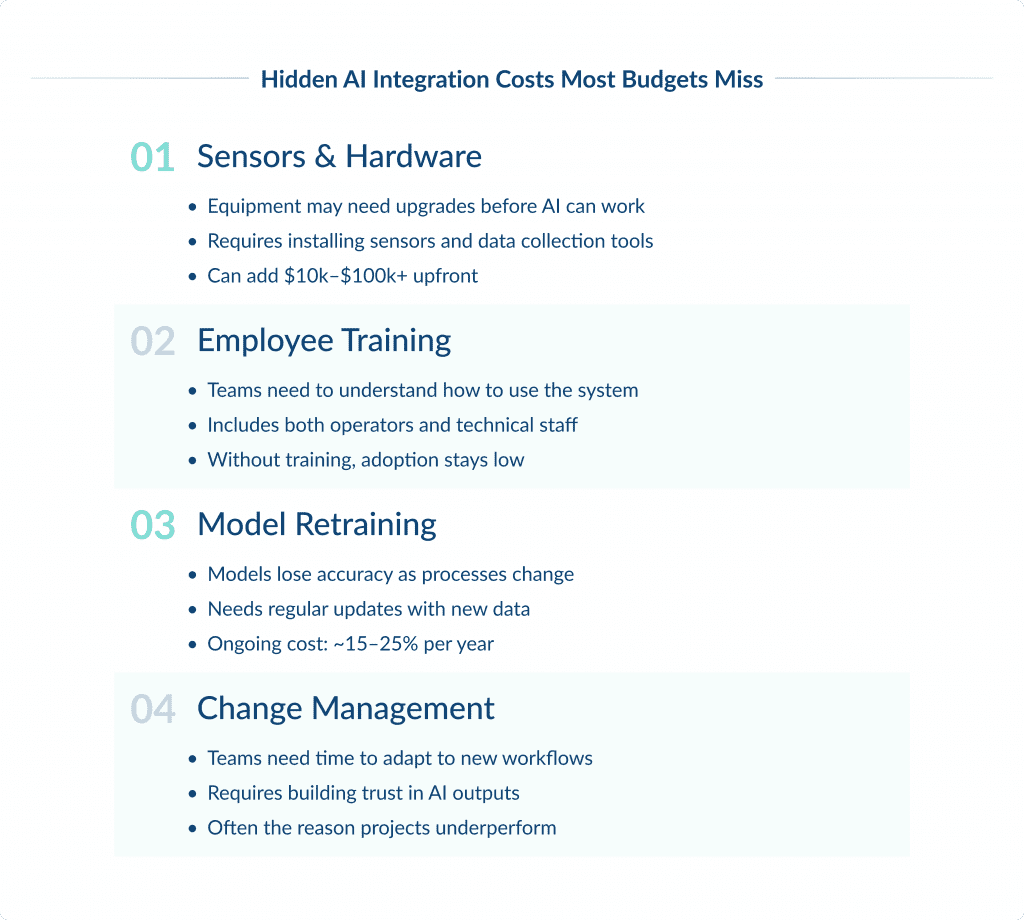
The Cost of Doing Nothing
It’s also worth putting these numbers in context. The costs above are real, but they need to be weighed against the cost of the problems AI is designed to address.
Unplanned downtime costs industrial manufacturers an estimated $50 billion annually across the sector, according to Deloitte.
A single hour of downtime on a high-volume automotive line can cost $10,000–$50,000, depending on the facility. A quality escape that reaches the field can trigger recall costs that run into the millions.
When you frame AI implementation against those numbers, a $50,000 proof of concept to validate predictive maintenance starts to look less like an experiment and more like basic risk management.
How to Approach the Budget Practically
The most sensible starting point for most manufacturers is a Proof of Concept. This is a focused, time-bound project that tests one use case against real production data and produces measurable results. At $20,000–$50,000, it’s a manageable investment that answers the most important question before you commit to anything larger: Does this actually work in our environment?
From there, a successful PoC gives you the evidence to justify a broader pilot, and a successful pilot gives you the foundation for a full rollout. Each stage builds on the last, which keeps risk manageable and makes internal sign-off significantly easier.
I remember a conversation with an operations director at a manufacturing company. We were discussing a potential AI project, and at some point, he paused and said that the investment felt too high for something that was still uncertain.
In his mind, it sounded like a large, complex initiative that would require changing a lot of existing processes at once.
So instead of pushing further, we stepped back and looked for a smaller, more practical starting point. One idea that came up was a computer vision system for security. The one that could monitor restricted areas, detect unusual activity, and support the on-site team without interfering with production itself.
It was a much narrower use case with quite clear benefits and measurable results. And, what was important for our client, it didn’t require deep integration into production systems and an excessive budget.
And this is something we’ve seen more than once. When companies try to approach AI as a large-scale transformation from the start, it often feels too complex and expensive. But when they begin with a specific, well-defined use case like this, it becomes easier to test the idea, understand the value, and decide what to do next.
ROI of AI in Manufacturing: When Does It Pay Off?
Spending up to $500,000 on an AI technology implementation is a significant commitment, and any reasonable leadership team is going to ask for a return on that investment before signing off. The good news is that manufacturing is one of the sectors where AI ROI is among the most measurable and consistent.
This is because manufacturing operations are already built around metrics:
- Downtime is tracked.
- Defect rates are logged.
- Energy consumption is metered.
- Inventory costs are visible.
And when AI algorithms move any of those numbers, the financial impact is calculable in a way that’s harder to do in, say, marketing metrics or customer service.
Here’s what the data shows across the main use cases:
| Metric | Typical improvement |
|---|---|
| Machine downtime | -20% to -40% |
| Production efficiency | +15% to +30% |
| Maintenance costs | -10% to -25% |
| Defect rates | -20% to -50% |
| Forecast accuracy | +20% to +50% |
| Energy consumption | -10% to -20% |
In most cases, manufacturers who implement AI thoughtfully (here, I mean starting with a clear use case, clean data, and proper integration) see their investment pay for itself within 6 to 18 months. That’s a relatively short payback period for a capital investment in operational technology.
A Realistic Timeline of AI Integration in Manufacturing
For manufacturers approaching AI implementation in a structured way, the typical journey looks like this:
| Stage | Timeline | What happens |
|---|---|---|
| Feasibility & data assessment | 2–4 weeks | Evaluate data readiness, define use case, estimate costs |
| Proof of Concept | 6–12 weeks | Build and test model on real production data |
| Pilot deployment | 3–6 months | Deploy on one line or area, measure results |
| Full rollout | 6–18 months | Scale across facility or multiple sites |
| Continuous optimization | Ongoing | Retrain models, expand use cases, refine integrations |
When people mention a 6–18 month ROI, they simply mean the point where the savings from the system start to cover what was spent to build and implement it.
In practice, though, results often show up earlier. Even during a pilot or PoC, teams can start noticing small but measurable improvements — fewer breakdowns, less waste, or smoother operations.
That’s why a well-designed PoC matters. It’s not just about testing whether the technology works. It also gives a first, realistic look at the potential return, before committing to a larger investment.
The Role of Custom Software in AI Manufacturing Solutions
Most manufacturers who move past the pilot stage run into the same reality: their environment is specific enough that generic solutions only get them part of the way there.
Every facility has its own mix of equipment, legacy systems, and production workflows. Almost every AI tool, regardless of how polished it looks in a demo, will need integration work before it connects meaningfully with your existing systems.
This is where custom development becomes relevant, not as a luxury, but as a practical necessity.
At SpdLoad, we help manufacturers bridge that gap. That means connecting AI models to the infrastructure you already run, building interfaces that operators can actually use on the floor, and making sure what gets built is maintainable and scalable as your needs grow.
The technology is only part of the equation. How well it fits your environment, and how well it’s designed for the people using it, is what determines whether your AI investment keeps delivering value a year after go-live, or quietly gets shelved because it never quite fits.
If you’re exploring where to start, we’re happy to talk through what makes sense for your specific situation.