The Best Digital Onboarding Solutions for Employee Onboarding
- Updated: Oct 10, 2025
- 10 min

Head of Recruiting
Digital onboarding is now more common than ever before. HR Tech Survey states that 46% of companies have already implemented digital onboarding tools as part of their chosen tech stack. Should you do that?
If you feel like your onboarding process holds new hires back instead of helping them, then the answer is YES. According to Gallup, a well-thought-out onboarding process can improve employee productivity by up to 60%. So, how do you level up your digital onboarding process in your HR operations?
This article explores how the digital onboarding process works. SpdLoad specializes in HR software development services. We’ve been working on solutions that help to streamline the onboarding for both new hires and HR teams. Here, we share both our experience in this area and some thoughts that might be insightful for you.
Contact us to get started!
What is Digital Onboarding
Digital onboarding is the process of using online technology to remotely register and verify a new customer or employee. The best thing about digital onboarding is that it replaces physical document processing and in-person meetings with automated, digital steps.
For customers and employees, this means proving their identity with a photo of an ID and a selfie to open a bank account or sign up for a new service. For new hires, it involves electronically completing forms, training, and paperwork before their first day.
The core goal is to make onboarding faster, more secure, and convenient for everyone involved while keeping employee/customer data secure. Digital onboarding has become a key practice for financial institutions, HR, and any industry that requires verification and registration.
Employee Onboarding vs Customer Onboarding Process
The answer is, the target personas are different. In employee onboarding, a new person integrates into the company. Its goal here is to make them feel welcome, complete necessary legal paperwork like tax forms, and train them for their new role.
Customer onboarding focuses on verifying a user’s identity and teaching them how to use a product or service. Its goal is to quickly provide value to new account holders and make sure they can successfully use what they’ve purchased.
Besides, the processes use different tools:
- Employee onboarding uses HR software for forms and training.
- Customer onboarding uses product tutorials and identity verification tech.
Ultimately, employee onboarding is about building an internal relationship for long-term retention. And customer onboarding demonstrates product value to achieve success.
How Does the Digital Onboarding for Employees Process Work
Here’s how it digital onboarding process works, step-by-step:
Signup process
- New user (hire) gets a welcome email with login to the onboarding portal.
- Access to documents, company info, and schedule.
Digital document submission
- Upload personal details, identity documents, phone number, tax forms, and contracts.
- E-signature to complete paperwork online.
Company introduction
- Welcome video or virtual tour.
- Overview of company culture, mission, and values.
Role-specific training
- Online training modules or e-learning courses.
- Access to the knowledge base and guidelines.
Tools & system access
- Accounts created for email, project management, and HR systems.
- Tutorials on how to use internal tools.
Team connection
- Virtual meet-and-greet with manager and team.
- Mentor or buddy assignment.
Progress tracking
- Checklist of completed steps.
- HR and the manager can track progress in real time.
Of course, the process can look different, depending on the company and industry you operate in. The main thing is that with the right tools, onboarding should be faster, easier, and less stressful for everyone involved. 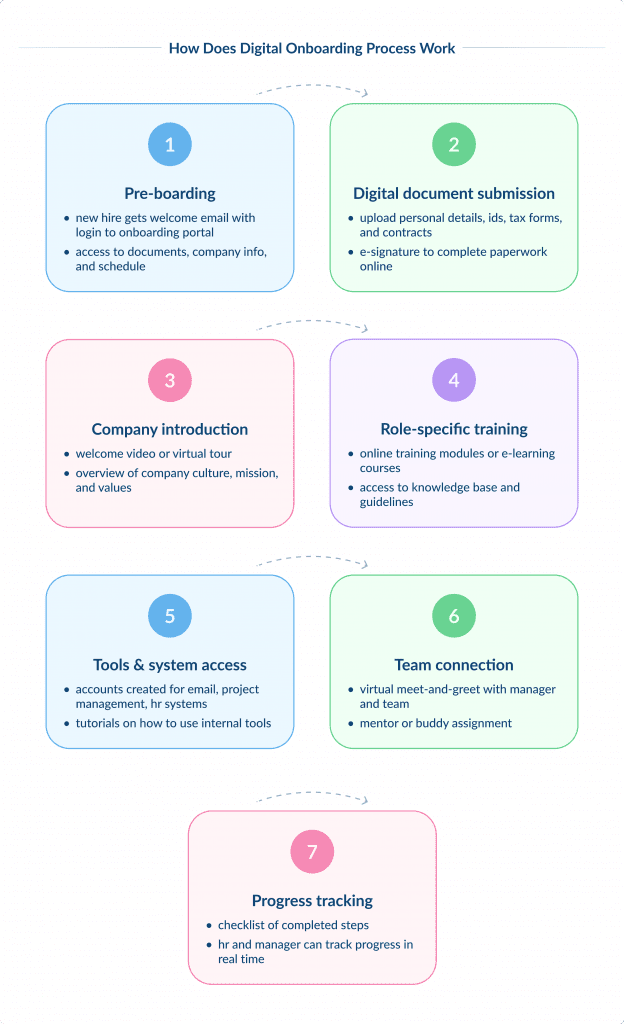
Types of Digital Onboarding Process
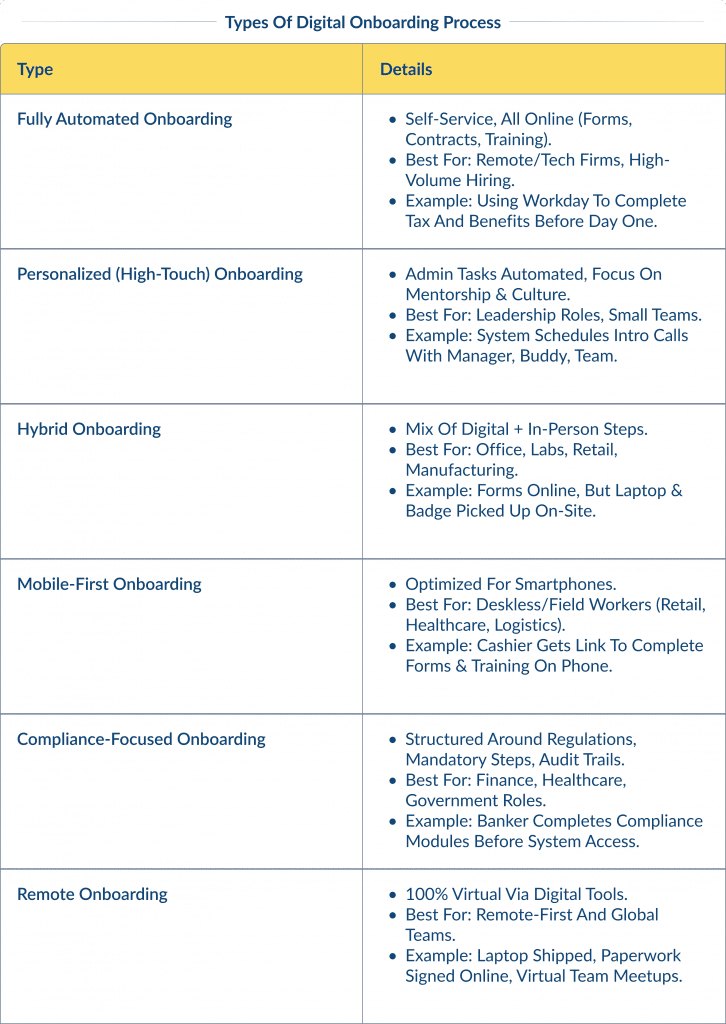
Here are the main types of onboarding methods companies can adopt for a frictionless onboarding experience:
1. Fully Automated Onboarding
This is a completely digital, self-service process. All tasks, including submitting documents, signing contracts, and completing training, are handled through an online portal via mobile device or a laptop. No need for direct human intervention from HR for the basic steps.
2. Personalized (High-Touch) Onboarding
This type uses digital tools to facilitate a more human-centric experience. The technology automates the administrative tasks and paperwork. It frees up HR and managers to focus on relationship-building and culture integration.
3. Hybrid Onboarding
This blends digital efficiency with necessary physical steps. The administrative work is done online, but certain elements require in-person interaction.
For example, a new employee can complete all their tax and identity verification online, but comes to the office on their first day to pick up their laptop and receive a facility tour.
4. Mobile-First Onboarding
The entire process is designed for a smartphone experience. This type can be a lifesaver for onboarding deskless workers, field staff, or hourly employees who may not have easy access to a computer.
5. Compliance-Focused Onboarding
The digital system is specifically structured to ensure strict adherence to industry regulations and legal requirements. It features mandatory, sequential steps and thorough digital audit trails.
6. Remote Onboarding
The entire process is conducted virtually, with the new hire, their manager, and the HR team all in different physical locations. It relies entirely on digital tools at every step, from paperwork to social integration.
How it works in practice:
- A welcome box with laptop, swag, etc. is shipped to the employee’s home.
- All paperwork (contracts, tax forms) is completed via a secure online portal.
- IT access is granted and configured remotely.
- The first week’s schedule is filled with virtual meet-and-greets, video training sessions, and introductory calls with the team.
- A “buddy” or mentor is assigned to check in regularly via chat and video call.
Role of Digital Onboarding Solutions in the Onboarding Process
Different industries require different levels of automation, oversight, and security. Whether you work in a financial sector, a credit union, an e-commerce platform, or a healthcare institution subject to strict compliance, there’s a digital onboarding software that is designed to meet your needs and enhance your customer retention efforts.
Here is how HR ON uses software for employee onboarding, instead of paper forms and long live meetings:
When a new colleague joins us, we naturally make use of both HR-ON Recruit and HR-ON Staff. First, we manage the recruitment process in Recruit, and as soon as the process is completed, the employee data is automatically transferred to Staff. If any information is missing, we send an Engagement directly from Staff to collect it. After that, the onboarding process begins. In Staff, we assign tasks and connect relevant colleagues so everyone knows what needs to be done. This ensures that the new colleague gets a great start, and that the rest of us are well prepared to welcome them.
Digital onboarding solutions act as the central command center for the entire onboarding process. Their main role is to automate all the boring, repetitive tasks and save time for both a new hire and HR professionals. Let’s elaborate more on the benefits of digital onboarding.
Benefits of Digital Onboarding
Digital onboarding brings value to both the company and the new employee. The benefits go far beyond just “going paperless.” The benefits of digital HR transformation include:
Operational Efficiency & Cost Savings
Digital onboarding automates repetitive, time-consuming tasks like sending reminder emails, manually entering data into multiple systems, and chasing down physical documents.
For instance, generating payroll documentation is streamlined with tools like CVS paystub, saving HR teams hours and reducing errors
This reduces the administrative burden on HR, allows them to manage more hires with the same resources, and focus on strategic initiatives like talent development and employer branding. It also saves on paper, printing, postage, and physical storage.
Compliance and Risk Management
The system ensures compliance as it provides a standardized process. It can require completion of necessary forms (I-9, W-4, policy acknowledgements, and other forms) before the employee can proceed. Digital audit trails create a secure, unalterable record of who did what and when, which is critical for legal and regulatory audits. This reduces the risk of penalties.
Consistency and Employer Branding
Every new hire gets the same organized, professional welcome experience. This consistency strengthens your employer brand and shows that your company is modern and efficient.
A good onboarding experience is also a powerful recruitment tool. New employees will likely share their positive experience with their network. And next time, when you will need to hire dedicated software developers, for example, the candidates will be more eager to join your team.
Faster Time-to-Productivity
When your new hires have completed all their administrative tasks before their start date, their first day can be dedicated to more important stuff. They can spend this time on training and building relationships to better understand their role. They can access the tools and information they need immediately and can contribute to the team goals much faster.
Support for Remote and Global Teams
Geography becomes irrelevant. Companies can onboard employees in different states or countries with the same ease as someone in the headquarters. This helps to build diverse, distributed teams and access a global talent pool, as in the case of IT outsourcing, for example.
When onboarding new team members or managing contractors in a critical market like the U.S., where talent acquisition is key, you want them connected immediately, not wrestling with airport SIM kiosks. Making sure they know how to quickly secure an eSIM data plan USA is a simple, smart step that guarantees instant connection for their first calls and secure system access, keeping the onboarding momentum going.
Here is how the digital onboarding process compares to the traditional onboarding:
| Aspect | Traditional onboarding | Digital onboarding |
|---|---|---|
| Speed | Slow (days or weeks) and requires scheduling and in-person meetings. | Short-term onboarding (hours or minutes). Usually automated and asynchronous. |
| Cost | High (paper, printing, postage, manual labor). | Low (automation reduces administrative overhead). |
| Accuracy | Prone to human error in data entry. | High. Automated data extraction and validation reduce errors & deliver accurate data. |
| Compliance | Manual tracking is prone to errors and missing documents. | Automated reminders and secure digital audit trails. |
| Experience | Inconsistent, often overwhelming on the first day. | Consistent, structured, and can be done before day one. |
| Accessibility | Requires physical presence or mailing documents. | Accessible 24/7 from anywhere in the world on any device. |
| New hire feeling | Anxious, overwhelmed, buried in paperwork. | Prepared, welcomed, and focused on people, not paperwork. |
| Sustainability | Paper-based, wasteful. | Completely paperless, eco-friendly. |
Top Employee Onboarding Solutions
Based on high user ratings and reviews on G2 and Capterra, here are the top employee onboarding software solutions. Some of these platforms we’ve already covered in our article about top HR solutions.
These platforms are praised for their ultimate customer experience and ability to improve the new hire experience.
1. BambooHR
Best for small to mid-sized businesses (SMBs) looking for an intuitive, all-in-one HR platform.
BambooHR offers a seamless onboarding experience that automates offer letters, new hire paperwork, and tasks. It allows for custom checklists for both HR and new hires and provides e-signature capabilities. Its user-friendly interface is a major highlight.
2. Rippling
Best for companies that want to automate onboarding alongside IT and app provisioning.
Rippling is powerful because it automatically handles both HR and IT setup in one go. When you hire someone, it can create their email account, provision software (like Slack, Microsoft 365), and even ship them a pre-configured laptop, all while managing their payroll and benefits enrollment.
3. Workday
Best for large enterprises needing a robust, scalable HCM suite that integrates with complex finance systems.
Workday provides a comprehensive and configurable onboarding module as part of its larger HCM suite. It excels at managing high-volume hiring, ensuring global compliance, and providing a structured, branded onboarding experience for new employees.
4. Paycor
Best for SMBs, particularly those focused on streamlining HR and payroll together.
Paycor’s onboarding module focuses on making the hiring-to-payroll process smooth. It helps create custom onboarding packets, track completion progress, and ensures all necessary tax and I-9 forms are completed correctly to get employees paid on time.
5. Deel
Best for companies with international or remote-first teams hiring globally.
Deel specializes in global onboarding and compliance. It allows you to hire and onboard full-time employees and contractors in over 150 countries, handling localized contracts, tax documents, and compliance automatically, which is its standout feature.
6. Sapling
Best for mid-sized to large companies focused on creating a personalized and engaging onboarding journey.
Sapling (now a part of Kallidus) excels at creating automated, personalized workflows. It helps schedule key meetings, assign mentors, and coordinate tasks across teams (HR, IT, Finance) to ensure a warm welcome and seamless first day for new hires.
7. Gusto
Best for very small to small businesses (startups, SMBs) that need simple, integrated payroll and benefits administration.
Gusto makes setting up a new hire for payroll incredibly simple. Its onboarding tools guide employees through filling out all required federal and state forms online and allow them to easily elect benefits, all within a very user-friendly platform. 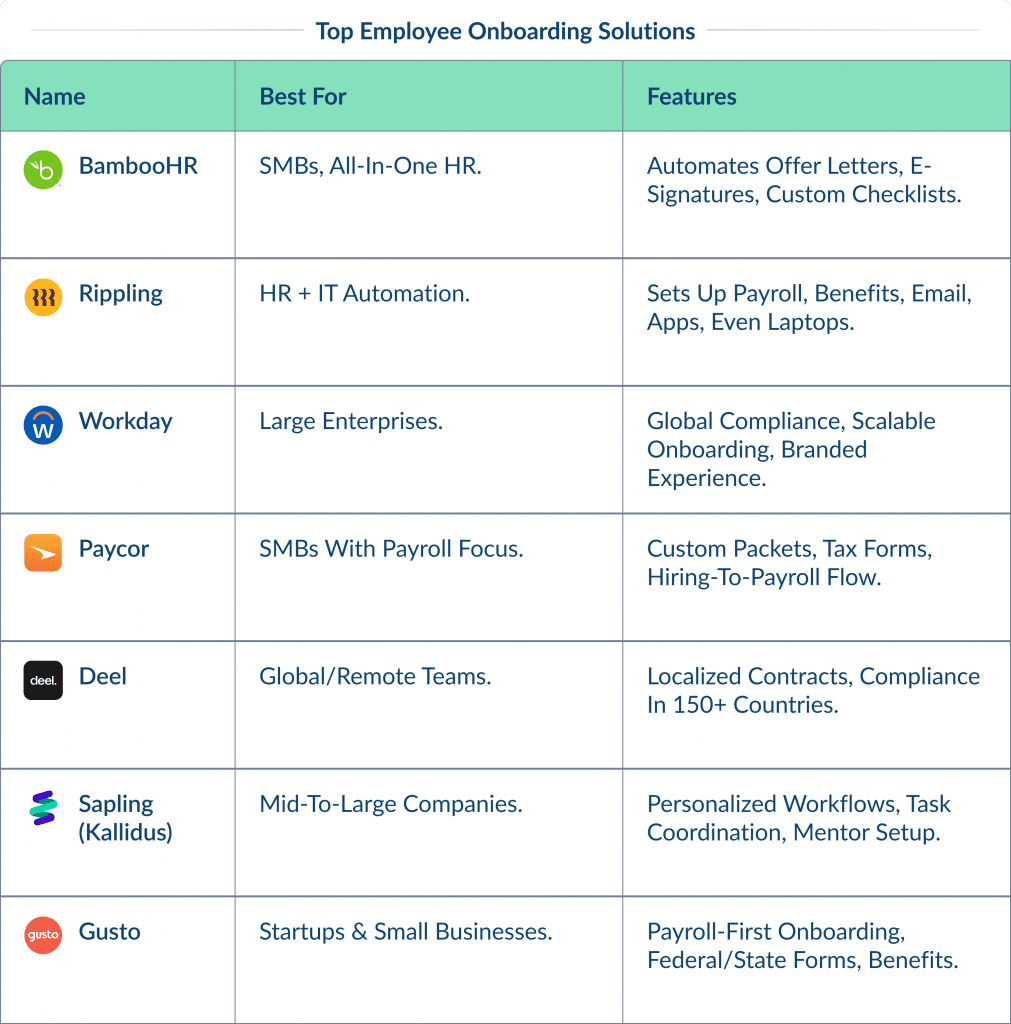
Should You Use Off-The-Shelf Onboarding Tools or Create a Custom One?
If you haven’t seen the features you need in the software tools we’ve explored above, chances are, you might need a custom HR tool for your company. This is a pretty common practice.
For example, when working on this recruitment software development project, we’ve built a custom system designed specifically for fast food employees. The client required a mobile application for employees, a web version for employers, and a web-based admin panel for their own use.
Now, the client has an app that allows users to see all job information in one place and apply for positions with a single click. When working on the project, we’ve paid great attention to how we design an HR app. The goal was to create an interface that easily allows job seekers to find and apply for jobs based on their preferences.
A custom-made HR app means fewer errors, lower chances of identity theft, better collaboration for internal teams, and more control over who you are working with.
If that is something you are looking for, or there are some specific features you would like to introduce, like facial biometrics or liveness detection, then a custom-made solution is the right option.
Final Words on Digital Onboarding
The “best” digital onboarding software always depends on your company’s specific size, budget, and needs. A large enterprise will have different requirements than a 20-person startup.
Take advantage of free trials or demos to see which platform feels right for your team. And if you feel like none of the available tools work for your corporate onboarding process, look for an app development partner to create a custom one.
We are ready to work with you and build a digital onboarding software that meets all your needs and has all the features you look for. Contact us for a free consultation and project evaluation. Also, check out this guide on HR software development costs to learn more about factors that influence the final cost.