How Much Does AI Development Cost? Pricing by Project Type
- Created: Jun 15, 2026
- 16 min

CEO
SpdLoad has been offering custom AI development services for over 3 years now. And every week, I get 2-3 versions of the same question: How much would it cost to build an AI solution for our product? And every time, my honest answer is: It depends.
But let me show you exactly what artificial intelligence development costs depend on.
After working with dozens of teams across SaaS, logistics, healthcare, and fintech, I’ve seen AI projects range from a focused two-week integration to a year-long platform build. The difference isn’t always about ambition. More often, it comes down to data readiness, integration complexity, how much reliability the business needs, and whether the team has validated the use case before writing a single line of code.
This article is my attempt to give you a realistic, structured picture of AI software development costs: by solution type, by project stage, and by the factors most teams underestimate. Not to give you a number to paste into a spreadsheet, but to help you ask the right questions before you talk to any vendor, including us.
At a Glance: AI Development Costs by Solution Type
Before diving into the details, here’s a high-level view of the main solution types we work with, what drives their cost, and how complex they typically are to build.
| Solution Type | Typical Scope | Relative Complexity | Main Cost Drivers |
|---|---|---|---|
| AI API integration | Add an existing model to a workflow | Low to medium | API integration, UX, prompt design, testing |
| Internal RAG assistant | Search and answer questions using company data | Medium | Document processing, embeddings, permissions, evaluation |
| AI agent | Perform actions across tools and workflows | Medium to high | Integrations, tools, memory, guardrails, monitoring |
| Predictive analytics | Forecast outcomes using historical data | Medium to high | Data quality, modeling, feature engineering |
| NLP solution | Classification, summarization, extraction | Medium to high | Domain data, language complexity, accuracy |
| Computer vision solution | Analyze images or video | High | Labeled data, model training, hardware, latency |
| Custom AI platform | Multi-component enterprise system | High | Architecture, security, integrations, governance |
Share your use case, data situation, and integration requirementsSPDLoad will help you define the right scope before development begins.
What Determines the Cost of an AI Project?
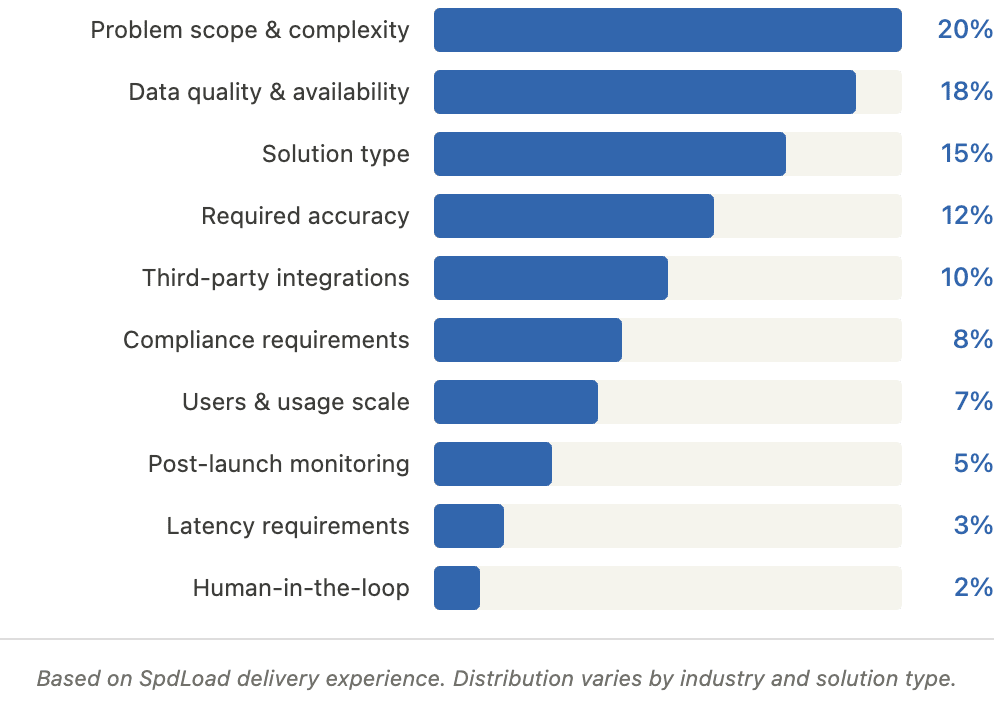
When I talk to clients early in the process, I’m trying to understand the problem before going into the tech details. From there, the AI solution development cost picture starts to take shape. Here are the factors that consistently affect budget:
| Factor | What it drives |
|---|---|
| Problem scope & complexity | Timeline, team size, iteration cycles, exploratory work before build |
| Data quality & availability | Pre-build cleaning and structuring effort; directly affects model performance |
| Solution type | Architecture complexity, tooling choices, required expertise |
| Required accuracy | Training data volume, evaluation cycles, iteration rounds |
| Third-party integrations | Scope creep risk, dependency complexity, testing overhead |
| Compliance requirements | Legal review cycles, documentation, audit logging, sign-off timelines |
| Users & usage scale | Infrastructure design, load testing, hosting architecture |
| Post-launch monitoring | Drift detection tooling, retraining cadence, alerting infrastructure |
| Latency requirements | Serving infrastructure, optimization work, speed/capability tradeoffs |
| Human-in-the-loop workflows | Review interface design, audit trail tooling, override mechanisms |
AI Development Cost by Project Stage
The total cost of an AI project is a sequence of investments, each with its own scope, timeline, and risk profile. Understanding what each stage costs, and what it produces, is the difference between a budget that holds and one that surprises you in month four.
| Stage | Timeline | Cost range | What’s included | Watch for |
|---|---|---|---|---|
| Discovery | 1–3 weeks | $5,000–$20,000 | Technical specification, data readiness audit, architecture recommendation, risk and cost estimate | Skipping discovery is the single biggest cause of mid-project overruns. Budget surprises in later stages almost always trace back to assumptions that weren’t validated here. |
| Proof of Concept | 2–6 weeks | $10,000–$40,000 | Working prototype validating the core AI hypothesis, accuracy baseline, early infrastructure sketch | PoCs look deceptively cheap — and deceptively complete. Production systems typically cost 3–5× more. A PoC that can’t be extended is a sunk cost. |
| AI MVP | 6–14 weeks | $30,000–$150,000 | Deployed working product, core AI pipeline, basic monitoring, user-facing interface | Most “vibe-coded” MVPs function here, then hit a wall at 6–9 months when technical debt, scale, or security requirements surface. |
| Production-Ready Version | 8–20 weeks | $50,000–$200,000 | Security hardening, comprehensive test suite, CI/CD pipeline, compliance review, fallback logic, documentation, SLA-backed infrastructure | This is where most hidden costs materialize — governance, evaluation datasets, monitoring, vendor abstraction. Teams that skipped these in the MVP phase pay for them twice. |
| Scaling & Maintenance | Ongoing | $3,000–$50,000/month | Model monitoring and drift detection, scheduled retraining, infrastructure optimization, usage cost management, feature updates | Costs scale with usage, not just features. Agentic workflows, large context windows, and parallel sessions are the fastest-growing cost drivers in 2025–2026. |
The cumulative path from discovery to production typically runs $95,000–$410,000 for a mid-complexity AI system. Enterprise systems with compliance requirements, multiple integrations, or custom model training sit above that range.
Two notes on sequencing.
First, discovery almost always pays for itself. Second, the gap between MVP and production-ready is wider than most project plans account for. An MVP is a hypothesis in code. A production-ready system is a product with accountability behind it.
SpdLoad offers a free first-pass code review as an entry point into any stage, including production hardening of systems built elsewhere. If your MVP is already live, that’s where we start.
Cost Breakdown by AI Solution Type
A straightforward API integration and a custom enterprise AI system are entirely different categories of investment. So, below you’ll see a realistic cost breakdown for each major solution type, based on our experience shipping AI systems across industries.
AI API Integrations
AI integrations are the fastest and lowest-cost entry point into implementing AI. You’re connecting your product to a third-party model, such as OpenAI, Anthropic, or Google Gemini. No need to train or host anything yourself. That keeps the build lean.
- Typical engineering effort: 2–6 weeks.
- Approximate development cost: $8,000–$40,000, depending on the number of endpoints, error handling complexity, and how much prompt engineering is required to get reliable outputs.
What makes API integrations expensive over time is the runtime. Token costs scale directly with usage. At prototype scale, $100–$300/month feels manageable. As usage grows, teams routinely hit $1,000–$5,000 per engineer per month in API spend without noticing, especially once large context windows and concurrent requests come into play. Budget accordingly from day one, and build monitoring into the integration.
The other cost that gets missed quite often is model deprecation. Providers retire model versions, and migrations require re-testing and re-validating every prompt and output pattern. Build with an abstraction layer so that version changes don’t require rebuilding from scratch.
First-year total cost estimate: $15,000–$100,000 (build + API usage at moderate scale).
RAG Systems
Retrieval-Augmented Generation systems let you ground AI outputs in your own data, including internal documents, product databases, and support histories. In this case, you are not relying on what the model learned in training. They’re more complex than API integrations and more expensive to build and maintain correctly.
Rag-based AI application development involves several interconnected components: a data ingestion pipeline, a chunking and embedding strategy, a vector database, and a retrieval layer that feeds context into the generation step. Each of these has its own cost, and each needs to be tuned for your specific data and query types.
- Approximate development cost: $30,000–$120,000.
- Engineering timeline: 6–16 weeks, though the tail of evaluation and tuning often extends the timeline by 30–50%.
Ongoing custom RAG development costs include vector database hosting ($200–$2,000/month, depending on index size), re-embedding costs when your data changes, and re-ingestion pipelines that need to run on a schedule or trigger. Organizations with large or frequently updated document sets should budget for continuous ingestion as an operational line item, not a one-time cost.
First-year total cost estimate: $40,000–$200,000.
AI Agents
AI agents are autonomous systems that plan, take actions, and iterate (often across multiple tool calls or sub-tasks) to complete a goal. They’re the most powerful AI architecture, and the most expensive to build and operate correctly.
- Approximate development cost: $80,000–$300,000+.
- Engineering timeline: 12–24 weeks for production-ready systems.
Each agent step is a separate LLM call, which means token costs multiply rapidly. Agentic workflows with large context windows and parallel execution can generate $2,000–$10,000/month in API spend for a single production agent running at moderate volume. Microsoft cut internal Claude Code usage after per-engineer costs hit $500–$2,000/month, and that was with human oversight. Fully autonomous agents running 24/7 scale further and faster.
On the build side, the engineering complexity is quite high. Fallback logic, loop termination, error recovery, and output validation all require careful design. Evaluation of AI agent development services is also harder: you’re testing behavior across sequences of actions, not single outputs.
First-year total cost estimate: $100,000–$500,000+.
Here’s more on how to build AI agents and what they are used for.
NLP Solutions
Natural language processing solutions (text classification, entity extraction, sentiment analysis, intent detection) cover a broad range of AI applications. Their development cost varies depending on whether you use a pre-trained API model, fine-tune an existing model, or train from scratch.
For API-based natural language processing services (classifying text using a foundation model via prompt), cost is closer to the API integration range: $10,000–$30,000 for the build, plus token usage costs at runtime. For fine-tuned models (where you train on labeled examples specific to your domain), the cost structure shifts substantially.
Fine-tuning requires a training dataset. If you don’t have labeled data, annotation is the first cost: around $5,000–$50,000, depending on dataset size, label complexity, and whether you need domain experts (medical, legal, financial NLP annotation is expensive and slow. Training runs on GPU compute, which adds $1,000–$10,000 depending on model size and iteration cycles.
Production NLP systems also require monitoring for drift: the real-world distribution of text your model encounters changes over time, and performance degrades without retraining. Budget for a retraining pipeline and a recurring evaluation cycle.
First-year total cost estimate: $25,000–$150,000.
Predictive Analytics
Predictive analytics systems use historical data to forecast future outcomes like demand, churn, fraud, failure, and conversion probability. They’re a mature category of advanced AI systems, and the cost structure is well understood. At the same time, it’s frequently underestimated in the data and infrastructure layers.
The most common cost surprise is data pipelines. Raw operational data is rarely structured for model training. Feature engineering (constructing the right inputs from raw events, transactions, or logs) often takes as long as model development itself. For organizations without a mature data warehouse, getting data ready to model can represent 50–70% of the total project cost. Here, we talk more about AI features for SaaS.
- Model development cost: $40,000–$150,000.
- Engineering timeline: 8–20 weeks.
Infrastructure costs depend heavily on prediction frequency; batch predictions run cheaply. Real-time inference (fraud detection, live personalization) requires a low-latency serving infrastructure that adds high ongoing cost.
Retraining cadence is the other variable, because models trained on last year’s behavior become stale. Plan for scheduled retraining, monthly or quarterly, as an operational line item, including the compute and engineering time to validate each new version before deploying it.
First-year total cost estimate: $50,000–$300,000.
Computer Vision
Computer vision systems, like object detection, defect identification, PPE compliance, medical imaging, and quality control, are among the most infrastructure-intensive AI workloads to build and run. We’ve shipped production computer vision systems in manufacturing and enterprise environments, and the cost curve is reliably steeper than clients expect.
The first major cost is dataset labeling. Vision models require labeled images. For specialized domains (industrial defect detection, medical imaging), labeling requires domain expertise, not just crowdsourcing. A production-quality labeled dataset of 5,000–50,000 images typically costs $10,000–$100,000 to build, and that’s before a line of model code is written.
- Development cost: $60,000–$400,000.
- Engineering timeline: 12–24 weeks.
Training cost depends on model architecture and iteration cycles. Fine-tuning a pre-trained backbone on your labeled data is the most efficient path. Training from scratch is rarely justified unless your domain is radically different from ImageNet-adjacent tasks. GPU compute for training: $2,000–$20,000 per training run, depending on dataset size and model complexity.
Production inference is GPU-dependent and expensive at scale. Video processing (real-time surveillance, conveyor belt inspection) is especially compute-intensive. Budget for GPU hosting as a recurring cost, not a development line item.
First-year total cost estimate: $80,000–$600,000+.
Custom Enterprise AI Systems
I’ve highlighted custom enterprise AI as a separate category in this article because it combines multiple AI components with enterprise-grade requirements: security, access controls, audit logging, regulatory compliance, integration with existing systems, and performance at scale.
These projects are complex in every dimension. The AI layer (often a combination of RAG, agents, NLP, and predictive components) sits on top of significant data engineering, security review, and enterprise integration work. Compliance requirements alone can add 4–8 weeks of review cycles and require dedicated legal and security resources.
- Approximate development cost: $200,000–$2,000,000+, depending on scope, integrations, and compliance requirements.
- Engineering timeline: 6–18 months for full production systems.
What makes enterprise AI expensive is the coordination costs across all the above-mentioned components and the accountability requirements that don’t apply to internal tools or MVPs. You’re building a system that people make real decisions with, at scale, in regulated environments. Every component needs to be auditable, recoverable, and explainable to non-technical stakeholders.
First-year total cost estimate: $300,000–$5,000,000+.
Note: All cost estimates reflect 2025–2026 market rates for production-quality systems with proper engineering, testing, and infrastructure. Proof-of-concept builds cost less; poorly scoped projects cost more.
SpdLoad delivers within these ranges, typically toward the lower end, due to our AI-native delivery model and Eastern European engineering rates. Our time-and-materials contracts mean the token risk and rework costs stay on our side, not yours.
Hidden AI Costs Companies Often Overlook
This is the section most budget conversations miss for some reason. And I get it why. The technical build is visible on a roadmap. But the following costs aren’t until they show up mid-project and start pulling at timelines and scope. These are the most important aspects to pay attention to when exploring AI pricing:
Data Cleaning and Structuring
Raw data is rarely model-ready. Research consistently puts data preparation at 60–80% of total data project effort. And in our work building production AI systems, that figure holds.
On projects where clients assumed their data was clean, deduplication, normalization, and format standardization work has pushed timelines by several weeks. You need to budget for it explicitly, or it absorbs time allocated elsewhere.
Access Permissions and Data Governance
Before you can use your company’s data in an AI system, you need to know who’s allowed to see what. Mapping and enforcing those permissions is its own engineering task, and one that consistently surfaces undocumented data policies, legacy access controls, and edge cases nobody anticipated. Skipping it creates compliance exposure that’s expensive to unwind later.
Evaluation Datasets
You need test cases to know whether your AI is performing as it should. For that, it’s important to build a high-quality evaluation dataset (especially for domain-specific tasks in healthcare, legal, or finance), which takes real time and senior expertise. In our experience, teams underestimate this by 2–3x.
Fallback Logic
What happens when the AI doesn’t know the answer, makes an error, or encounters an unexpected input? Designing graceful fallbacks is essential for production systems. An AI that fails silently, by that I mean it returns a confident but wrong answer, is often worse for user trust than one that fails loudly and says so.
Monitoring and Alerting
Model performance changes over time. Sometimes subtly, sometimes fast. A model that performs well on Q1 data can produce meaningfully degraded outputs by Q3 as user behavior and input patterns shift.
In every production AI deployment we’ve run, the monitoring stage is the mechanism that tells you your system is still doing what you think it’s doing. So, make sure you also budget for it accordingly.
Documentation
Internal documentation for the engineering team and user-facing documentation for the people who’ll actually use the system. In our experience, both get scoped in a day or two and end up taking a week or more. The gap is always larger than the estimate. I always recommend planning accordingly, or your team might ship something they can’t hand off.
User Training
Even a well-designed AI tool requires onboarding. People need to understand what it can and can’t do, and how to interpret outputs that look confident but may not be.
You might skip this step, thinking it will save time, and people will figure the system out somehow. But, in reality, it will only generate support tickets, mistrust, and workarounds that are harder to fix than the training would have been.
Vendor Switching Costs
If you build tightly around one AI provider’s API and that provider changes pricing or deprecates a model, migration isn’t a quick swap. It typically means re-engineering integrations, re-validating outputs across use cases, and absorbing weeks of regression risk.
The AI market is still in a land-grab phase. Today’s prices reflect VC subsidy, not sustainable unit economics. Building with an abstraction layer now is cheaper than rebuilding under pricing pressure later.
Cloud Usage Growth
Inference costs that look manageable in a prototype can scale 10x–100x in production as usage grows. We’ve seen teams hit $1,000–$5,000 per engineer per month in API spend once agentic workflows and large context windows come into play. That’s well above what any initial subscription estimate suggested. Make sure your budget accounts for infrastructure at scale, not just the development phase.
Compliance Review
Depending on your industry, you may need legal or compliance sign-off on how your AI system handles data, makes decisions, or communicates with users. In regulated industries, such as healthcare, finance, and government, this review can add 4–8 weeks to a timeline and requires dedicated preparation.
In-House Team vs Outsourcing AI Development
This is a question I get asked often, and my honest answer always is: it depends on your situation. Here’s how I think about the tradeoffs of each path for AI software development.
| Factor | In-house team | Outsourcing |
|---|---|---|
| Hiring speed | Slow. AI talent is competitive and takes months to recruit | Fast. A good vendor can start within weeks |
| Annual overhead | High. Salaries, benefits, tooling, management & more | Predictable. Often, it’s a time and material model or retainer-based cost |
| Specialist availability | Limited. Generalist hires rarely cover all AI disciplines | Broad. Teams bring ML engineers, data engineers, and domain specialists |
| Knowledge retention | Strong. Context stays in-house | Depends on documentation and handoff quality |
| Flexibility | Low. Hard to scale up or down quickly | High. Scope can be adjusted as needs change |
| Product complexity | Better suited for long-term, deeply embedded AI systems | Better suited for defined scope, initial builds, or augmenting an existing team |
For most early-stage or mid-market companies, outsourcing the initial build makes sense, especially if you don’t yet have a clear picture of the full scope. Once the system is proven and the requirements are stable, you can bring certain functions in-house to save money.
For guidance on how to structure that team, check out this article on how to build an effective AI development team. It covers the practical considerations in detail.
How to Reduce AI Development Costs Without Damaging Quality
From my experience, most of the budget overruns came from non-technical things that could be easily avoided with a conversation. For example, the ones I see most often are starting too broad, too fast, or without honest answers to basic questions about data. So, here are a few tips for better budgeting for your next AI initiative:
Pick One Workflow and Prove It
The single most effective thing a team can do is narrow the scope before writing any code. Pick the workflow where the problem is clearest and the data is most accessible. If the result is also easy to measure, that would be even better. Then ship that and learn from it. Then expand.
Don’t Skip the MVP
One company came to us after spending six figures building a production-ready system around an assumption. The system didn’t work as they expected. We ran a discovery session and learned that a six-week build would have disproved this assumption and, in fact, the system turned out to be a bottleneck for them.
That’s why I keep saying that validating the idea with an AI MVP is how you find out if you’re building the right thing before you’ve committed to building all of it.
Resist the Pull Toward Custom Model Training
Fine-tuning and training from scratch are genuinely useful, but only when the problem is specific enough and the data is clean enough. And also when a general model with good prompting can’t do the job.
In my experience, that threshold is higher than teams expect. A well-structured RAG system handles the majority of real business use cases without the overhead. Here, we talk more about custom AI vs off-the-shelf solutions.
Look at Your Data Before You Scope Anything
Before committing to a scope, someone needs to sit with the actual data to understand what’s there, what’s missing, and what it would take to make it usable. That conversation is almost always worth having before estimates are signed off. Without high-quality data, your AI investment will not be worth it.
Set a Real Success Metric
Make it more intelligent tells nothing about when you’re done or whether it worked.
But when you put it like Reduce manual review time by 40%, it does. Basically, these two phrases mean the same thing. However, you need to put a measurable metric to understand if the thing even works.
How to Get a More Accurate AI Project Estimate
These are the ten questions I ask every new client before we scope anything. Work through them before you talk to us or anyone else about custom software development cost:
| # | Question | Why it matters |
|---|---|---|
| 1 | What specific problem are you solving, and what does success look like? | Vague goals produce vague estimates |
| 2 | What data do you have, and what state is it in? | Data readiness shapes almost every other decision |
| 3 | What systems does the AI need to connect with? | Integrations are where hidden complexity lives |
| 4 | Who are the end users, and how many? | Affects architecture, load, and UX requirements |
| 5 | What are your latency and reliability expectations? | Real-time systems cost more to build and run |
| 6 | Are there compliance or regulatory requirements? | GDPR, HIPAA, SOC 2 — each adds scope |
| 7 | What’s your timeline, and are there hard deadlines? | Deadlines change how work gets staffed and sequenced |
| 8 | Have you run any experiments or proofs of concept? | Existing work tells us what’s already been ruled out |
| 9 | What’s your internal capacity for ongoing maintenance? | Determines how much we need to build for self-sufficiency |
| 10 | What budget range are you working within? | Helps us propose the right scope, not the maximum one |
It’s also worth thinking through how you’d calculate AI project ROI before the conversation. Because it forces you to get specific about what value you’re trying to create, and that clarity makes every other conversation easier.
Conclusion: What Your AI Budget Is Really Buying
In most cases I’ve seen, budgeting for AI projects is hard because people treat it like budgeting for regular software. But AI software is different. The technology is moving faster than anything we’ve had before, and the data situation is almost never what you expect. Plus, the difference between a project that delivers and one that gets shelved usually comes down to decisions made in the first two weeks.
So what is your AI budget actually buying? Mostly, it’s buying the quality of those early decisions: the clarity of the use case, the honesty of the scoping conversation, and the experience to know which shortcuts will cost you later.
If you’re sizing up a project right now, bring the use case, and let’s get into the details.