Cerner vs Epic: A Comprehensive Guide to Choosing the Best EHR System
- Updated: Mar 18, 2026
- 16 min

Solution Architect, Front-end
Cerner and Epic are the top electronic health record systems in the world.
Both Cerner and Epic EHR systems offer solutions that streamline the processes of healthcare organizations. Their main features are patient communication, charting, and billing. However, they also have significant differences that may be critical for healthcare professionals.
As a company offering EHR and EMR software development services, we know what healthcare providers are looking for in these systems.
In this article on Cerner vs Epic, we explain Epic EMR and Cerner EMR and their features, benefits, and drawbacks. This comprehensive analysis will help you choose the system that will work best for your healthcare organization.
Empower your practice with custom EHR/EMR solutions tailored just for you.
Overview of EHR Systems
An EHR system is a digital version of medical information about a person. This information includes diagnoses, medications, tests, allergies, treatment plans, and more. The data is stored on a computer or on the cloud and is accessible to all healthcare providers.
The main goals of EHR systems are to improve patient care, streamline clinical workflows, and enhance data exchange between healthcare organizations.
According to the market research, the global EHR market reached $ 32.97 billion in 2024. By 2033, it is expected to reach $ 50.78 billion, growing at a CAGR of 3.8%.
The main factor that drives the global adoption of EHR systems is the rise of government initiatives and regulatory mandates.
For example, the HITECH Act in the US offers financial incentives for certified EHR systems, while the European Health Data Space (EHDS) focuses on data interoperability and cross-border healthcare services. Developing regions are also investing in digital infrastructure to modernize their healthcare systems. This contributes to the further expansion of the EHR market.
New regulatory frameworks mandate data privacy, security, and reporting compliance to provide safe and effective implementation of EHR systems. These initiatives foster innovation and improve global healthcare delivery.
Adopting Cerner vs Epic helps healthcare providers ensure they meet all the necessary regulations and have the highest level of security in the healthcare industry. These systems offer a wide variety of modules and features which we will discuss later on.
Cerner vs Epic: Brief History and Evolution of Cerner and Epic
Cerner and Epic have a rich history and have evolved significantly over the years.
Cerner was founded in 1979 by Neal Patterson, Paul Gorup, and Cliff Illig. The goal was to digitize paper health records and automate clinical lab work. At first, Cerner was solely focused on laboratory health information systems. Gradually, it expanded its offerings to include comprehensive clinical solutions such as pharmacy, radiology, and patient care. Here is more about how radiology information systems work and integrate with other systems.
In 2022, Cerner was acquired by Oracle in a deal worth $28 billion. The acquisition helped Cerner expand its reach and capabilities further. At this point, Cerner Powerchart ambulatory EHR serves over 27,500 facilities worldwide. It offers cloud-based solutions that reduce initial infrastructure costs and facilitate quicker deployment.
Just like Cerner, Epic was founded in 1979. The founder, Judith Faulkner, put in an initial investment of $70,000. The goal of the newly created organization was to create a unified patient record accessible across all care areas. Epic provided a single, unified database that could be used by multiple applications without data siloing. This was in high demand at that time, and the company gained traction quickly.
Now, Epic is the leading EHR vendor in the U.S. Epic EHR holds medical records for 78% of patients in the country and over 3% globally. It is known for its user-friendly interface and strong capabilities for managing high patient volumes.
As you can see, in this Cerner vs Epic debate, both systems have much in common. However, there are many things that set them apart. Let’s explore these further.
What is the Difference Between Cerner vs Epic?
Epic competes with Cerner, yet both EHR systems maintain a significant market presence in the healthcare sector. In 2020, Epic accounted for nearly 37.7%, while Cerner possessed approximately 22% of the overall EHR market share. 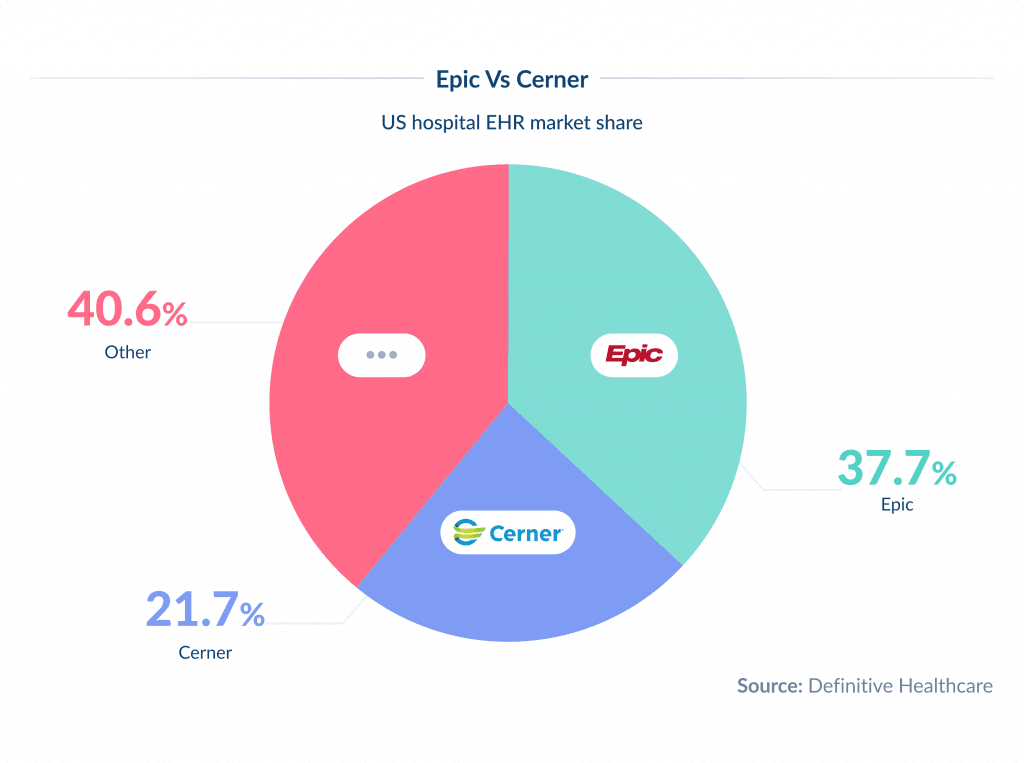
A significant number of the biggest healthcare institutions opt for Epic Software. Nonetheless, Cerner EMR is a favored choice for clinical and outpatient care. Both Cerner and Epic offer very comparable solutions: revenue cycle management, interoperability, mobile access, artificial intelligence, and telemedicine software development to reduce telemedicine software expenses.
However, there are certain areas where their capabilities differ, such as:
- Epic incorporates CRM, while Cerner does not.
- Cerner provides consulting, but Epic does not have this facility available.
- Cerner provides users with real-time data, but Epic does not.
For a more detailed view, here is the Cerner and Epic comparison table:
Feature | Cerner EHR software | Epic EHR system |
|---|---|---|
Target market | Small to mid-sized hospitals, outpatient clinics, and health systems. | Large hospital networks, academic medical centers, and enterprise-level health systems. |
User interface | More flexible and customizable but can be complex. | More structured and standardized, with a cleaner UI. |
Interoperability | Strong focus on interoperability, works well with third-party applications. | Works best within the Epic ecosystem; interoperability with external systems can be challenging. |
Implementation time | Generally faster, with some deployments taking months. | Longer implementation time, often over a year for large organizations. |
Customization | Highly customizable but requires IT expertise. | Less flexible but offers a more streamlined workflow. |
Pricing | Generally lower upfront costs, but variable depending on modules and support. | Higher initial costs, but comprehensive support and training included. |
Market share | Used by over 27% of U.S. hospitals. | Dominates with over 35% of U.S. hospital market share. |
Cloud-based solutions | Offers cloud-based and on-premise options. | Primarily on-premise but has a cloud-based option (Epic Community Connect). |
Population health management | Strong analytics and predictive modeling tools. | More advanced population health features with integrated AI-driven insights. |
Best for | Smaller hospitals, clinics, and health systems looking for cost-effective and flexible EHR solutions. | Large healthcare centers, academic medical centers, and organizations that want a unified EHR system with advanced analytics. |
Comparing Cerner vs Epic: Key Features
Now, let’s explore the key features of Cerner and Epic EHR systems.
Cerner’s Key Features
Cerner has many products, but three proprietary ones are Cerner Millennium, Cerner PowerChart with PowerChart Touch, and Cerner CareTracker.
Millennium is Cerner’s EHR platform that gives clinicians and hospitals real-time access to patient data. PowerChart is an EHR built for clinical workflow acceleration with a patient portal and e-prescribing.
PowerChart Touch is an app that lets clinicians see patient charts on their iPhones or iPads. CareTracker is a point-of-care documentation system for long-term care facilities.
Feature | Description |
|---|---|
| Cloud-based Solutions | Offers a range of cloud-based EHR and health IT solutions tailored to different healthcare providers’ needs. |
| Cerner Millennium® | A comprehensive EHR platform that integrates clinical, financial, and operational data across healthcare systems. |
| PowerChart | An advanced clinical documentation tool that helps physicians and nurses streamline workflows and improve patient care. |
| CareTracker | A solution designed for long-term and post-acute care providers to manage patient records and care plans efficiently. |
| Clinical workflow optimization | Enhances coordination between departments, reducing administrative burden and improving care delivery. |
| Patient engagement tools | Includes portals, mobile apps, and secure messaging for better communication and self-service options. |
| Operational efficiency | Automates administrative tasks, optimizes resource allocation, and improves financial performance. |
Epic’s Key Features
Epic Systems’ products are EpicCare, MyChart, Healthy Planet, Revenue Cycle Management, Tapestry, and Mobile interfaces. These products integrate with a wide range of settings and functions.
EpicCare is the primary EHR product that is designed for physicians and organizations. It focuses on clinical care, decision assistance, and efficient processes. MyChart offers patient engagement features such as family health information.
Other Epic EHR system products are:
- Healthy Planet, which leverages data interoperability to improve population health management efforts.
- RCM software, which assists with patient claims and invoicing
- Tapestry, which handles managed care tasks.
Feature | Description |
|---|---|
| Comprehensive EHR system | Self-hosted Epic EMR is designed to improve patient care, streamline workflows, and enhance data exchange between healthcare providers. |
| EpicCare | A core EHR solution offering clinical documentation, order entry, and decision support tools. |
| MyChart | A patient portal that allows users to schedule appointments, view medical records, and communicate with providers. |
| Hyperspace | Epic’s primary user interface, known for its intuitive design and user-friendly experience. |
| Interoperability & data exchange | Supports seamless data sharing across hospitals, clinics, and third-party systems through Care Everywhere. |
| AI & predictive analytics | Uses machine learning to provide clinical insights, identify patient risks, and enhance operational efficiency. |
| Telehealth & remote monitoring | Integrated virtual care solutions for video visits, remote patient monitoring, and digital check-ins. |
| Revenue cycle management tools(RCM) | Automates billing, claims processing, and financial reporting for improved reimbursement and efficiency. |
| Epic Cosmos | A big data platform that aggregates anonymized patient data to support research and population health initiatives. |
| Mobile & cloud-based solutions | Offers mobile apps for clinicians and cloud-based deployment options for scalability and accessibility. |
| Regulatory compliance | Ensures adherence to HIPAA, FHIR, and other healthcare standards for data security and privacy. |
Cerner vs Epic: Which is Easier to Use?
Epic is like a custom-fit suit — it’s built to be molded to specific workflows and departmental needs. This flexibility is a big plus, but it also means there’s more to learn.
For example, Epic’s “storyboard” feature brings all essential patient information into one place, which can cut down on clicks once you get the hang of it. With some upfront training and setup, Epic becomes a powerful tool tailored just for hospitals and healthcare centers. This is an excellent fit for large, complex healthcare systems that want a solution built around their needs.
Conversely, Cerner is more like an off-the-rack option that is ready to go as soon as you try it on. Its tile-based, modular design is intuitive and easy to navigate, so new users can get comfortable quickly.
The simplicity of Cerner’s layout helps people find what they need without much training or fuss. This approach makes Cerner ideal for smaller facilities or organizations that need something they can implement fast without a lot of setup or customization.
So, which is easier to use: Cerner vs Epic?
While both systems have their complexities, Cerner powerchart ambulatory EHR might be considered easier to start using for beginners due to its simpler initial setup.
However, Epic’s electronic health records system offers a more streamlined and intuitive interface once mastered, despite its steeper learning curve. Ultimately, the choice depends on the specific needs and preferences of the healthcare organization, including the level of technical expertise available and the complexity of workflows.
Cerner vs Epic: Security and Compliance
The healthcare industry is strictly regulated and both Epic and Cerner are highly compliant and secure. So, you should mainly worry about these aspects when choosing a less established system among Epic and Cerner competitors.
When it comes to Cerner and Epic, it is worth noting that these EHR systems meet several regulatory requirements, including HIPAA (learn more about HIPAA-compliant app development), HITECH Act, PCI DSS (for the US), and General Data Protection Regulation (for the EU). Also, they comply with ISO quality standards (such as ISO/IEC 27001:2013 and state-specific regulations like the California Consumer Privacy Act).
Both Cerner and Epic have made substantial capital investments in security features aimed specifically at the healthcare sector. These features include multi-factor authentication (2FA), advanced encryption, and detailed access controls that limit data usage according to user roles. Furthermore, the audit trails feature tracks who accessed data and what changes were made.
These robust security features make these electronic health record systems the top choice for both large enterprises and smaller healthcare organizations.
Cost Analysis
When it comes to EHR implementation, cost is often a decisive factor for many healthcare organizations.
Both Cerner and Epic are known to be quite costly systems. However, their implementation is considered a must-have investment that can help healthcare providers actually improve clinical care outcomes.
Here’s a cost comparison table for Epic vs. Cerner:
Category | Epic EHR Implementation | Cerner EHR Implementation |
|---|---|---|
| Pricing model | Upfront licensing fee + maintenance costs | Subscription-based and per-user pricing options |
| Initial cost | Starts at $1.2M+ for large hospitals | Starts at $30K – $50K+ for smaller practices |
| Implementation cost | Can exceed $100M for large healthcare systems | Typically lower, but varies based on customization |
| Training & support | Included but can be expensive for ongoing training | More affordable, with scalable training options |
| Customization costs | Higher costs for extensive custom workflows | More flexible and cost-effective customization |
| Hardware requirements | Requires robust infrastructure, often on-premise | Cloud-based options reduce hardware costs |
| Total cost of ownership (TCO) | Higher long-term investment, but comprehensive | More affordable upfront, scalable as needed |
Now, you might wonder why these systems cost so much.
Let’s break it up.
Epic EHR System Pricing Model
The Epic EHR pricing model is quite complex and depends on the size and needs of the healthcare organization.
The pricing includes various costs, including software, hardware, and implementation services.
Depending on the size of your healthcare organization, Epic’s licensing fees can cost millions of dollars.
On top of that, customization, integration, and staff training also increase the cost of implementation.
Epic also charges annual maintenance fees, typically around 15-20% of the total software cost.
Mayo Clinic, for example, spent $1.5 billion on its Epic implementation, including software, training, and IT upgrades. This is a modest investment compared to the $764 million spent by NYC Health + Hospitals in its Epic rollout. This wide range of pricing just shows that the company offers flexible pricing options for clients of all types and needs.
Cerner EHR System Pricing Model
Generally, Cerner is considered to be a more budget-friendly option than Epic. This makes Cerner a go-to EHR for mid-sized hospitals and health systems looking for cloud-based solutions.
Adventist Health, for example, spent $83 million implementing Cerner across its network, while Broward Health signed a $144 million contract for its Cerner EHR upgrade.
The main factors that influence the implementation costs are integrations, customization, staff training, and IT support.
Besides cloud-based options, some hospitals choose on-premise Cerner’s solutions, which adds up to the final costs.
Also, annual support and maintenance fees (typically 5-10% of total cost) add to long-term expenses.
Cerner vs Epic: Customer Support
Customer support and satisfaction are key when evaluating EHRs. Both Epic and Cerner are well known for their customer support, but they have different approaches to meet different needs.
Epic is highly rated for customer support, with 95% user satisfaction. Here are some notable testimonials captured on G2:
- The ease of use. Once I learned my way around, it is great how accessible it is.
Plus, Epic has an online resource center with tutorials, webinars, and other educational content to help users get the most out of the system:
- Organization and ability to customize tabs, and most importantly steal productivity tips/smart phrases from my colleagues that allowed me to hit the ground running in my new job.
However, some users highlight that the system might be confusing, complicated, and hard to learn due to numerous updates:
- Sometimes, there are too many options, and it can become convoluted and confusing to find things I need.
- EPIC is difficult to learn as there are so many features and many ways to do things. They also do many updates that change things around, and then it takes a while to get the hang of things again.
According to the G2 reviews, Cerner’s user satisfaction is positive overall:
- Cerner is generally straightforward and easy to use. There are not a lot of hidden things that are difficult to find. It is easy to learn whether or not you have experience working with electronic medical records.
- There are tabs for various departmental results, such as lab, dietary, and pharmacy, so that everything is well organized.
but there are some mixed reviews on the timeliness and effectiveness of support in high-demand situations:
- The functionality of the program could use some work, and the training provided could be better.
- Too many windows to go through to get to information. Have a hard time finding information I need, such as infusion times, orders, etc.
Plus, Cerner has direct support, webinars, tutorials, and on-site training to help healthcare providers get the most out of their Cerner EHR.
Category | Epic | Cerner |
|---|---|---|
| Support availability | 24/7 support for critical issues | 24/7 support for critical issues |
| Implementation support | Dedicated implementation teams, but requires Epic-certified professionals | Offers implementation guidance, often more hands-on for smaller providers |
| Training programs | Extensive but expensive training, requiring Epic-certified personnel | More flexible training options, including online and in-person sessions |
| Response time | Varies based on contract, but known for slow responses to non-urgent issues | Generally responsive, especially for cloud-based solutions |
| Customization support | Requires in-house or third-party Epic-certified professionals for customizations | Cerner provides direct customization assistance, often at lower costs |
| User community & knowledge base | Strong Epic User Group (EUG) with peer-to-peer support | Cerner U.Cern community and online knowledge base available |
| On-site support | Typically required during implementation and major upgrades | Available but less dependent on on-site teams |
| Cost of support | High, with additional costs for extended service contracts | More affordable, with scalable support packages |
| Overall customer satisfaction | Highly rated for reliability but criticized for high costs and complexity | Generally well-rated, especially for ease of use and affordability |
Cerner vs Epic: Integration Capabilities
Cerner’s integration is diverse and robust. They offer multiple ways to integrate with other healthcare systems through Cerner Ignite APIs, Oracle Health Seamless Exchange, and other advanced technologies. This flexibility means Cerner can accommodate many different integration scenarios. Here are some more insights on the EHR integration strategies.
What sets Cerner’s medical records apart is their focus on interoperability. They’ve taken this a step further by partnering with other EHR vendors to create the CommonWell Health Alliance, a not-for-profit industry trade association. This initiative provides standards and policies for sharing and accessing patient data so Cerner users can easily share with other healthcare providers.
But Cerner doesn’t stop there. With over 50 third-party integrations available, users have many options to connect to other healthcare systems and applications. This broad integration capability makes the platform more versatile and applicable to more scenarios.
For example, Cerner users can use Reference Lab Networks to send data to multiple acute and reference labs without setting up connections to each lab individually. This saves time and ensures seamless data transfer. With Reference Lab Networks, the hassle of setting up separate connections to different labs is eliminated and healthcare professionals can focus on delivering efficient care.
Epic EMR is no slacker when it comes to integration. They have their own integration platform called Epic Bridges, which allows seamless data exchange between Epic and other systems.
Epic also supports industry standards like HL7 and FHIR APIs, making it easier to integrate with third-party applications and systems. Epic follows industry standards, so they can work with many healthcare solutions. Epic may not have as many third-party app integrations as Cerner but they have partnered with other healthcare organizations and initiatives to promote interoperability and data sharing even for non-Epic users.
For example, non-Epic providers can access patient information from Epic EHR as easily as using Google Drive with EpicCare Link. And Epic is also part of the Carequality network which connects many EHRs across the country, so Epic users can share and access patient data from many healthcare providers. 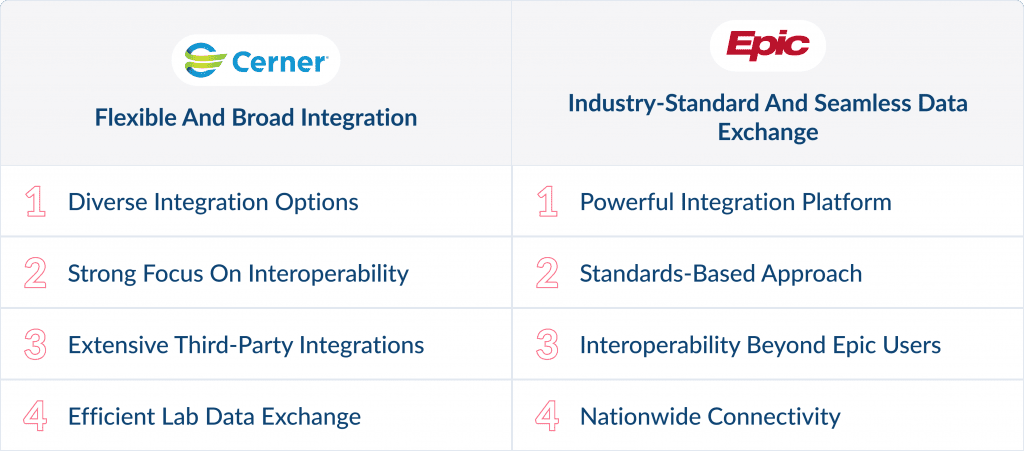
How Cerner and Epic Introduce Emerging Technologies
Both Cerner and Epic EHRs are introducing emerging technologies to enhance clinical workflows, improve patient care, and support advanced healthcare data analytics.
Cerner EHR, for example, introduced its Oracle Health Clinical AI Agent in 2025. This AI-powered voice recognition technology records essential information from the doctor-patient meeting. It then uses this information to understand the situation and enter a preliminary note into the Oracle Health electronic health record (EHR). This enables the doctor to quickly review and approve the clinical notes that were created.
In 2022, Oracle moved most of its Cerner customers to the cloud. The company says this move is going to save money and improve data security. Cerner’s Ignite API facilitates robust data interoperability, enabling seamless integration with various healthcare applications and services. This enhances collaboration and data exchange between providers.
Epic EHR is also actively implementing AI into its hospital management system. It has integrated AI-driven analytics to analyze vast datasets for early detection of conditions like sepsis in ICU patients. This improves response times and patient outcomes.
On top of that, Epic has partnered with Microsoft to leverage GPT-4 to reduce administrative burdens. The company has also released an open-source AI validation tool to help health systems validate AI models integrated with EHRs.
Overall, both Cerner and Epic are leveraging emerging technologies to improve data management and enhance operations. 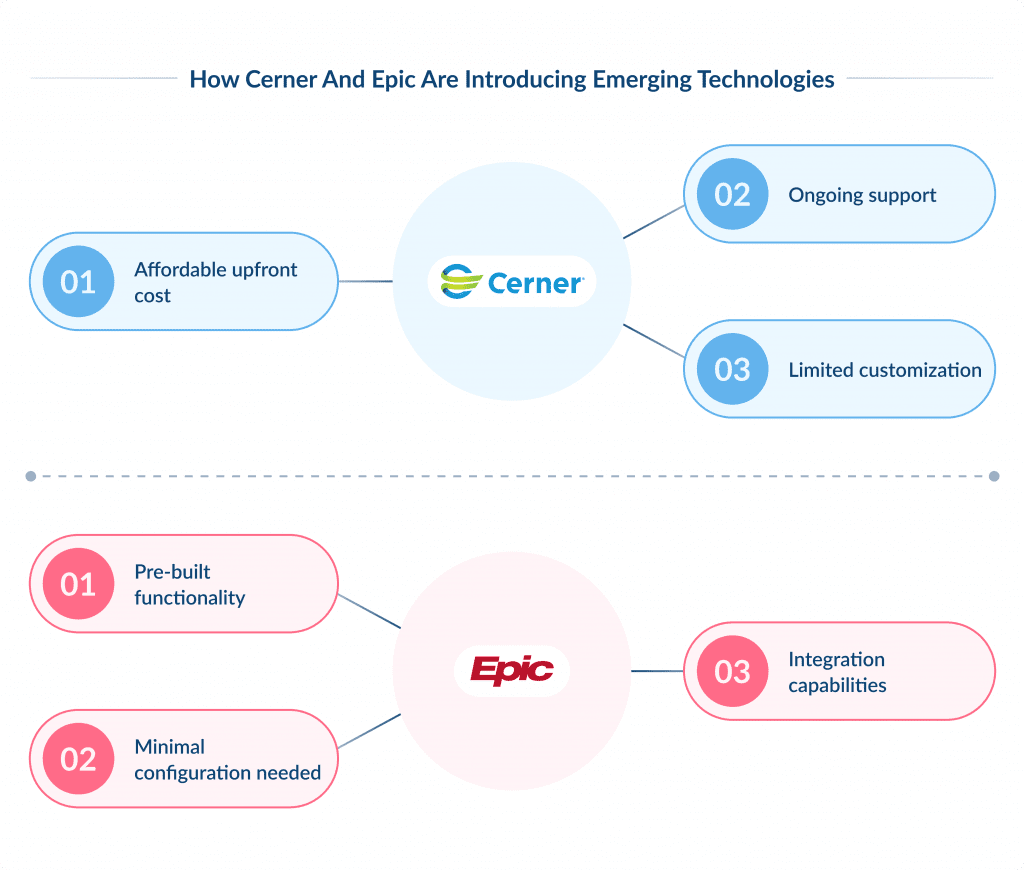
Cerner vs Epic: Which One Do You Choose?
So, what system wins in this Cerner vs Epic battle? Epic or Core Cerner EHR?
The answer is — it depends. There really is no simple answer, to be honest. When choosing an EHR system, healthcare organizations need to consider several factors, including cost, software functionality, and scalability.
Cerner and Epic are both popular EHR systems, but they have different strengths and weaknesses. Epic is the best choice for large hospital systems with significant resources and a need for robust interoperability. Cerner is a better fit for smaller healthcare providers looking for a cost-effective and adaptable solution.
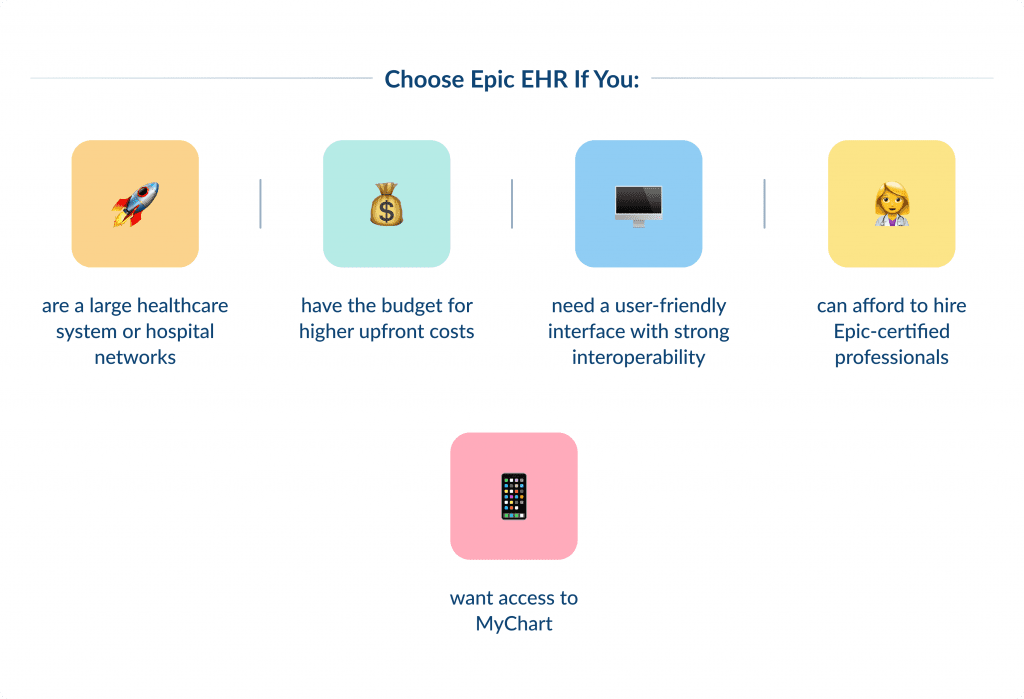
Choose Epic EHR if you:
- are large healthcare systems or hospital networks that need a highly scalable, integrated EHR solution.
- have the budget for higher upfront costs and ongoing maintenance.
- need a user-friendly interface with strong interoperability for seamless data exchange.
- can afford to hire Epic-certified professionals for implementation and maintenance.
- want access to MyChart. Epic charting is a well-regarded patient portal with strong engagement features.
Choose Cerner EHR if you:
- are a small to mid-sized healthcare facility looking for a more affordable EHR option.
- need a cloud-based, flexible solution that allows for easier updates and scalability.
- want faster implementation with more direct vendor support.
- require strong population health management tools and analytics.
- prefer a system that offers more customization without requiring a certified IT team.
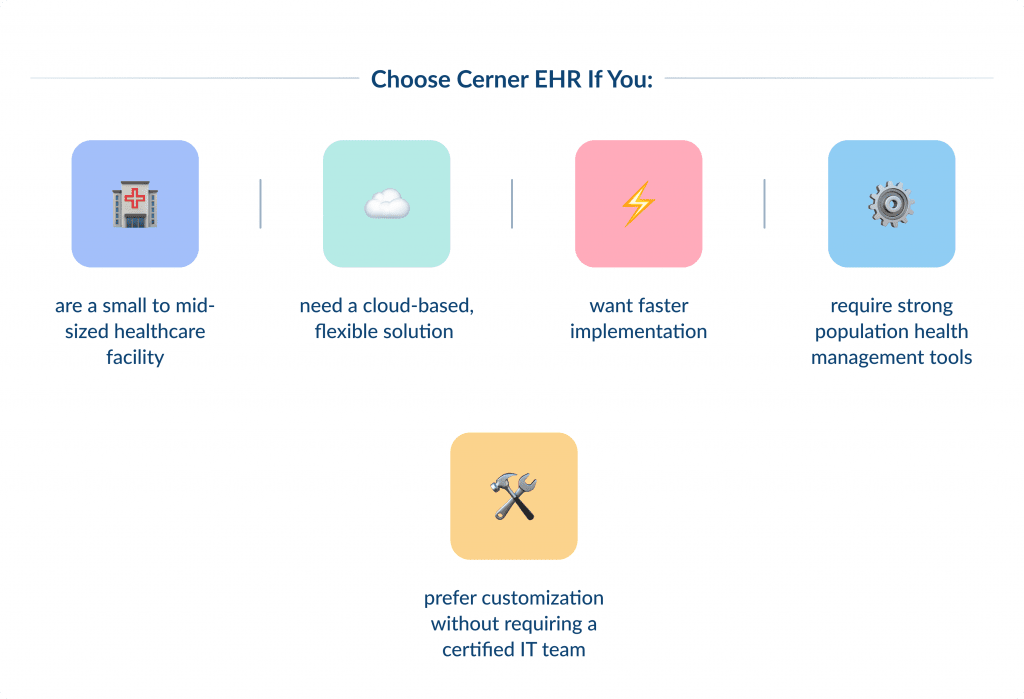
Overall, you need to evaluate your organization’s needs and choose an EHR system that meets those needs.
Our Experience With Custom Healthcare Software Development
SpdLoad is a healthcare digital transformation consulting company specializing in developing and implementing EHR/EMR systems.
We also have expertise in modernizing EHR and EMR systems, alongside data migration from EHR for medical, telemedicine, and remote care organizations. We have been working with numerous clients to help them enhance clinic workflow and attract more patients through effective and user-friendly healthcare software solutions.
One of the projects we have been working on is this custom CRM for dental clinics. This is a complex CRM system for a small size network of dental hospitals. It is designed to rapidly scale business, cut operational costs, and improve the quality of services.
The client was flooded with paperwork and it slowed down the work. On top of that, keeping and storing is costly, the access to images was limited, and all images that are older than 6 months were lost. This caused inconveniences for both patients and healthcare providers. The digital solution could solve this. Hence, he reached out to our team.
We started off with the discovery phase, where our team analyzed the customer and existing business processes to create a value-centered system and show the Return on Investments for stakeholders.
We decided on the core features and were able to share our insights with stakeholders to get a reasonable development budget. At the development stage, we developed the platform according to planned sprints.
Key deliverables included:
- An advanced system of collecting 3D X-Ray images and scalable cloud storage
- A custom administration panel to track the core KPI and analyze sales funnels. Including the layout of a doctor, a hospital and a network
- A custom scheduling tool to book appointments with a doctor
- Right-to-Left design implementation
As a result, the client received a comprehensive CRM that met their needs and goals while taking in budget.
If you are looking for software development services to develop a modern healthcare solution, feel free to reach out. We can schedule a brief meeting and discuss your project requirements, costs, technology required, and much more.