Healthcare Data Analytics and Its Role In Patient Outcomes
- Created: Aug 28, 2025
- 8 min

CEO
Consumer-centered services are on the rise now. And the healthcare industry is no exception.
Nowadays, healthcare organizations and healthcare professionals must adapt to higher consumer standards to remain competitive in the market and improve health outcomes.
In this context, big data analytics will play a prominent role as it can help healthcare providers streamline their operations.
With this emerging technology, healthcare professionals will be able to reshape patient health care and facilitate predictive modeling in the future.
At SpdLoad, we have always been interested in innovation in healthcare since healthcare software development services are one of our key areas of expertise.
If you are thinking of introducing healthcare data analytics software, we are here to help you out.
This short guide shares practical insights for healthcare data analysts, data scientists, and healthcare managers. We will explore the importance of data analysis in healthcare and its role in treatment strategies.
But before diving in, let’s identify what is healthcare data analytics.
Get a strategic MVP to mitigate risks.
What Is Data Analytics In Healthcare?
Data analytics is used in multiple industries to analyze raw data and make informed decisions based on the insights provided.
For example, insurance businesses use insurance data analytics software and tools to optimize their performance, automate claims processing and underwriting, and increase profits.
So, what is data analytics exactly?
Data analytics relies on a variety of software tools, including spreadsheets, data visualization, reporting tools, data mining programs, and open-source languages.
Healthcare organizations utilize data analytics to identify trends, patterns, and insights and use the results to make more informed decisions.
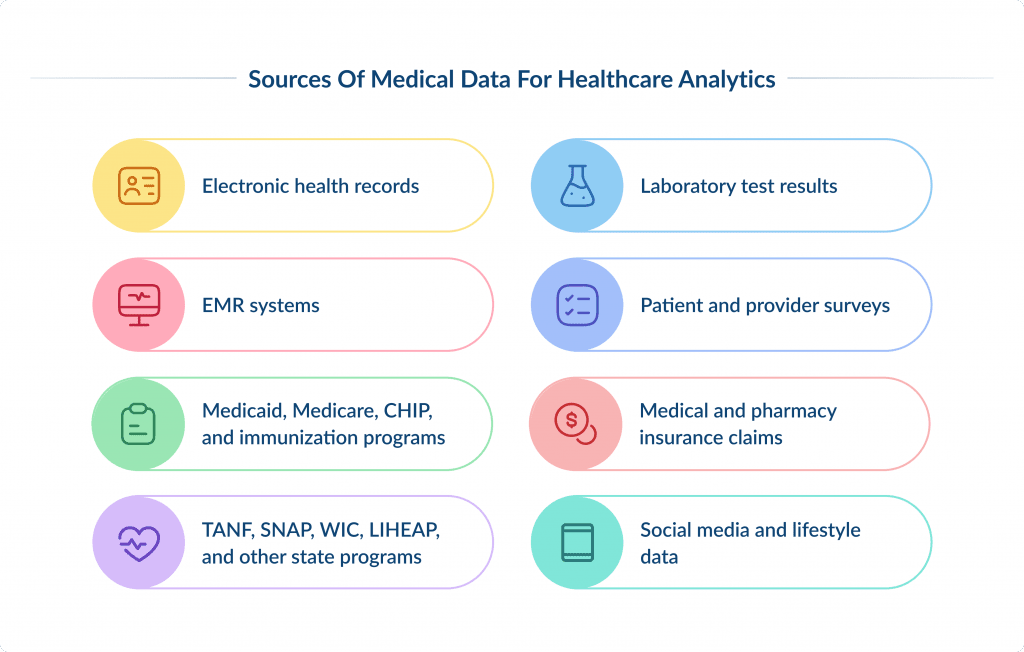
This data can come from a variety of sources, including:
- Electronic health records (feel free to check out our guide on how to build EHR software)
- EMR systems (here’s everything you need to know about EMR system development)
- Medicaid, Medicare, CHIP, and immunization programs
- TANF, SNAP, WIC, LIHEAP, and other state programs
- Laboratory test results
- Patient and provider surveys
- Medical and pharmacy insurance claims
- Social media and lifestyle data
Some of the most popular EHR systems in the US are Cerner and Epic. In this Cerner vs Epic guide, we compare both systems, covering their prices as well as pros and cons for a comprehensive overview.
Types Of Healthcare Data Analytics
In healthcare, data analytics is broken down into 4 main categories: descriptive, diagnostic, predictive, and prescriptive analytics.
Let’s explore them further.
Descriptive Analytics
As the name implies, descriptive data analytics describes what has happened during a certain time.
This is the simplest type of medical data analysis. It looks at historical data and reports on it.
For example, healthcare management teams can use descriptive analytics to figure out how contagious a virus is by looking at the number of positive tests in a certain time period. Or when a hospital is busiest.
By reviewing past admission data, clinics can staff up during peak times and ensure that everyone gets seen without overexerting staff.
Diagnostic Analytics
Diagnostic data analytics is like detective work.
Like descriptive analysis, diagnostic analysis examines past data, but instead of asking “what,” it asks “why.”
It gets to the root of the problem, and this insight helps healthcare providers make better decisions.
For example, diagnostic analytics can be used to drill down into specific symptoms, find patterns, and diagnose patients faster.
A clinic sees many patients coming back after being treated.
Diagnostic analysis of historical clinical data can highlight the main reason – perhaps new symptoms, wrong medication prescription, or human error in treatment.
Predictive Analytics
In predictive data analytics, health data analysts use data science techniques like data mining, statistical modelling, and machine learning to look into the future. Here are more insights about predictive analytics in healthcare, its main benefits, and limitations.
This work uses clean, sorted, and structured historical data to train models and define patterns and trends.
Some examples of how does data analytics help healthcare include:
- Calculating the probability of certain complications
- Assigning risk scores for a condition to specific patient groups
- Identifying the likelihood of hospitalization
- Predicting the number of patients who will choose home therapy over a clinical stay
- Forecasting average revenue per patient visit for the next month or quarter
- Planning for the number of extra staff for the winter season
Prescriptive Analytics
While predictive data analytics tries to describe the future, prescriptive analytics tells you what to do in that scenario.
By diving into predictive data, data analytics specialists determine what can be changed for the better and come up with prescriptions for good outcomes.
This level of analytics allows you to make recommendations on healthcare delivery and process optimization.
In a hospital, prescriptive analytics can suggest the best treatment for patients based on what worked in the past.
Prescriptive analysis can also recommend optimal staffing levels, advise on advanced hygiene measures before seasonal outbreaks, suggest when home treatment is better than hospital admission, and more.
Both predictive and prescriptive data analytics unlock your organization’s data to get you into a world of precision, efficiency, and patient-centric care.
Simpler systems may only enable one or two of them, while the most advanced solutions often combine all four. 
Why Is Data Analytics Important in Healthcare
There are multiple benefits of using data analytics solutions for healthcare organizations.
Among them are data-driven insights, better flexibility, cost-efficiency, enhanced patient data security, and improved health data sharing and management. Further, we dive into some examples of data analytics in healthcare and the potential benefits it can bring for the healthcare sector.
Data-Driven Insights
According to this research on the Use of Big Data Analytics in Healthcare, utilizing big data enhances the accuracy of diagnoses.
Health care providers can tailor treatments to individual patient characteristics. They can analyze vast datasets from electronic health records (EHRs), genomics, and wearables.
Big data for healthcare also means more accurate diagnoses, more comprehensive treatment plans, and improved use of predictive analytics.
Flexibility and Cost-Efficiency and Flexibility
McKinsey’s report on the Big Data Revolution in US Healthcare highlights that healthcare providers can save approximately 12% to 17% of total healthcare costs by using big data.
Additionally, the HIMSS Analytics survey on digital health transformation notes that 83% of healthcare providers have already turned to the cloud for their operations, as it offers the cost-efficiency they need.
Healthcare analytics tools range from medical billing software to resource allocation, supply chain management, and everything in between.
All these tools can identify bottlenecks, provide actionable insights, streamline operational efficiency, and reduce unnecessary costs.
Another benefit of using cloud data analytics in healthcare industry is flexibility.
Use of data analytics in healthcare ensures that organizations can adapt their infrastructure based on evolving operational needs and pay for only what they use. 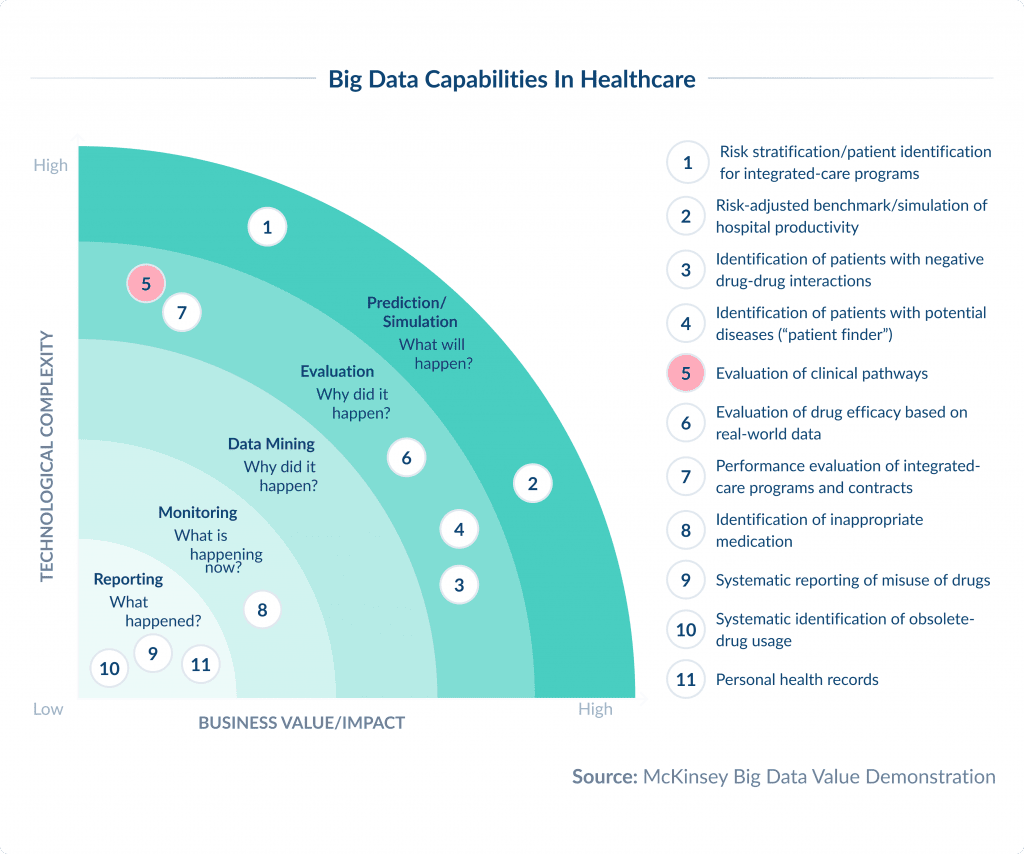
Enhanced Security
In the context of patient care, data analytics is particularly valuable because it supports compliance with privacy regulations like HIPAA.
It helps organizations maintain the confidentiality, integrity, and availability of sensitive health information by preventing breaches that could compromise patient data, including through secure data pipeline ETL processes.
This approach not only enhances security but also builds trust with patients and stakeholders.
The study on the role of predictive analytics in cybersecurity explains how predictive analytics helps stop security issues before they happen. It analyzes past data, like previous breaches or suspicious activity, to predict where new threats might appear.
Using tools like machine learning and neural networks can make these predictions more accurate.
The health care data analysts believe predictive analytics is a game-changer in cybersecurity.
Improved Health Data Management
The same report from McKinsey we’ve mentioned above estimates that big data can potentially help the US healthcare system save a staggering $300 billion annually by improving the efficiency of healthcare operations.
Healthcare analytics allows for comprehensive health management by evaluating large amounts of data from various institutions (clinics, labs, insurance firms) and sources (EHRs, records, wearables, and telehealth systems).
Once datasets have been merged, cleaned, and formatted in an AI-ready format, healthcare organizations may identify at-risk citizens, devise tailored interventions, and allocate resources where they are most needed.
Future Of Data Analytics In Healthcare
Like in many other industries, there is a bright future for data analytics in healthcare. The COVID-19 pandemic has contributed significantly to this.
During the pandemic, when millions of people around the world required healthcare for treatment of the virus, healthcare organizations have used data analytics to manage the global health crisis and treat patients better.
In the end, there will always be a need for value-based patient care.
Health care data analytics not only improves patient care but also population health management.
Population health management is the process of improving the clinical outcomes of a group of people through better care coordination. Patient engagement is also part of this process.
Healthcare data analytics can help with population health management. How? By allowing data scientists to build predictive AI models.
These models enable healthcare organizations to manage initiatives for specific populations.
This is done by identifying the healthcare system’s most vulnerable patients.
Then, organizations can do outreach and interventions to improve patient care and further refine the AI model, according to the article in the Health Catalyst journal.
As AI advances, so does its potential in medicine. Learn how AI and healthcare are shaping the future.
Market-Available Vs. Custom Healthcare Analytics Software
There are many analytics platforms that healthcare organizations can utilize.
However, as our experience shows, having custom health care data analytics software tailored to unique corporate workflows, needs, and regulatory requirements is a much better choice.
Let’s compare market-available vs custom healthcare analytics software.
Feature | Market-Available Software | Custom Healthcare Analytics Software |
|---|---|---|
| Cost |
|
|
| Implementation Time |
|
|
| Customization |
|
|
| Scalability |
|
|
| Integration |
|
|
| Support for Regulations |
|
|
| Data Ownership |
|
|
| Updates and Maintenance |
|
|
| Analytics Capabilities |
|
|
| Vendor Lock-In |
|
|
Explore our SaaS services today
Final Words About the Importance of Data Analytics in Healthcare
Healthcare and data analytics go hand in hand when it comes to personalized medicine and data-driven decision-making.
So, how is data analytics used in healthcare? As we’ve explored here, healthcare data analytics helps doctors and hospitals deliver better care. It spots health issues early and tailors treatments to each patient.
It also cuts costs by preventing unnecessary procedures and making sure resources are used wisely. Plus, it helps healthcare systems keep communities healthier and run more smoothly.
That is why choosing the right healthcare analytics software is crucial for successful implementation.
If you are looking to choose a software development company that will help you build a healthcare data analytics solution, the SpdLoad team is here for you.
In over 10 years in software development, we have been working with multiple health care organizations, developing telemedicine apps, EHR and CRM systems, mental health platforms, and much more.
Our Agile discovery process helps us develop solutions that can outshine your competitors and help you reach your business goals.
Reach out to us today, and we will get back to you in less than 24 hours and schedule an intro call to discuss data analytics and healthcare.