What is Digital HR Transformation & How It Works
- Updated: Mar 18, 2026
- 15 min

Head of Recruiting
In SpdLoad, we provide HR software development services. We build digital HR solutions to create personalized employee experiences. And one thing we have noticed in the last five years is that many companies update their HR practices and implement various HR software solutions into their workflows.
Basically, every HR process is now digitized. HR professionals implement AI tools to screen candidates and offer flexible work conditions. Plus, tools like employee recognition programs and employee wellness solutions help companies create a better space where people are valued and appreciated.
This shift toward digital rather than in-person communication between a company and an employee is a new reality. And, surprisingly, the HR digital transformation has proven to bе more effective than manual processes.
But the question arises: will the HR technology dehumanize HR? Or is this just another logical step in the HR evolution towards being more accessible and tailored to individual needs without losing the human touch?
Here, I try to figure it out.
Contact us to get started!
What is Digital HR Transformation
IBM identifies digital HR transformation as the process of moving from manual, paper-based HR practices to digital ones. It happens through the adoption of new technologies, data analytics, and automation. They highlight that HR digital transformation means more in the context of HR practices:
… digital HR represents more than a technological upgrade; it fundamentally changes how organizations attract, develop, engage and deploy talent to create business value.
HR digital transformation strategy is often a part of a wider corporate transformation policy where companies integrate technology across all departments to enhance efficiency and drive overall business growth.
Key components of the HR digital transformation include:
| Component | Description | Benefit |
|---|---|---|
| Strategy & leadership | Sets vision and aligns digital efforts with business goals | Better focus, innovation, and adoption |
| HR technology | Implements digital tools (cloud, AI, automation) for HR functions | Increased efficiency and reduced manual tasks |
| Innovation | Fosters experiment-driven culture and agile HR solutions | Adaptability and continuous improvement |
| HR processes | Redesigns HR processes with automation and digitalization | Saved time, reduced complexity, and improved accuracy |
| People | Upskills HR team for digital competencies, change management | Successful adoption and collaboration |
| Data & analytics | Uses integrated sensitive employee data for decisions and predictive insights | Data-driven HR strategy and planning |
When Did Companies Start to Implement Digital HR Transformation
Some of the first companies to implement digital HR transformation were industry leaders like LEGO and Google.
In 2008, LEGO centralized its HR applications with a digital system and became a pioneer in the digitalization of the HR function.
In 2016, the management team felt the company was not done with the transformation. They had built an enterprise infrastructure to support digital solutions, but the company was not a digital-first organisation.
One of the first things they did was to streamline decision-making by removing silos and reducing the number of overseeing boards.
Another example is Google. Its HR team, led by executives like Laszlo Bock, was among the first to embrace HR analytics and reporting solutions.
They promoted data-driven hiring and talent management strategies. The company started to implement digital tools to boost output, encourage innovation, and establish a dynamic workplace culture.
But the real popularity of HR tools happened during the pandemic, when work from home became a new common practice.
Companies faced urgent challenges in managing distributed teams, communicating effectively, onboarding new hires virtually, and maintaining employee engagement at a distance.
This led to a rapid increase in the use of cloud-based HR management systems, virtual collaboration tools, digital onboarding solutions, and advanced analytics platforms.
Everyone, including us, started to implement digital HR strategic initiatives to make all this software work as it should.
HR Digital Transformation Strategy: What is It & How Does It Work
HR digital transformation is basically a plan that integrates digital technologies, data, and processes to optimize HR functions.
Other goals of digital HR strategy include improving employee experience and helping achieve business goals. A successful strategy makes HR more agile, data-driven, and employee-centric.
How Does HR Digital Transformation Strategy Work
AIHR identifies three main components that drive HR digital transformation. These include:
Digital users
Equip HR teams and employees with digital skills, awareness, and access to the right tools for everyday tasks.
Digital integration
Connect disparate HR systems and data sources to enable centralized management and analytics for workforce planning and decision making.
Digital experimentation
Encourage an agile approach where new HR technologies and processes are piloted, iterated, and scaled based on outcomes and user feedback. 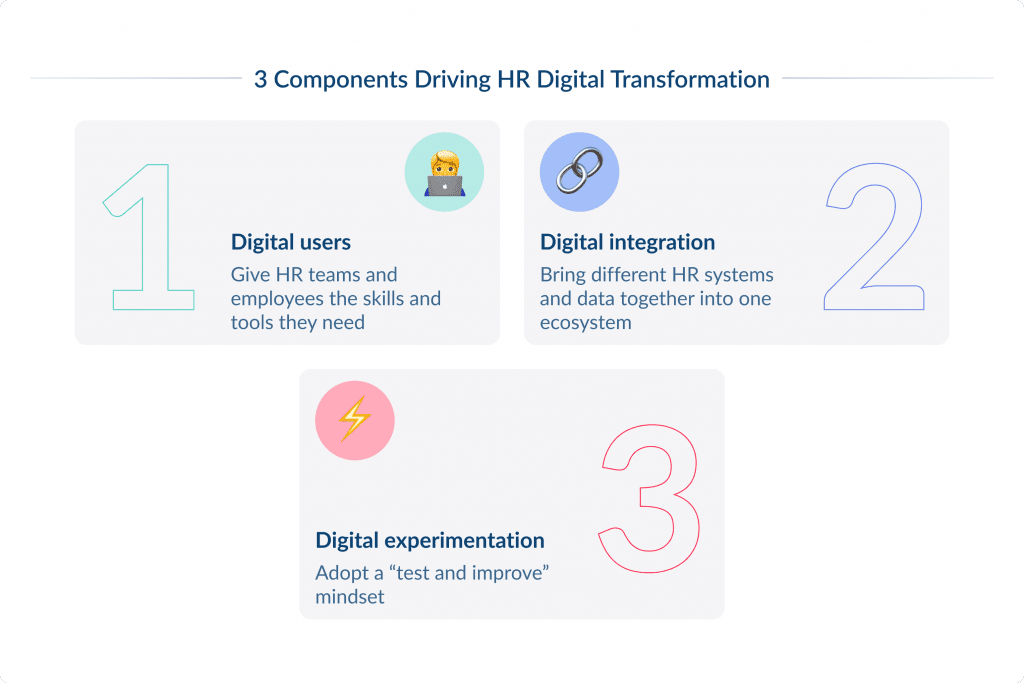
Example of an HR Digital Transformation Strategy
This is an example of an HR digital transformation strategy. It might differ from company to company, but the core components and steps are:
| Step | Action | Objective/Metric |
|---|---|---|
| 1. Assess HR maturity | Evaluate current HR systems, process gaps, skills, and stakeholder pain points | Map maturity, define baseline |
| 2. Set objectives & KPIs | Establish SMART goals (e.g., reduce time-to-hire by 20%, increase tool adoption) | Clear targets for efficiency, engagement |
| 3. Identify initiatives | Select projects like process automation, self-service portals, AI pilots, analytics | Focus on high-impact priorities |
| 4. Prioritize & sequence | Plan quick wins and long-term projects with an impact-effort assessment | Minimize disruption, optimize resources |
| 5. Change management | Engage stakeholders, provide training, and communicate benefits | Support adoption and sustained change |
| 6. Execute & monitor | Roll out initiatives in phases, track KPIs, and refine approach | Continuous progress tracking |
| 7. Review & optimize | Conduct quarterly reviews, analyze feedback, and realign initiatives as needed | Ensure lasting transformation |
How to Align HR Digital Transformation with Business Objectives
Jesper Diget, Group Chief People Officer at emagine Consulting A/S, says:
When you think of HR, people think about recruiting talent and creating a happy workforce, but I believe HR holds the key to many elements of business performance.
And I can’t agree more, because when HR is done right, it directly impacts the company’s growth. But how do you align the HR goals with the company’s objectives?
This requires a strategic, unified approach that will make sure that digital HR efforts drive meaningful impact on critical aspects such as workforce productivity, talent management, and overall business success. HR leaders and the corporate board should work together to:
- Review succession plans quarterly so leadership gaps don’t catch the company off guard.
- Use employee survey data at board meetings to spot culture issues before they impact retention.
- Tie compensation structures to long-term goals (like innovation or sustainability) rather than just short-term financial metrics.
- Invest jointly in reskilling programs so the workforce is ready for shifts in technology and market demands
These KPIs reflect how effectively HR digital initiatives contribute to business performance and employee experience. Here are key business KPIs influenced by HR digital transformation:
| KPI | Description | Why it matters |
|---|---|---|
| Employee satisfaction scores | Measures employee happiness and engagement with tools | High satisfaction correlates with retention and productivity. |
| Automation adoption rates | Percentage of HR tasks/processes automated and utilized | Indicates efficiency gains and user acceptance. |
| Digital training completion rates | Tracks the completion of upskilling on new digital platforms | Reflects workforce readiness for new tech. |
| Time saved through automation | Quantifies time reduction in HR workflows | Shows operational efficiency and cost savings. |
| Workforce analytics utilization | Usage of data analytics for decision-making | Drives data-informed talent and business strategies. |
| Time to hire | Speed of filling positions | Affects organizational agility and costs. |
| Employee turnover rate | Rate of employee departures | Impacts cost, morale, and retention strategies. |
| Quality of hire | Performance assessment of new recruits | Links recruitment process to business outcomes. |
| Cost per hire | Average cost for recruiting new employees | Helps optimize recruitment spending. |
Change Management and Its Role in HR Digital Transformation
In HR digital transformation, change management is the disciplined framework for managing the human transition required to achieve the desired business outcomes of a new technology.
It’s the critical bridge between the technical implementation of a system and the actual realization of its value. A new platform is just software. Its ROI comes only when people adopt it, use it correctly, and integrate it into their daily workflows.
Think of it in three layers:
The Individual Level
This is about the person using the system every day. A new HR platform won’t help if employees don’t know how to use it or don’t see why it matters. Here, the goal of change management is to build awareness and show the benefits for each employee and business leader.
If your company rolls out a new performance management tool, employees need to understand how this tool helps them plan their career growth and reduce repetitive paperwork. Without that understanding, they might resist using it.
The Organizational Level
Even if individuals are ready, the organization itself must adapt to make the new technology work. This means adjusting processes, roles, reporting lines, or incentives to reinforce the new system.
If the tool automates time-off requests, HR might need to update approval workflows, redefine who approves what, and change reporting metrics. Without these structural changes, employees might bypass the system, and the organization won’t capture the expected gains.
The Cultural Level
This is the deepest and often most challenging layer. Successful HR digital transformation can require a shift in mindset and behaviors across the organization. This can mean moving from old habits and practices to a culture that embraces change and innovation. That might be hard to do.
If people at your company are used to working alone and getting credit for their own results, a system that encourages sharing information and working as a team won’t work well on its own. The culture needs to change so that teamwork and openness are recognized and rewarded. Change management helps guide this shift, making the new system feel natural in everyday work.
If you don’t manage the people side of change, new HR technology can fail. Employees might not use it, and the company won’t see the benefits it hoped for. An effective change management plan focuses on both people and processes, helping the technology actually work in real life and deliver better experiences. 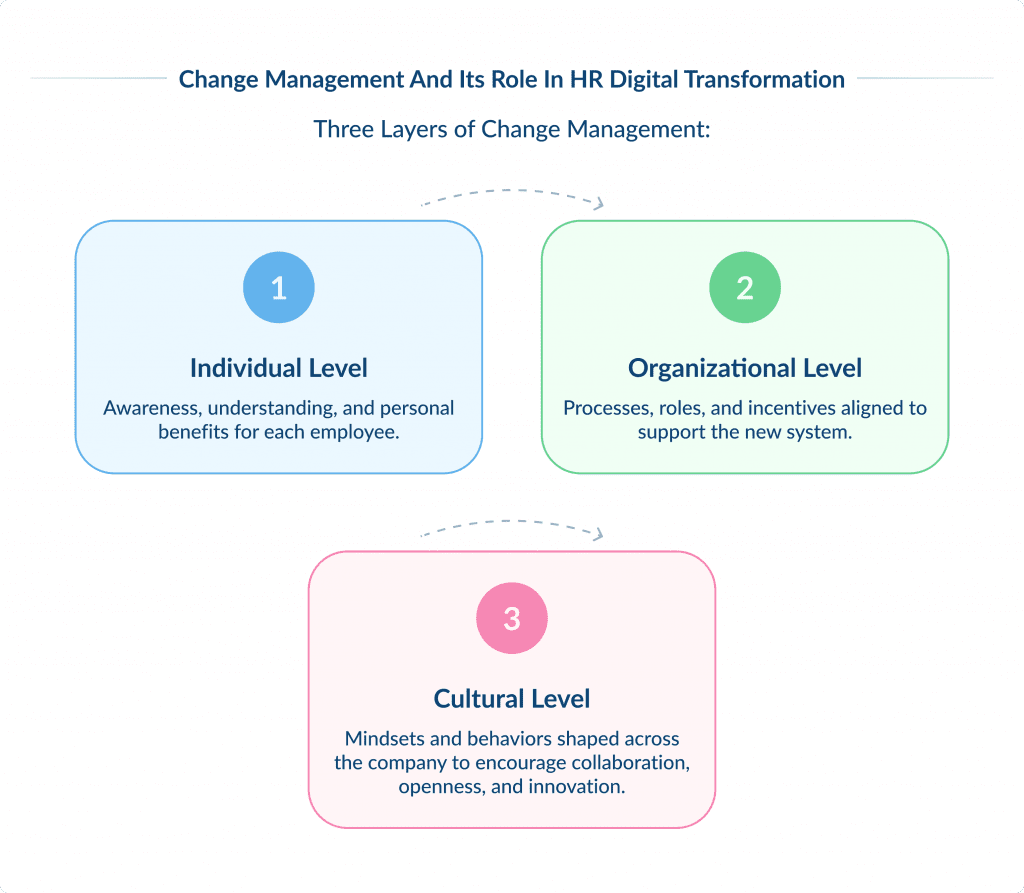
Examples of Digital Transformation in HR Operations
Here are concrete examples of digital transformation in HR, moving from traditional, manual processes to modern, integrated, and data-driven experiences.
1. AI-Driven Talent Acquisition
Earlier, recruiters manually sifted through hundreds of emailed resumes for every job opening.
An AI-Powered Applicant Tracking System (ATS) automatically parses resumes, scores candidates based on skills match, and even uses chatbots to schedule initial interviews. This reduces time-to-hire and helps remove unconscious bias since the system is focused on qualifications first. The final decision is still taken by the human, but it is data-backed.
2. Personalized Digital Onboarding
New hires used to spend their first day filling out stacks of paper forms and watching generic orientation videos. It wasn’t very productive, as the person wasted time on tasks and activities that are not related to their job description. Sometimes, it still happens.
I’ve heard many stories when new hires were just left on their own on their first work day to watch some intro about the company or go through the corporate website to “get into what we’re doing here”.
But this is not what onboarding is for. In my mind, the goal of onboarding is to help the new employee start their new role as seamlessly as possible and start communicating with new colleagues right away. This way, they get to work within 1-2 days or even hours, depending on the roles. And HR digital transformation can help here.
For example, a digital onboarding solution can be used to create a personalized onboarding checklist. Before day one, they complete digital paperwork, receive equipment, and meet their team virtually. The system automatically triggers tasks for IT, facilities, and the manager. All together, it creates a seamless and engaging first experience.
Here is an example of how they do employee onboarding on Deel: 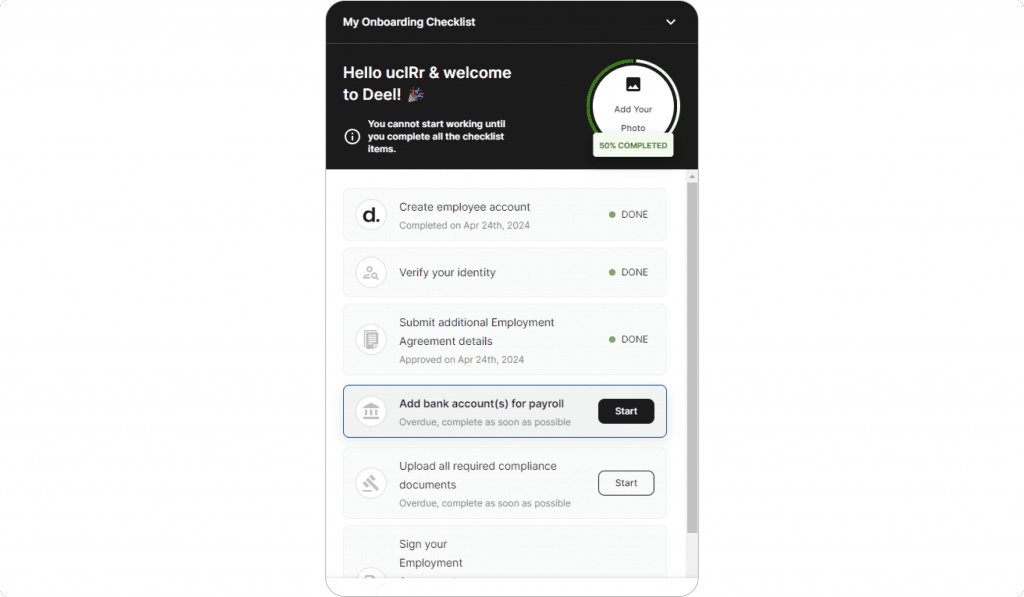
3. Employee Learning & Development
The common problem with employee training and development programs is that many of them are one-size-fits-all training sessions on a fixed schedule. You can’t skip those as they are mandatory, even if the schedule doesn’t fit you. As a result, you’re swapped with work tasks plus training activities, and the effectiveness of such sessions is pretty questionable.
In fact, Hermann Ebbinghaus’s research shows that people forget an average of 50% of new information within an hour and 70% within 24 hours if the training is a one-time event without reinforcement. This makes one-off, mandatory sessions highly ineffective.
Digital transformation efforts can change that. For example, a learning experience platform uses AI to recommend personalized learning paths (short videos, courses, articles) based on an employee’s role, career goals, and skill gaps. This way, learning becomes continuous and directly tied to career development.
4. Performance Management for Continuous Feedback
If you are an HR professional, one of the most hated tasks for you (probably) is annual employee reviews. You have to complete lengthy annual review forms once a year, covering a full year’s worth of work, which often relies on vague recollections rather than concrete HR data.
Plus, the goals and plans you need to cover may have become irrelevant months ago. The feedback feels outdated and disconnected from current priorities, but it’s a time-consuming task that has to be done.
There is a better way to do that. Performance management systems are created for real-time feedback, peer recognition, and regular check-ins via mobile apps. You can update goals (OKRs) regularly to align individual work with company objectives and current business processes.
5. AI-Powered HR Self-Service
One of the most tedious tasks in the HR department is answering the same basic questions over and over. You spend your day at the information desk, responding to emails about pay stubs, vacation balances, or how to update a mailing address.
This constant interruption pulls you away from strategic work. It also leads to delays for employees, who just want a simple answer but have to wait for you to be available.
There is a better way to do that. Modern HR service platforms use an AI-powered chatbot to provide instant answers to these common questions. Employees can ask “How much PTO do I have?” at any time and get an immediate, accurate response. For complex issues, the system automatically routes a ticket directly to the right HR specialist, streamlining support for everyone.
6. Workforce Analytics: From Gut Feel to Strategic Insights
As an HR and recruiter, I can’t deny the power of gut feel. Sometimes it really helps to choose the best candidate and build lasting relationships with employees. But HR is about data, and we can’t solely rely on our intuition, even if we have trained it well.
Traditionally, you’re stuck reporting on basic metrics like headcount and monthly turnover. These reports describe the past but offer little guidance for the future. It’s hard to prove your impact or get a seat at the strategic table.
There is a better way to do that. People Analytics platforms integrate data from recruiting, performance, and engagement surveys. This allows you to move from describing problems to predicting and solving them. You can identify which employees are flight risks, understand the traits of your top performers, and model the ROI of a new retention bonus, finally making HR a true data-driven partner to the business. 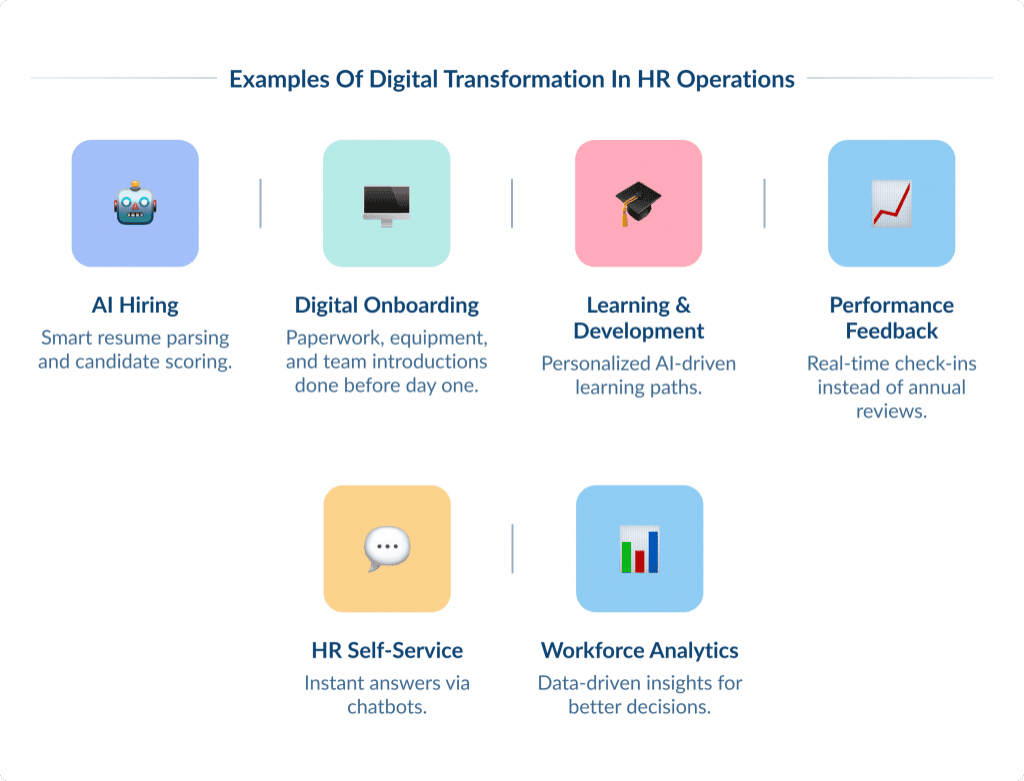
Employee Experience and Engagement in HR Digital Transformation
How do we keep employees engaged and genuinely interested with all those tools and AI chatbots? This is a question that came to my mind when I was researching for this article on HR digital transformation. The answer is: we should still keep the human touch and find the balance between software and real interactions.
True engagement happens day-to-day. It’s about:
- Giving people the right tools to do their jobs without frustration.
- Making them feel heard and valued.
- Providing clear paths for them to learn and grow.
When we get this right, people are more productive and more likely to stay.
We often buy new HR software to save time on admin tasks. But we can also use it to directly boost engagement. The tools we give our employees shape how they feel about their work.
Stop thinking of digital tools as just a way to cut costs. Start using them as a way to build a better work environment. When you make an employee’s daily life easier and more rewarding, you build real engagement.
Checklist: Choosing Software for HR Digital Transformation
This is basically a summary of all the points highlighted above. For convenience, let’s break down the process into three stages:
Phase 1: Foundation & Self-Assessment (Before Looking at Vendors)
- Clearly articulate the specific business problems you are trying to solve. It can be something like “reduce time-to-hire by 30%” or “improve employee engagement scores”.
- Document your existing HR workflows. Identify clear pain points, bottlenecks, and areas for improvement.
- Establish a cross-functional committee. A dedicated digital transformation team should include key stakeholders from HR, IT, Finance, and representative business unit leaders.
- Determine total budget for licensing, implementation, training, and ongoing support. Differentiate between must-haves and nice-to-haves.
- Decide how you will measure ROI. These can be efficiency gains, improved retention, or cost savings.
Phase 2: Vendor Evaluation & Selection
- Create a list of core functionalities that are non-negotiable for your needs.
- Explore top HR software solutions on resources like Capterra and G2. Shortlist the candidates.
- Evaluate the user experience of the shortlisted candidates. Is the interface intuitive and pleasant for employees, managers, and HR admins? Request a hands-on demo.
- Look for integration capabilities. Can the software seamlessly connect with your chosen tech stack? Ask for a pre-built integration list.
- Will the software grow with your organization? Can it be configured to fit your unique processes?
- How does the vendor protect data? Are they compliant with relevant regulations (like GDPR, CCPA)? Review their security protocols.
- Research the vendor’s financial health, market reputation, and client testimonials. What is their customer support model: do they offer a dedicated account manager and 24/7 support?
- Get a detailed quote covering all costs: per-user licensing, one-time implementation fees, and annual support/maintenance fees.
Phase 3: Validation & Decision
- Run a trial with a small group of actual users, for one department at first, to test real-world usability.
- Speak to 2-3 current customers in your industry or of a similar size. Ask about implementation challenges and support quality.
- Score each vendor against your predefined criteria (features, cost, UX, support) with input from all stakeholders.
You can use your own evaluation system, or check out this one that we use at SpdLoad:
Instructions:
- Before scoring, assign a Weight to each category based on its importance to your organization (total should equal 100%).
- Each stakeholder scores the vendor on a scale of 1-5 for each criterion.
- The Weighted Score is calculated as: (Average Score / 5) * Weight.
- The vendor with the highest Total Weighted Score best aligns with your prioritized needs.
| Evaluation category | Weight (%) | Evaluation criteria & questions | Vendor A score (1-5) | Vendor B score (1-5) | Vendor C score (1-5) |
|---|---|---|---|---|---|
| Features & functionality | 30% |
| |||
| User experience (UX) | 25% |
| |||
| Total cost of ownership (TCO) | 20% |
| |||
| Integration & technical fit | 15% |
| |||
| Vendor support & viability | 10% |
| |||
| TOTAL WEIGHTED SCORE | 100% | Calculation: (Sum of all Weighted Scores) | Vendor A total: | Vendor B total: | Vendor C total: |
Scoring Guide
Use this guide to ensure consistent scoring across stakeholders.
| Score | Features & Functionality | User Experience (UX) | Cost (TCO) | Integration & Support |
|---|---|---|---|---|
| 1 (Poor) | Missing key must-have features; inflexible. | Difficult and confusing to use; frequent errors. | Significantly over budget; hidden costs. | Major integration hurdles; poor security; weak support. |
| 2 (Fair) | Meets some must-haves but with significant gaps. | Clunky but usable; requires considerable training. | Over budget; pricing model is complex. | Custom integration required; support is slow. |
| 3 (Good) | Meets most must-haves; moderate configuration needed. | Logical with some minor usability issues. | Aligns with budget; acceptable value. | Integrates with core systems with some effort; support is adequate. |
| 4 (Very Good) | Meets all must-haves and several nice-to-have features. | Intuitive and user-friendly; requires minimal training. | Good value for the price; transparent pricing. | Pre-built connectors for key systems; strong security & support. |
| 5 (Excellent) | Exceeds requirements; highly adaptable for future needs. | A pleasure to use; enhances productivity and adoption. | Exceptional value; significantly under budget. | Seamless, native integration; excellent proactive support and partnership. |
Feel free to customize the criteria. You can add specific sub-criteria under each main category, for example, under “Features,” list “Recruiting,” “Performance Management.”
Then, gave each stakeholder (HR, IT, Finance, Business) to fill out their own scores.
The real value comes from discussing different scores. For example, if IT scores “Integration” low but HR scores it high, it reveals a need for alignment. The final score is a data point to inform a consensus-based decision, not just a mechanical choice. The vendor with the highest score is likely your best strategic fit.
One thing I wanted to highlight is that sometimes choosing off-the-shelf HR software is not an option. For example, you might have unique processes or needs, and the solutions that are available just don’t work for you. One of our clients didn’t find the recruitment software they needed. They reached out to us to build a custom HR platform that would meet their needs.
In the development process, our team collaborated with expert I/O psychologists to create and validate assessments that meet the highest standards of reliability and validity. The system was designed to help businesses objectively evaluate job candidates and make smart hiring decisions.
If you have a specific need or vision, you can reach out for custom HR software development. This way, you will make sure that each feature is created with your specific goals in mind, and you are in control of every stage of software development, from HR app design from scratch to choosing a tech stack.