Healthcare Project Management: Strategies & Methodologies
- Updated: Mar 18, 2026
- 9 min

Head of Sales
When Boston Children’s Hospital transitioned its EHR system to EPIC, the project was massive. Without proper project management, it could have caused serious disruptions. Doctors could be missing critical patient and insurance information, or staff spending hours trying to figure out new software.
Instead, project managers planned the rollout step by step. They trained staff, set up support teams, and tested the system before going live. The project outcome was a smooth transition that improved patient safety and reduced errors.
This shows how healthcare project management solves real problems. They keep care safe, help to avoid waste, and make sure new tools actually help patients and staff.
Here, we explore project management in healthcare, covering benefits, implications, stages, and benefits for healthcare providers.
Unlock your startup potential now — start transforming your vision into a scalable solution with our expert developers!
What Is Project Management in Healthcare?
Healthcare project management means planning, organizing, and managing projects in hospitals, clinics, and other medical organizations to reach specific goals.
It helps improve patient care, lower costs, and make daily operations more efficient.
A healthcare project manager oversees the whole process. They make sure projects finish on time, stay within budget, and meet quality standards.
To do this well, they need strong skills in communication, leadership, and problem-solving.
The Project Management Institute (PMI) offers well-known project management certifications like PMP (Project Management Professional) and CAPM (Certified Associate in Project Management).
These are not healthcare-specific, but they show strong project management expertise. Some universities and training providers also offer certificates focused on healthcare project management.
Role of a Healthcare Project Manager
A healthcare project manager is the person who keeps complex medical projects from turning into chaos. They create clear plans, assign tasks, and make sure everything stays on track.
They’re also great communicators who can bring doctors, nurses, hospital administrators, and tech teams onto the same page. That’s no small task in a busy hospital setting.
Take telemedicine as an example. Rolling out virtual care isn’t as simple as turning on video calls. It means choosing the right platform, training staff, setting up secure data systems, and helping patients use the new tools. Without a project manager, the rollout could drag on, cost more than expected, or frustrate patients and staff. With one, the process is smoother, safer, and delivers real value.
When problems pop up, like a budget running tight or a new system glitching, certified healthcare project managers already have a backup plan ready.
To do this well, they need both strong project management skills and a solid understanding of how healthcare works in real life.
At the end of the day, their biggest challenge is balance. Every project has to improve patient care, support staff, and make sense for the organization. When they get it right, everyone wins, especially the patients.
Tasks of Healthcare Project Managers
Healthcare project management is unique due to its strict regulatory environment, direct impact on patient care, and the involvement of diverse stakeholders (clinicians, administrators, IT, patients, etc.).
These tasks reflect that complexity:
| Project phase | Category | Common tasks |
|---|---|---|
| Initiation | Definition & feasibility | • Define project scope and objectives. • Identify key stakeholders: physicians, nurses, IT staff, patients, administrators, and regulatory bodies. • Develop business case and conduct feasibility studies. • Get initial executive sponsorship and project charter approval. |
| Planning | Strategic design | • Create project plan. scope, schedule, budget, resources, quality, risk. • Develop a clear and thorough communication plan for clinical and non-clinical audiences. • Risk management. Identify potential risks and develop mitigation strategies. • Regulatory compliance (HIPAA, GDPR, FDA, JCAHO standards). • Project governance and decision-making processes. • Change management and end-user training (critical for clinical adoption). |
| Execution | Implementation & coordination | • Lead project team. • Manage vendor relationships and contracts. • Coordinate with department heads for resource allocation. • Develop/test clinical workflows with new system or process. • Configure/customize health IT systems. • Facilitate end-user training. |
| Monitoring & controlling | Oversight & compliance | • Track project performance against scope, timeline, and budget (KPIs, dashboards). • Manage change requests through a formal process to control scope creep. • Quality assurance and validation of deliverables meet clinical requirements. • Status meetings and reports to stakeholders and sponsors. • Manage and mitigate issues and risks as they arise. |
| Closing | Evaluation & handoff | • Get stakeholder and sponsor sign-off on deliverables. • Hand over the project to operational teams (e.g., IT support, clinic managers) for maintenance. • Document lessons learned and archive project documentation. • Measure project success against original goals. • Celebrate the team’s success and release project resources. |
| Ongoing | Cross-cutting responsibilities | • Stakeholder management. Manage expectations and communicate with all parties, especially resistant clinical staff. • Patient safety & care. The lens for all decision-making. • Budget management. Overseeing often strict and complex healthcare budgets. • Navigating the dynamic world of healthcare. |
Stages of Effective Project Management in Healthcare
Project management process for healthcare companies usually follows five stages: initiation, planning, execution, monitoring & controlling, and closure.
1. Initiation
This is where the project begins. The manager defines the purpose, scope, and expected outcomes. They also estimate costs and identify possible risks. They can use this project initiation checklist to make sure they do not miss anything critical.
For example, if a hospital wants to launch a telemedicine service, the manager studies whether it’s feasible, how much it might cost, and what challenges could appear. This stage is especially important in telemedicine app development, where careful planning can prevent delays or errors.
2. Planning
Once approved, the project moves into detailed planning. The manager outlines tasks, sets deadlines, assigns responsibilities, and finalizes the budget.
In the telemedicine example, this could mean deciding on the software, scheduling staff training, and setting up a budget for equipment. From our experience, proper planning is an essential step when providing healthcare software development services. It helps us stay on track and keep our clients in the loop.
3. Execution
Here, the team starts working on the plan. Healthcare professionals might test the telemedicine platform, IT staff set up secure systems, and nurses learn how to guide patients through the process. If needed, the project management team can reach out for external help. Here is more about the benefits of healthcare IT outsourcing.
4. Monitoring & Controlling
While the project is underway, the manager tracks progress, manages risks, and makes adjustments if things go off course. If the telemedicine platform experiences technical issues, the project manager ensures quick fixes and keeps everything on schedule.
5. Closure
When the project ends, the manager evaluates results and documents lessons learned. In the telemedicine case, they would measure how many patients successfully used the medical service, gather feedback from staff, and note what could be improved for future projects. 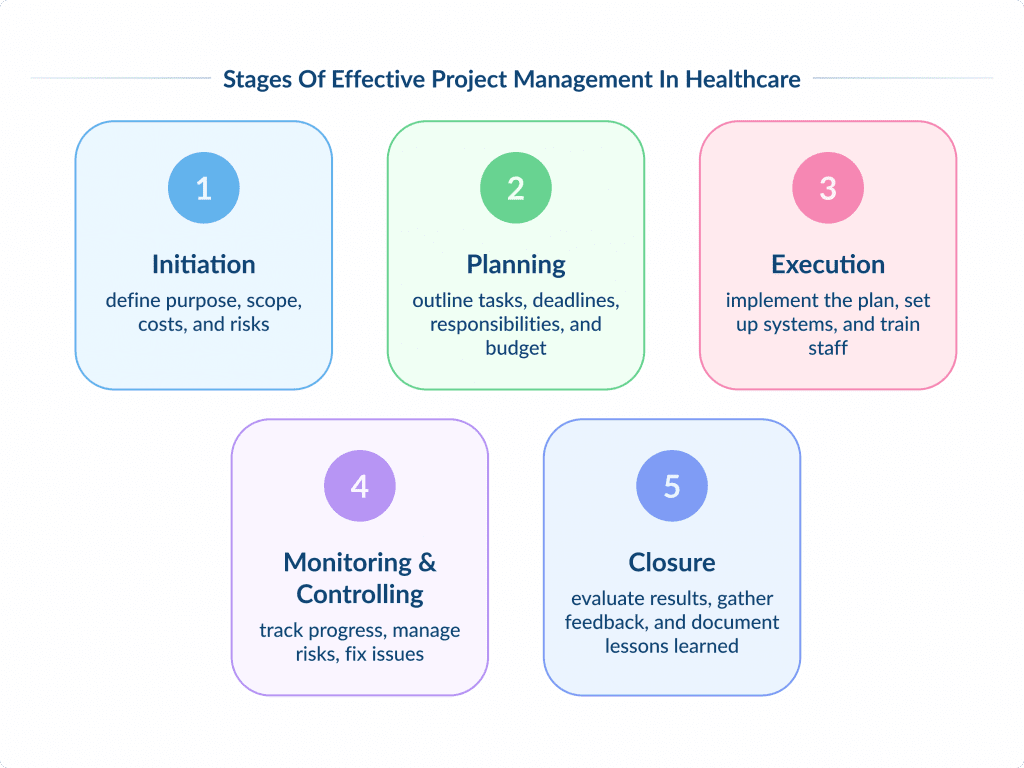
Project Management Methodologies
Project management methodologies are structured approaches or frameworks that guide how a project is planned, executed, and completed. Projects in the healthcare sector are complex, and choosing the right project management methodology can make a big difference.
Here are the most popular methodologies that healthcare organizations can use in project management:
Waterfall
Waterfall takes a step-by-step approach. Each stage must finish before the next begins. It works best when requirements are clear and stable.
For example, a hospital implementing a new EHR can use Waterfall to design, develop, test, and deploy the system in sequence using the efficient EHR integration strategies. Any late changes, however, can cause delays and extra costs.
Agile
For our team, the Agile discovery process is the key step in software development projects. We use it because Agile is flexible and iterative.
In Agile, teams work in short cycles. They quickly adapt to feedback and improve continuously. For example, when working on the new telemedicine platform, Agile is a real time saver. Developers release video call features first, then adjust based on feedback from medical staff and patients. This allows for the gradual building of a more effective system.
Scrum
Scrum is a type of Agile that organizes work into short sprints, usually one to four weeks. Daily check-ins track progress, and teams review results at the end of each sprint.
For instance, a hospital IT team that develops a doctor appointment app can add new features like appointment reminders or reporting dashboards sprint by sprint, making adjustments as they go.
Kanban
Kanban uses a visual board to track work. Tasks move from “to do” to “in progress” to “done.” This makes it easy to spot bottlenecks and keep work moving. A clinic can use Kanban to track electronic health record updates. The board shows progress clearly, so nothing gets stuck.
Lean
Lean is a project management method that makes processes faster, simpler, and more efficient.
How it works in practice:
- List every step in the workflow, like patient intake or software testing.
- Spot steps that don’t help patients or staff, like repeated forms or unnecessary approvals.
- Remove steps, simplify tasks, or make them faster.
- Check if the process is quicker, cheaper, or smoother. Adjust as needed.
A hospital can use Lean to simplify patient intake. Staff remove duplicate forms and cut waiting time. As a result, patients get seen faster, and staff have more time for care.
Six Sigma
Six Sigma aims to reduce errors and improve quality using data. For example, a medical lab can apply Six Sigma methods to minimize mistakes in test results. This improves patient safety and reduces costs from repeat tests.
The right methodology depends on the project type, project goals, and environment. 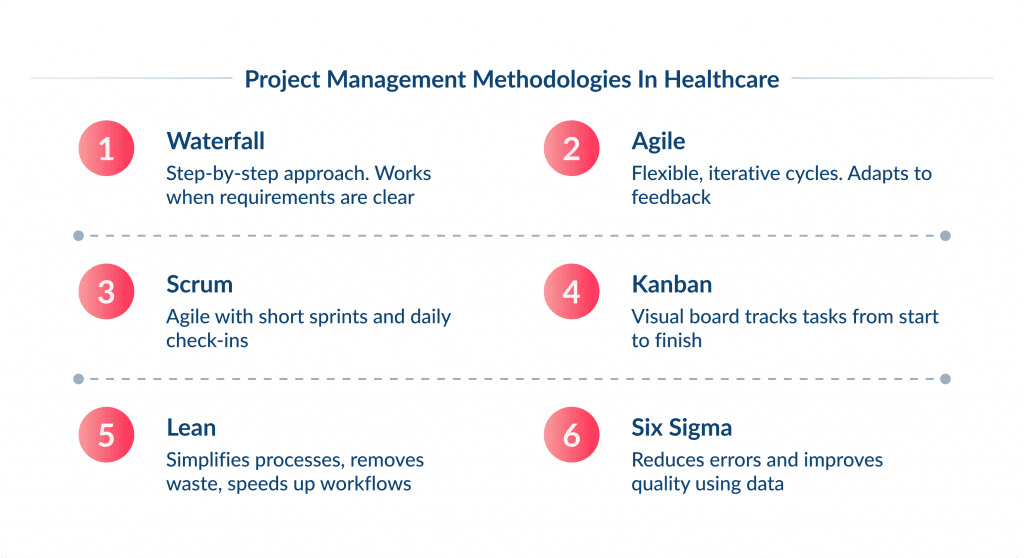
Key Challenges in Healthcare Project Management
Healthcare project management is uniquely complex because of its mission-critical nature and highly regulated environment. The key challenges come from patient care, technology, regulations, and human factors. Let’s explore these in more detail.
1. Regulatory and Compliance Hurdles
Regulatory standards are much more complex than in other industries.
All healthcare delivery projects must adhere to a multitude of regulations like HIPAA (data privacy and security), GDPR (for international patients), JCAHO standards (quality of care), and FDA regulations (for medical devices and software).
On top of that, the regulatory landscape is not static. Rules change frequently, and project managers must be adaptable mid-stream. This can cause delays and even rework.
Also, healthcare companies must remember that every decision and system configuration must be documented to withstand internal and external audits.
2. Stakeholder Complexity and Resistance
Managing multiple stakeholders with conflicting priorities is a big job.
Healthcare projects involve clinicians (doctors, nurses), administrators, IT staff, patients, insurers, and external vendors. Each group has different goals, jargon, and priorities.
Physicians and nurses are time-pressed and mission-focused. They may resist new technologies or processes that they use. This is because it disrupts their workflow or does not directly enhance patient care. Their buy-in is critical and hard to get.
Administrators, on the other hand, focus on cost savings and ROI, while clinicians focus on patient outcomes and ease of use. Project management is on a mission to bridge this gap.
3. Data Security and Privacy Concerns
All project activities must be designed to protect Protected Health Information (PHI). A data breach is a catastrophic failure with legal, financial, and reputational consequences.
Introducing new systems often requires interfacing with legacy systems (like EHRs). This can create new vulnerabilities that must be secured.
Also, defining and managing access to data within a new system is a complex process that must adhere to the “minimum necessary” standard. A project management experience is required to meet all the data privacy requirements
4. High-Stakes Environment and Patient Safety
For healthcare facilities, there’s no margin for error.
A failed project in healthcare can impact patient safety, outcomes, and even lives. A system outage or workflow error can have immediate clinical consequences.
Implementing new systems requires a “go-live” transition. Planning for this with zero disruption to clinical operations is a high-pressure task. Rollbacks must be meticulously planned.
The culture of medicine is risk-averse for good reason. This can conflict with the need for innovation and change, slowing down project momentum.
5. Technological Integration and Interoperability
Healthcare systems are complex and siloed.
Many healthcare organizations run on old legacy systems that are hard and expensive to integrate with modern solutions.
Different systems (EHRs, lab systems, pharmacy systems) from different vendors don’t talk to each other. A major project challenge is creating interfaces and ensuring data flows correctly between them.
Relying on third-party vendors for software and hardware introduces risks around their performance, stability, and timeliness.
6. Resource Constraints
Healthcare organizations are stretched thin, financially and in terms of people.
Budgets are tight and heavily scrutinized. Healthcare managers have to justify their organizational spending habits against other clinical needs.
The most critical team members, busy clinicians, are also the hardest to pull away from their primary patient care duties for project meetings, testing, and training.
An organization may be running dozens of critical initiatives at the same time, competing for IT and financial resources and clinical attention.
7. Measuring Success and ROI
Defining and proving value is hard
While cost savings are important, the ultimate value of a healthcare project is often in improved patient outcomes, enhanced safety, better patient satisfaction, or improved clinician morale. These are qualitative metrics that are hard to quantify and attribute to the project.
The true return on investment for a project like choosing between Cerner vs Epic EHR or a population health initiative may not be visible for years. 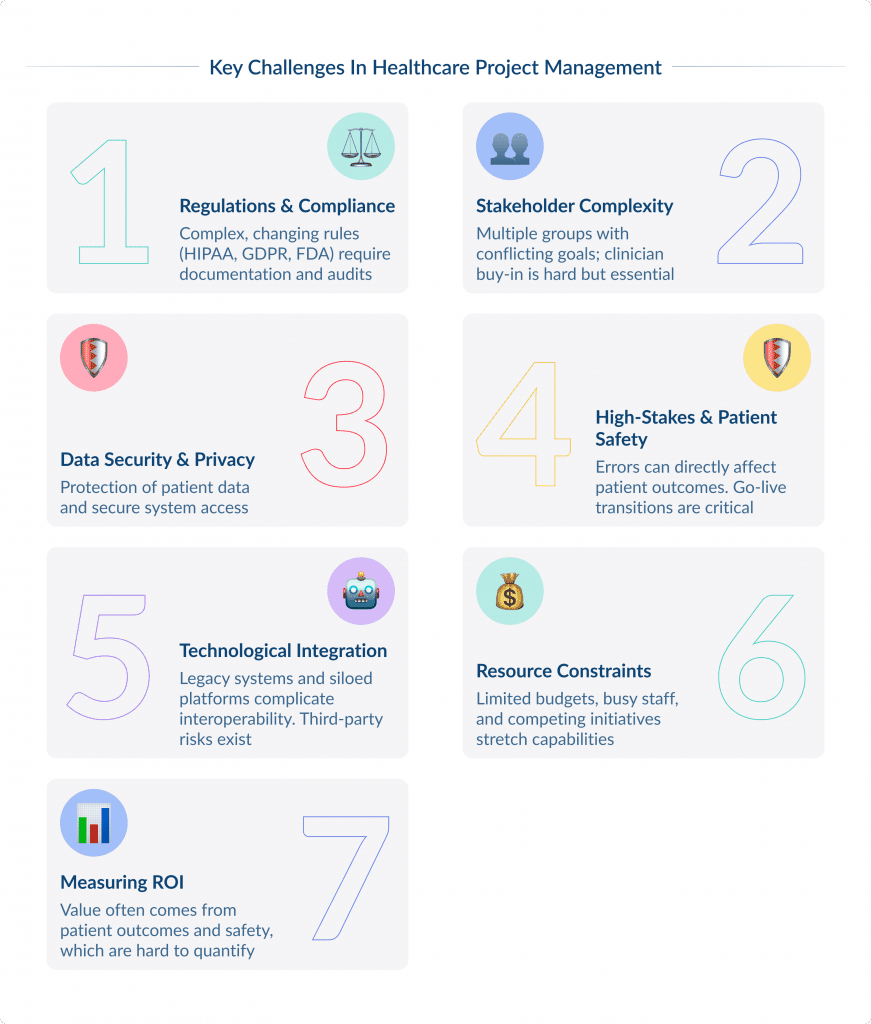
Summing up
Project management in healthcare requires multiple skills and continuous learning to keep the workplace organized. It can be hard to juggle tight deadlines, limited budgets, and the needs of patients, staff, and administrators all at once. But with the right partner on your side, it can be much easier.
If you are planning a new project, like working with a company that offers EHR software development services or integrating data analytics in healthcare, feel free to contact us. Our team will help turn your ideas into a working solution and support you throughout the development process.