
Get a RAG Feasibility Assessment
See if RAG implementation can benefit your business processes.
We design private AI systems using Retrieval-Augmented Generation (RAG) to deliver accurate, secure, and compliant LLM solutions on your retrieved data
Talk to a RAG Expert
Enterprise-grade RAG

Custom LLM solutions (no vendor lock-in)

Private & secure data pipelines

Flexible integration with existing systems
LLM hallucinations
Create liability when models confidently present false information as fact.
Outdated knowledge
Leaves critical gaps when models can't access data created after their training cutoff.
Data leakage risks
Happen when sensitive information is processed by third-party models.
No auditability
Makes it impossible to trace how the system arrived at specific answers.
You get outputs that are tied directly to source documents.
Your private data remains accessible to authorized users without leaving your infrastructure. Compliance and security requirements are met through controlled access and audit trails.

Most importantly, you gain accuracy and trust that make AI adoption sustainable across your organization.
See if RAG implementation can benefit your business processes.
 RAG Feasibility and Architecture Assessment Data Readiness and Document Strategy Evaluation Vector Database and Retrieval Strategy Development LLM Selection Guidance Cost and RAG Performance Estimation POC → MVP → Production Roadmap Creation
 This stage helps us determine if RAG is the right solution for your use case, or if another approach might work better. We evaluate your business objectives and goals, existing systems, and internal and external data sources to design an architecture that actually fits how your organization works. You'll get a clear recommendation on whether to move forward and what success would look like.
Your RAG system is only as good as the data it can access. We review your existing documents, databases, and knowledge sources to see what shape they're in. This means identifying gaps in quality (is information accurate and up-to-date?), structure (is data organized in a way AI can understand?), and accessibility (can we actually reach the information that matters?). We'll flag any issues that could affect performance and recommend practical steps to address them before building begins.
This is where we figure out the technical foundation of your system. Think of it as designing the filing system and search mechanism that will help your AI find the right information quickly. We define how your content will be stored, how it gets converted into a searchable format, and what retrieval methods will work best for your type of content. The goal is fast, accurate results when users ask questions.
The right choice depends on your specific situation. We help you compare open-source options like LLaMA and Mistral against proprietary models from providers like OpenAI. We'll walk you through the trade-offs: open-source models give you more control and privacy, while proprietary models might offer better performance out of the box. Together, we'll find the option that matches your security requirements, performance expectations, and budget constraints.
You need to know what you're getting into before committing resources. We provide realistic estimates of what implementation will cost in time, money, and internal effort. More importantly, we map this against the expected business value, whether that's time saved, better customer service, more relevant data, or reduced risk. This helps you make an informed decision and build a solid business case for stakeholders.
Finally, we create a clear path forward that breaks the project into manageable phases. We start with a Proof of Concept to validate that the approach works with your real data. Then we build a Minimum Viable Product that solves a specific, high-value problem. Only after proving value do we scale to full production deployment. This staged approach reduces risk and lets you learn and adjust as you go.



“Early-launched LegalTech platform acquiring first clients in 3 months”

“A cross-platform design tool for SharePoint, Microsoft Teams, and SAP”

“After launching, the client raised funding with the support of H&S Investments”

“A user-friendly home warranty software focused on transparency and customer choice”
“From manual consulting workflows to a scalable, automated marketplace”

“Scalable MVP that helped founders raise Series A funding”
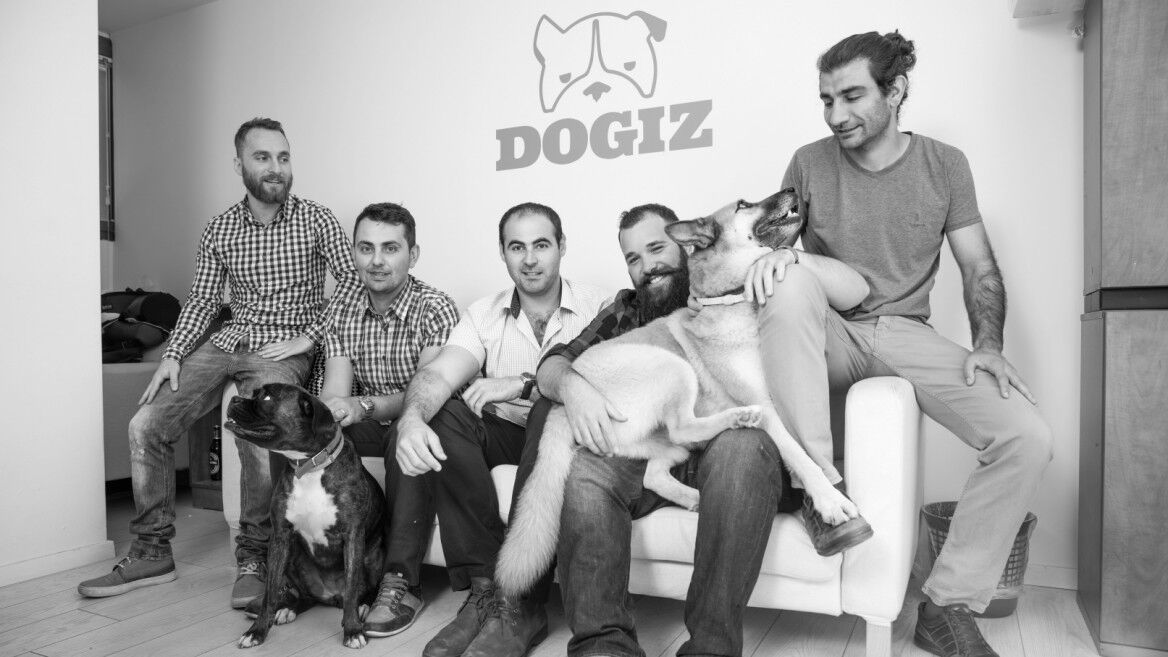
“Scheduling-first pet care marketplace with real-time tracking and chat”

“Our efficient project management delivered a 20% faster turnaround”

“Unified web and mobile system for therapist workflows and patient data”
Let's get in touch to discuss your needs and priorities

AI assistants that give employees instant access to company knowledge without hunting through folders and documents. Ask a question in plain language and get accurate, contextually relevant responses drawn from your internal knowledge base.

Intelligent search systems that find information across all your data, structured and unstructured data sources. Teams can ask questions naturally instead of guessing keywords or knowing where information lives.

AI assistants that help your support teams by providing accurate and context-aware outputs grounded in your actual product documentation and past user interactions. Faster resolution times and consistent, reliable information for customers.

AI solutions that meet strict regulatory requirements with full auditability and transparency. Every answer can be traced back to its source, and the system maintains detailed logs to satisfy industry-specific compliance standards.

Custom RAG systems that can read, understand, and extract insights from large volumes of documents automatically. Whether it's contracts, reports, or research papers, the AI helps you find patterns and information that would take humans weeks to uncover.

AI is integrated into your existing business processes to automate repetitive knowledge work. The system handles routine decisions and the information retrieval process to free your team to focus on work that requires human judgment.
1
2
3
4
5
Discovery & RAG Consulting
This is where we align AI capabilities with real business needs. Our RAG application development company always starts by understanding your use case, users, data sensitivity, and success criteria. We identify where RAG is truly needed, what problems it should solve, and what risks must be avoided. This phase helps avoid overbuilding and ensures the solution is viable, compliant, and cost-effective from day one.
Data Ingestion & Preprocessing
AI quality depends directly on data quality. We analyze your existing documents, databases, and knowledge sources, then define how data should be structured, cleaned, and updated. This includes removing duplicates, handling outdated content, and defining access rules for sensitive information.
Retrieval & Embedding Design
This step determines how your AI finds the right information. We design the retrieval logic that decides what data is searched, how it is ranked, and when it is returned. This includes choosing embedding strategies, chunking rules, and search methods such as semantic or hybrid search.
LLM Integration & Orchestration
Here, retrieval meets generation. We connect the retrieval layer with the selected language model and define how prompts, context, and responses are orchestrated. This ensures the RAG model answers only using approved data and follows your business rules, tone, and constraints.
Evaluation & Optimization
At this point, we validate retrieval accuracy and trust. We test the system against real user queries, edge cases, and failure scenarios. Responses are evaluated for correctness, completeness, latency, and hallucination risk. Based on results, we fine-tune retrieval logic, prompts, and system parameters.
Deployment & Monitoring
AI systems must perform consistently in real environments. We deploy the solution to your chosen infrastructure, cloud, private cloud, or on-premise, and set up monitoring for usage, performance, and retrieval quality. Logging and audits ensure transparency, while monitoring helps detect drift or degradation over time.


RAG systems turn scattered documentation into accessible knowledge, reducing time spent searching and improving decision quality across teams.

Law firms and compliance departments use RAG to quickly find relevant precedents, regulations, and internal guidance while maintaining strict confidentiality.

Medical organizations deploy RAG to help clinicians access patient histories, research, and protocols without compromising HIPAA compliance.

Financial institutions use RAG to query transaction data, market research, and internal reports with natural language while maintaining regulatory compliance.
Support teams leverage RAG to provide accurate answers grounded in product documentation, reducing resolution time and improving customer satisfaction.

HR departments use RAG to give employees instant access to policies, benefits information, and training materials, streamlining onboarding and reducing repetitive inquiries to HR staff.


Discover how we solved complex technical challenges and implemented durable solutions for a visual website builder.


Learn more about how the eLearning app implemented an innovative business model for an old problem.


Discover how a startup in HR shapes employee management in enterprise-level companies using complex tech solutions.


In this case study, we show how we helped a non-technical founder create the most user-friendly telemedicine app.
Use AI without giving up control of your data.
RAG development services involve building AI systems that combine large language models with real-time retrieval from private or enterprise data sources to produce accurate, grounded answers.
Private AI solutions are AI systems designed to operate on private, enterprise, or regulated data without exposing it to public models. Retrieval-Augmented Generation (RAG) is a core architecture used to ground LLM responses in trusted internal data.
When you deploy an LLM without retrieval augmented generation systems, there might be several challenges that can damage trust and decision-making. Its knowledge becomes outdated the moment it’s trained, leaving gaps in accuracy. And if the company is feeding sensitive data into public models, there is a risk of data leakage and compliance violations.
Fine-tuning changes model behavior by retraining on specific data, while RAG retrieves external knowledge at runtime. RAG keeps answers up-to-date without retraining and reduces hallucinations by grounding accurate responses in actual documents.
Yes. Our RAG development services cover designing custom RAG solutions tailored to your enterprise data, security requirements, and performance needs. Every implementation is built around how your organization actually works.
Absolutely. We build private RAG and enterprise LLM solutions with strict access control, precise data retrieval, secure deployment, and compliance with regulations like GDPR and HIPAA. Your data never leaves your controlled environment.
Timeline varies by complexity. A proof of concept typically takes a few weeks to validate feasibility. MVP implementations run two to three months. Enterprise-grade RAG systems with seamless integration and security requirements may take several months.
Yes. RAG as a service consulting helps validate feasibility, define architecture, and estimate ROI before significant investment. Many of our clients start with consulting to evaluate our RAG expertise and build internal buy-in, and clarify requirements.
Private AI defines how data, generative models, and infrastructure are isolated and controlled to prevent external exposure. RAG is a core technique used inside private AI systems to connect LLMs with internal knowledge securely. Most private AI systems we build use RAG as a foundational component.
In the manufacturing industry, AI mostly means three things: Analyzing equipment data to catch...
read more A learner signs up for your course. They complete the first two modules, maybe even leave a comment...
read more AI in product development means using artificial intelligence to build software products. There are...
read more
Cloud-to-cloud migration means moving your applications, data, and workloads from one cloud...
read more
The top SaaS trends in 2026 are centered around smarter automation, more personalized user...
read more
Data analytics in insurance is the process of collecting information, spotting patterns, and using...
read more


