Custom Software Development Costs in 2025 (Full Breakdown)
- Updated: Mar 18, 2026
- 13 min

Head of Sales
What’s the actual price tag for building a custom software solution?
Finding the answer to this question might be confusing. Hourly software development rates range from $40 to $150+ per hour, and software development projects easily hit thousands of hours. So, it might be worth it to better understand the factors that impact development costs to budget your project more efficiently.
This article is a complete guide to custom software development costs. We have been providing custom software development services for over a decade, and here, we would like to tell you about the following aspects of developing a high-quality custom software:
- A definition of custom software development
- Typical software development cost ranges
- A full breakdown of the key factors that influence the cost of software development
- Hidden software development expenses to account for
- Budgeting advice to plan your software development project
Whether you’re a startup planning an MVP, a Fortune 500 company replacing legacy systems, or anything in between, read on for a detailed analysis of custom software development rates in 2025.
Transform your ideas into reality with custom software tailored just for your business – contact us today!
What is Custom Software Development?
Custom software development is the process of planning, designing, developing, launching, and maintaining a software solution tailored to specific requirements, rather than using off-the-shelf or generic solutions.
The software development process is straightforward, but with strict adherence to specifications that answer the following questions:
- Who will be using the software products?
- When will the software be used?
- How accessible will the software be?
- How will the software be used?
If you would like to rebuild a generic solution to make it your brand’s product, tailored to your requirements, then it’s custom software development. Most enterprise software falls into this category. Large organizations usually need solutions adapted to their complex processes, integrations, and scale. These are things standard software can’t fully address. 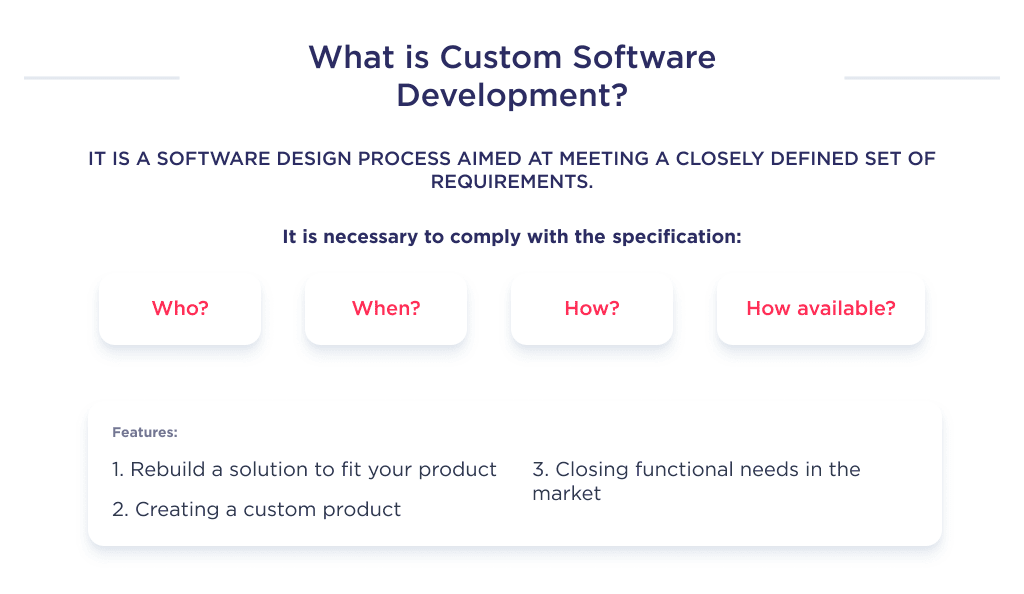
How Much Does It Cost To Develop A Custom Software?
The average software development costs range between $120,000-$500,000 and more. This figure is not residual because software development costs constantly increase due to inflation and the rising prices of software development services worldwide, from the U.S. to India.
However, the exact cost of developing your software depends on the pricing model, which is:
- The complexity of the custom software project
- Your software development team type
- The location of your software development team
Let’s discuss the cost of software development for each pricing model.
Custom Software Cost Breakdown Based on Software Complexity
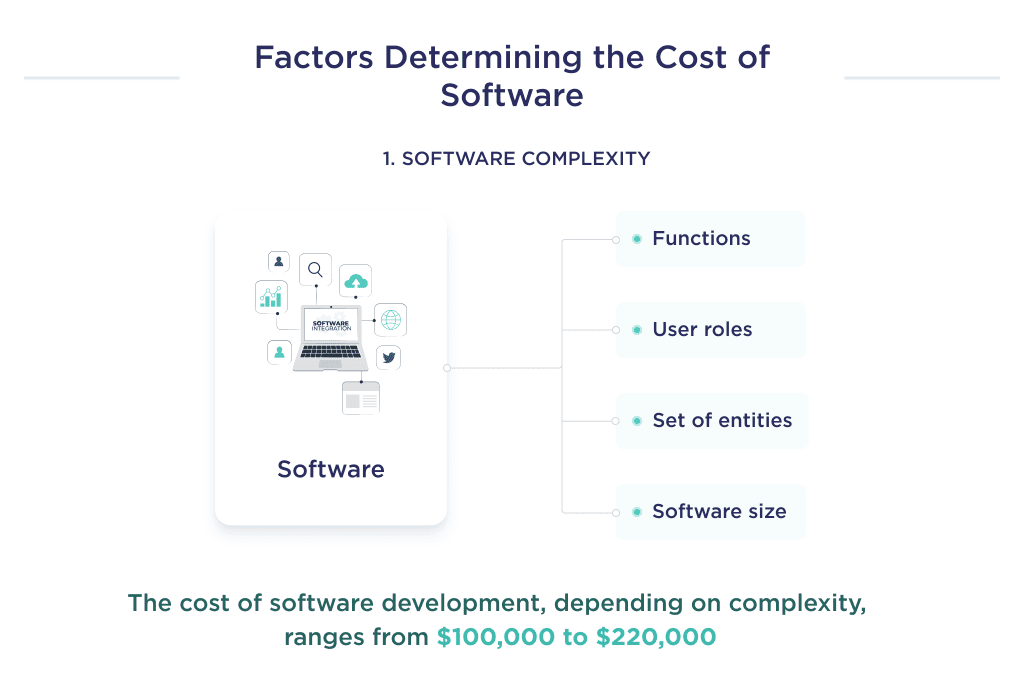
The complexity of the software is the set of entities, functions, user roles, software size, and how they interact within the system. Simply put, the functionality of your cross-platform determines how sophisticated it is.
Complexity is also affected by the UI/UX design, as the more characters in its user interface, the more sophisticated it is.
For example, if you want to create a corporate website, you might need a map of the location and a form to gather user information.
This will be less complex than creating the MVP of a SaaS eWallet cross-platform that uses machine learning to offer optimized solutions.
As such, the website development cost for a corporate site is less than the average SaaS development price.
This is because the SaaS platform has multiple user roles, medium-sized software, more functions, and higher entities.
Thus, it costs more than custom web development services.
Custom software development costs are often estimated based on the complexity of the project. It is typically broken down into three categories: basic, moderate (or average), and highly complex.
- Basic complexity apps are simple, with few features, no third-party integrations, and minimal UI .
- Moderate complexity apps have multiple user roles, integrations (like payment gateways), and a more refined design.
- High-complexity software is packed with advanced functionality like AI, real-time data sync, custom logic, and integrations with multiple systems.
Let’s take a look at the software development cost based on its complexity:
| Complexity Level | Cost, $ |
| Basic | 100,000 |
| Average | 150,000 |
| Complex | 220,000 |
We will discuss the details of each complexity level later. Now, let’s focus on the software development cost breakdown by team type.
Software Development Costs Based on Team Type
Another factor that determines custom software development cost is the type of your development team. In the table below, we’ll compare the cost of hiring four types of teams: a local US company, an in-house team in the US, freelance developers, and an outsourcing development agency from Ukraine.
For illustrative purposes, we’ll assume that you have requested custom software development services to build an app of average complexity:
| Type of Team | Cost, $ |
| The local development company, the US | 200,000 |
| In-house, the US | 220,000 |
| Freelance developers | 70,000 |
| Outsourced agency, Ukraine | 90,000 |
Let’s break down what stands behind those numbers.
In-House Developers
These are custom software coders working inside the startup as employees of the organization.
They receive day-by-day instruction from management and have a clear understanding of the solution being created.
Local Development Company
A local development company is a software solution provider that’s located in the same country as your startup. For example, a startup in the United States may partner with a team of dedicated developers in the same country.
Freelancers
Freelance custom software programmers are independent developers who are not full-time company employees. These types of developers accept contracts and build to specification, or sometimes at discretion.
Outsourcing Agency
An outsourcing agency is a third-party company that provides software development services, often from a different country or region than the client. These agencies typically have cross-functional teams: developers, designers, testers, and project managers, and are experienced in delivering solutions to clients worldwide. 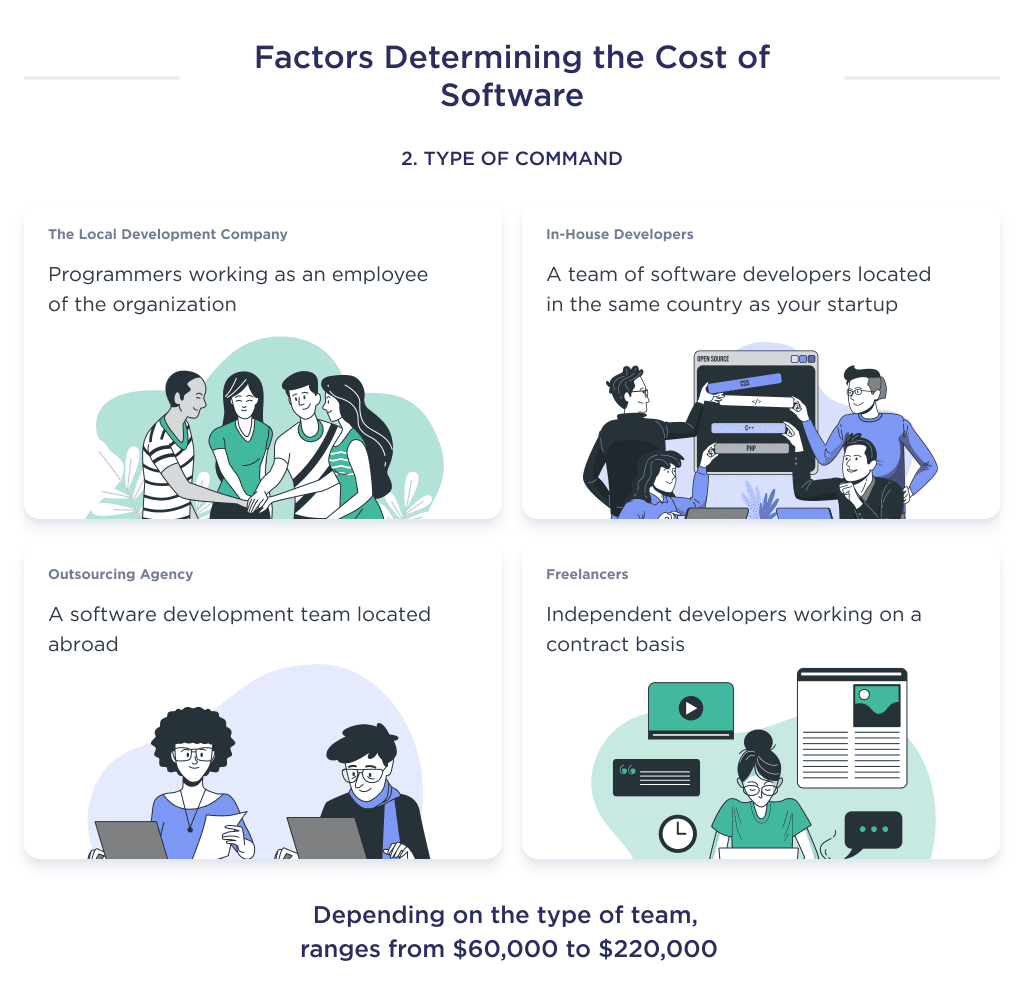
Software Development Costs Based on Team Location
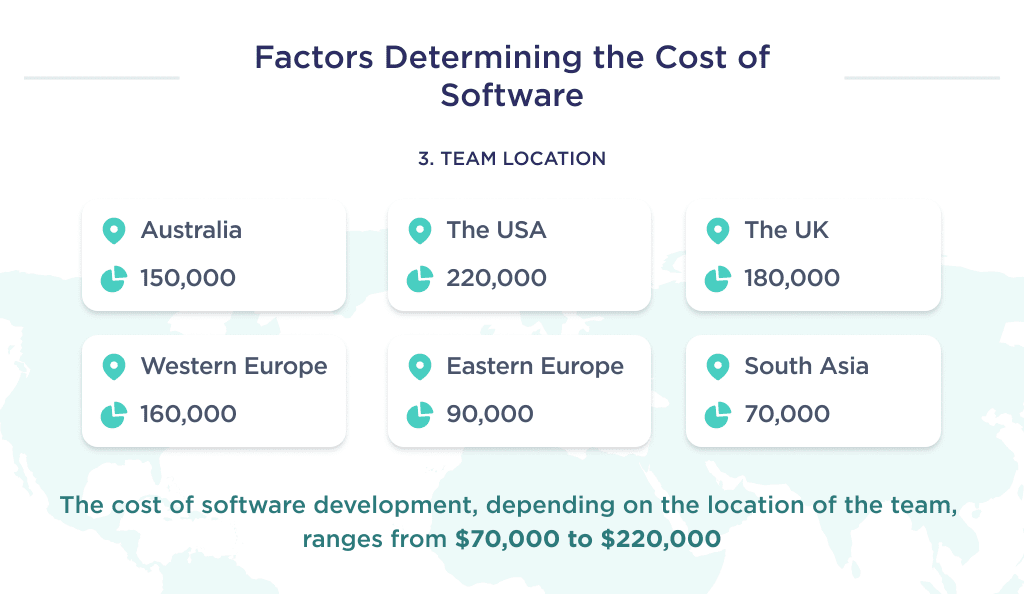
Your team’s location is a significant determinant of the software development cost.
For example, the average cost of custom software development in Eastern Europe is approximately $90,000, while the same software products will cost $220,000 in the US.
Below is a more detailed spreadsheet of costs, categorized by the team’s location. Feel free to check out our article on the top 10 countries for outsourcing software development for more insights.
| Country | Cost, $ |
| Australia | 150,000 |
| The USA | 220,000 |
| The UK | 180,000 |
| Western Europe | 160,000 |
| Eastern Europe | 90,000 |
| South Asia | 70,000 |
Factors Impacting Custom Software Development Costs
The cost of a custom software solution is affected by several factors.
These factors are:
- The complexity of the software development project
- The MVP development team you’re partnering with
Let’s discuss each of the factors to consider when estimating software development costs.
Software Complexity
The complexity of custom software varies with:
- The technology required to build custom software.
- The number and level of developers required to create the solution.
We’ll discuss each of these factors and help you understand how they affect the final software development budget.
Software development complexity depends on several factors, including the number of user roles, third-party integrations, custom design requirements, and the depth and variety of features and functionalities.
The higher the number of characters within the solution, the greater its complexity.
Also, solutions with more features are more complex than those with fewer features.
The only exception is instances where those features are sophisticated ones like blockchain, machine learning, or AI.
To know how complex software is, first identify the following:
- The seniority of developers needed to create the solution
- The skill set required for development and maintenance
- Number of object types that should be managed in a cloud server
- The tech stack needed to build the solution
- Certifications and licenses required.
Based on these, software development complexity can be classified into basic, average, and highly complex. Let’s discuss each type of project complexity in detail.
Basic Complexity
Basic complexity is a custom software that primarily provides users with general information.
It sometimes gets data from users, but it’s usually minimal.
An example of software with basic complexity is Blogger.
Most lightweight CRM platforms or simple cross-platform applications fall into this category. If you’re interested in how to build CRM from scratch, our guide will give you all the tools and insights you need.
Average Complexity
These types of software have multiple basic and complex functionalities.
Although junior developers can build them, they still require input from senior developers on a number of complex features.
This type of software is the most common for startups and scale-ups.
An example of software in this category is BigOven. The mobile app has a basic complexity because its main function is to provide users with cooking recipes.
Difficult Complexity
This type of custom software has many sophisticated functionalities, APIs, entities, and user roles.
Building this type of software requires top-notch expertise from senior developers and a lot of long-term development effort.
An ideal example of custom software of high complexity is QGIS, a geographic information system.
This software helps scientists and researchers analyze and predict geographic features like sea levels, wind speed, etc.
Another important cost-determining software development factor to consider is the dedicated development team type you’re partnering with. 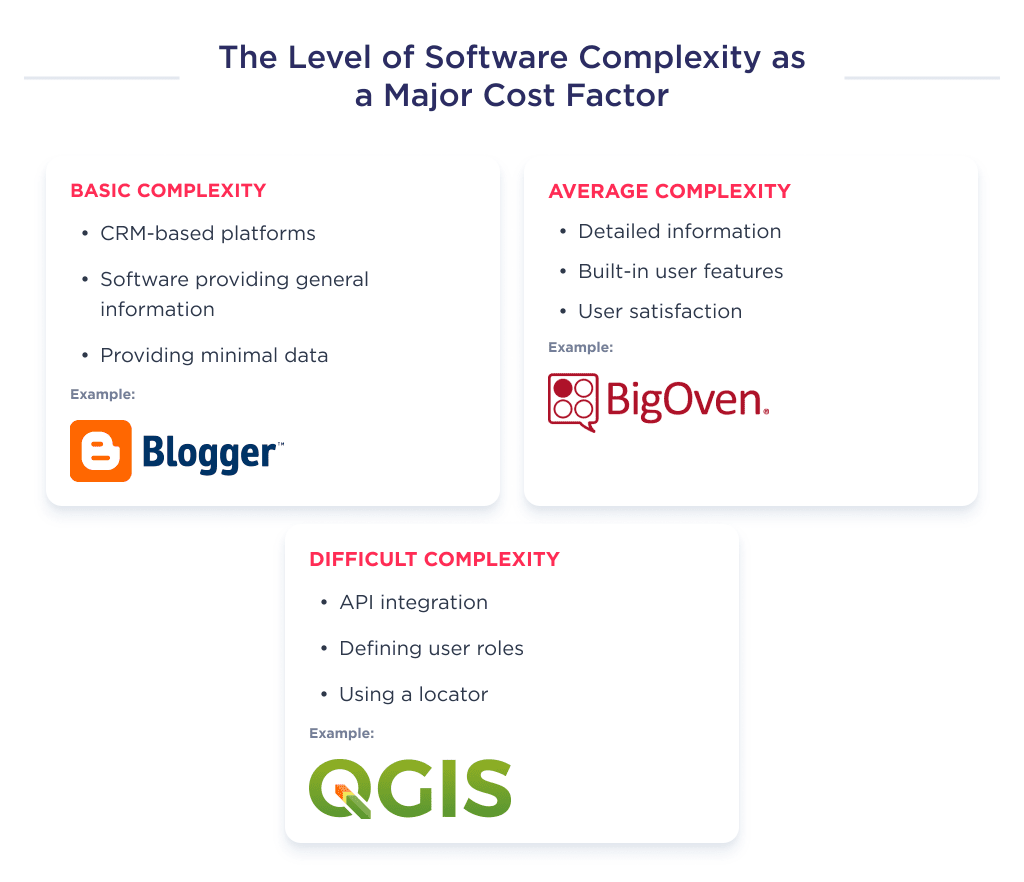
The Role of the Software Development Team in Software Cost Estimation
Your preferred team affects the price tag to hire developers for startup in multiple ways. Software development cost is affected by the following:
- The seniority and experience of the developers involved
- The location of the development team
- The vendor’s business focus
Let’s discuss each of these points briefly.
The Seniority of Developers Involved
Prices charged by developers vary with the seniority of the developers involved in creating a custom software solution 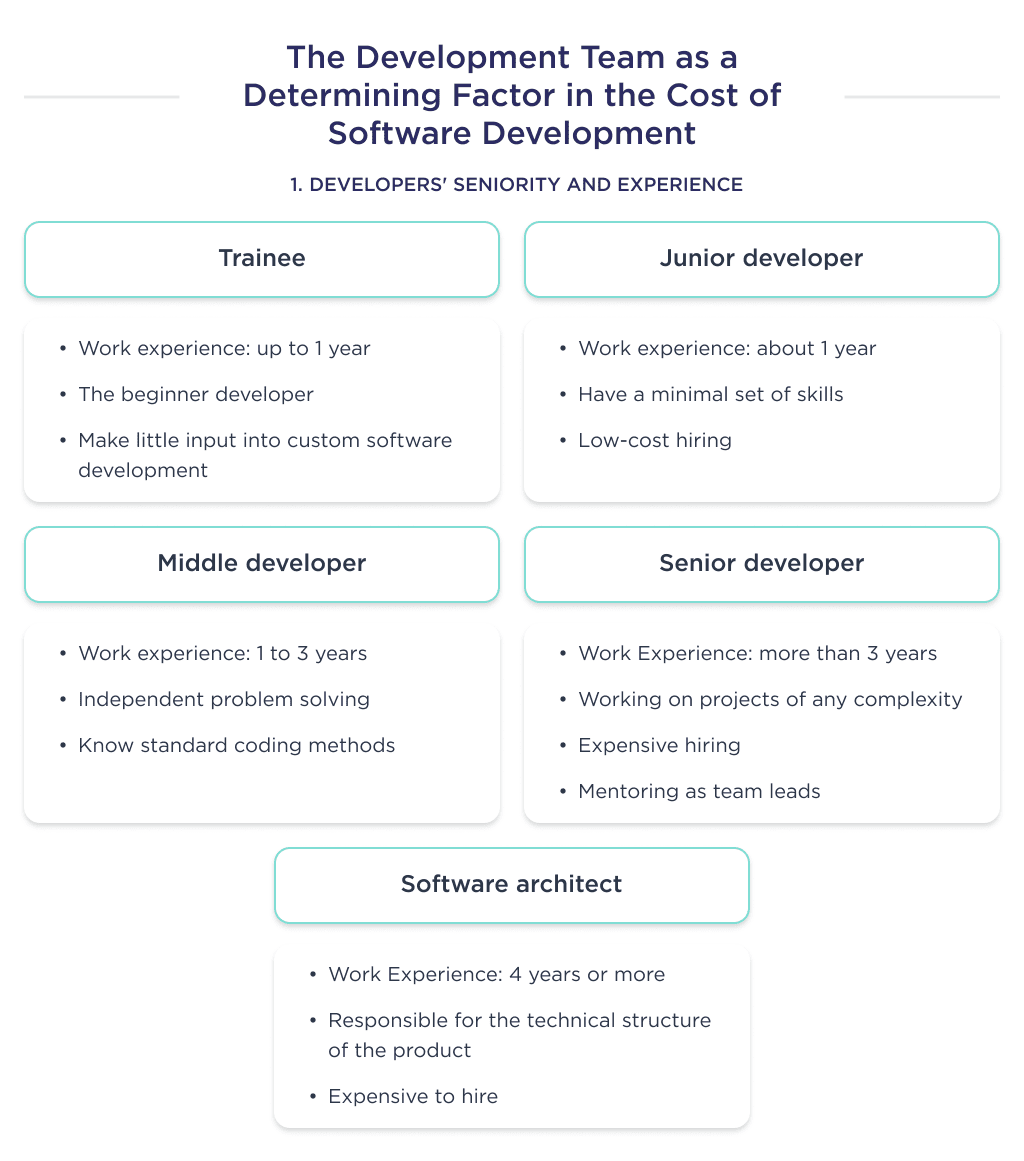
Another team-related factor that affects software project cost is the location of the development team.
Location of Development Team
For example, the average custom software development pricing by a U.S.-based team is about three times more expensive than one developed by a Ukraine-based team.
The final cost differs per geographical area because of the following:
- Minimum wage
- Cost of living
- Workforce availability
To get a better understanding of how price varies by team location, check out the section on “cost defined by team location” above. 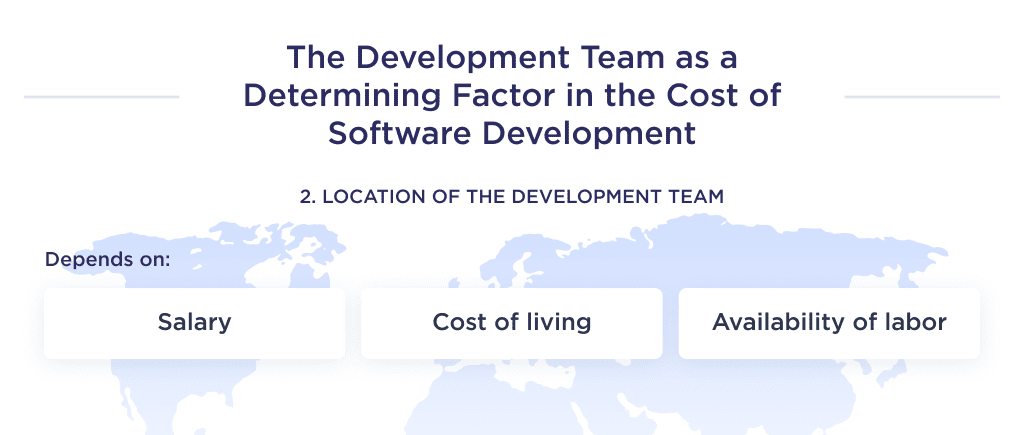
The Vendors’ Size and Business Focus
Size and business focus are other factors to consider. How?
Software development companies charge different fees based on their preferred tech stack and their size. For example, if you’re building a blockchain-based eCommerce solution, working with a blockchain-specialized agency can save time and reduce risk thanks to their expertise, though costs may vary depending on the scope and complexity of your project. Discover eCommerce startup ideas that fit the latest trends and customer demands.
Also, based on resources from SoftwareWorld, Thinkmobile, and Clutch, we found that the size of the outsourcing software development agency affects IT outsourcing costs.
Here, you may find approximate rates based on the vendor size:
| Agency type | Staffing | Typical clients | Rates (per hour) |
|---|---|---|---|
| Global agencies | 1000+ employees | Enterprises, Fortune 500 companies | $200 – $500 |
| Large agencies | 100 – 1000 developers | Large corporations, governments | $120 – $300 |
| Mid-size agencies | 10 – 100 developers | Growth-stage startups, SMBs | $80 – $200 |
| Boutique agencies | Up to 10 developers | Niche startups, specific industries | $50 – $150 |
| Freelancers | Solo developers | Startups, small projects | $20 – $150 |
| Offshore agencies (Eastern Europe, India, LatAm) | Varies | Startups, cost-conscious businesses | $25 – $100 |
Now that you have an idea of the factors impacting custom software development pricing, we’ll discuss some unforeseen costs you might encounter.
Hidden Costs Of Custom Software Development
Custom software development offers tailored solutions and long-term value, but it often comes with hidden costs that businesses don’t always anticipate upfront.
Here’s a breakdown of the most common ones:
Unclear Requirements That Lead to Scope Creep
If your project goals aren’t clearly defined, features and functionality may keep expanding during development. This leads to longer timelines, more hours billed, and higher final costs.
For example, you start with a simple booking system, but later realize you also need calendar sync, email automation, and a mobile version, all of which weren’t budgeted for.
Integration Costs
Custom software often needs to integrate with other systems (CRMs, ERPs, payment gateways). These integrations can be complex, require extra development, data migration, and involve third-party fees.
For instance, connecting your app with Salesforce or Stripe may involve API customization. This takes extra time and may include usage-based fees.
Marketing Costs
The marketing cost is the amount expended on making your solution known to its target users.
Marketing cost should be x2-x3 of the initial development price/annum.
That is, if the cost estimate of developing new software is $50,000, then your marketing budget should range between $100,000-$150,000 yearly.
This cost will be expended on the following:
- On-site, and off-site SEO
- Email marketing
- Information architecture
- Social media marketing
- PR
- Product Hunt launches
- And more!
Some of this money will also be spent as an overhead cost for the marketing team.
Looking for effective email marketing strategies? Here is our email marketing guide for your business. 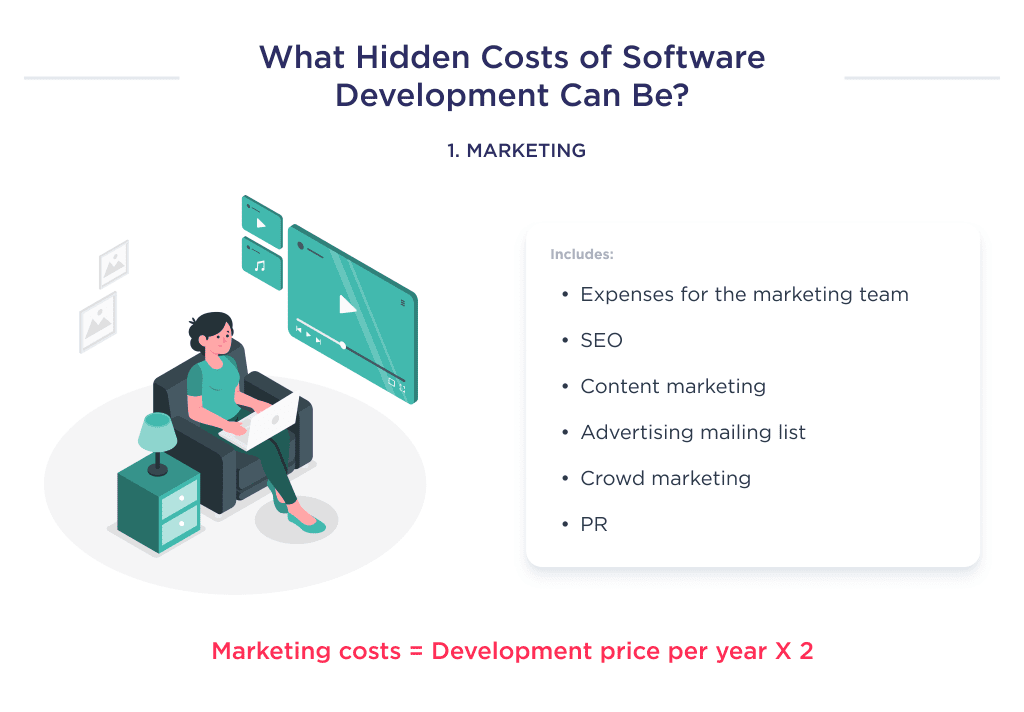
Another cost implication to consider is maintenance. Let’s discuss it.
Maintenance Costs
Ideally, the maintenance price tag is expected to be X2 of the software development cost/annum.
For example, if the total cost of developing software is 50,000, then the cost of maintenance is expected to be about $100,000.
Your maintenance cost may differ from this if you’re creating a highly sophisticated solution that requires some legal compliance from the government.
An ideal maintenance cost will include spending on:
- Email services
- SSL certificate
- Domain name
- Hosting
- iOS and Android app store hosting services
- Technical support.
This cost keeps your software running and provides a quick fix during downtime or when an error occurs.
Maintenance costs exist throughout the solution’s lifecycle.
If you’re planning to build an app, these detailed guides on Android app development costs and, if you are building for iOS, see also iOS app development costs. These will help you navigate the financial aspects. 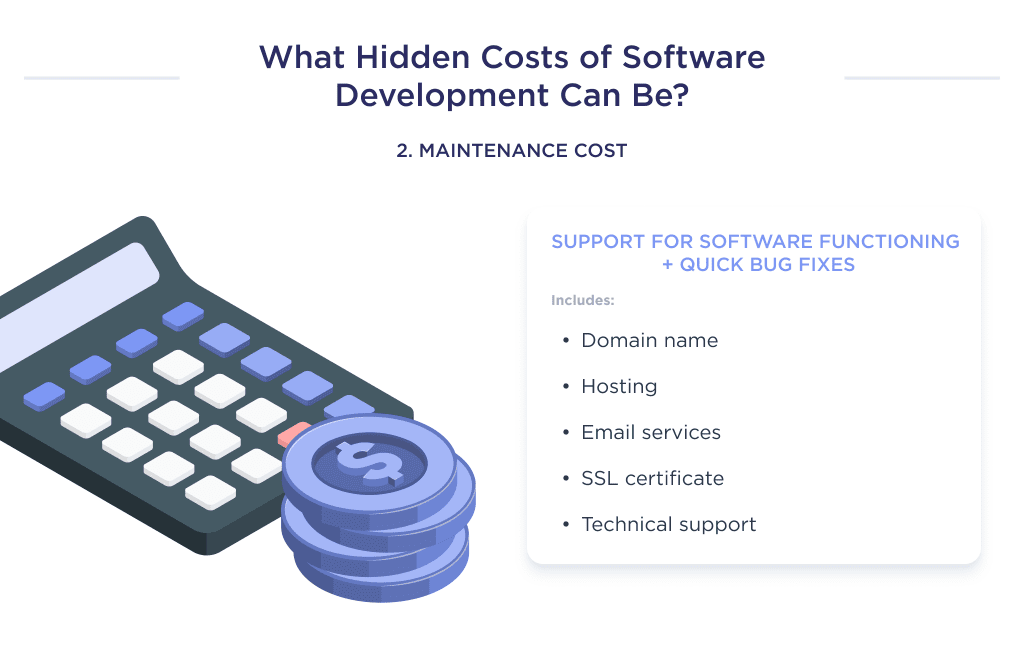
Now that you have an idea of some hidden bespoke software development costs. What’s more?
Here are all the hidden costs of custom software development and their potential impact:
| Category | Hidden costs | Potential impact |
|---|---|---|
| Requirements & planning | Discovery phase, changing requirements, documentation | Delays, budget overruns |
| Infrastructure | Servers, cloud services, maintenance contracts | Higher operational costs |
| Integration | API development, data migration, third-party connectors | Extended development time |
| Testing & QA | Automated testing, performance testing, and security audits | Additional resources needed |
| Post-launch | Bug fixes, user training, ongoing maintenance (15-25% of initial cost/year) | Long-term recurring costs |
| Scalability | Architecture revisions, feature additions, tech stack updates | Future rework expenses |
| Human resources | Knowledge transfer, specialized talent, and project management overhead | Higher labor costs |
| Legal &compliance | Licensing fees, regulatory compliance (GDPR, HIPAA), IP protection | Unexpected legal issues |
From concept to creation – launch your marketplace with SPDLoad!
How To Estimate Custom Software Development Cost?
Depending on the software development partner you choose, they might have different methods of estimating software development costs.
At SpdLoad, it takes us around 2 business days to estimate the cost of a software development project. You can also use our software development cost calculator to estimate the approximate project cost.
The estimates we provide are free and targeted to your specific needs. Plus, you can always reach out for a free consultation.
First, we schedule a brief call where we learn about your software project, whether you want to update your existing software or build one from scratch, what features you need and want, your timeline expectations, and your budget. Then, we break down the software development project into the following stages:
- Business Analysis
- UI/UX Design
- Backend Development
- Frontend Development
- HIPAA Compliance
- Quality Assurance
- Project Management
Each stage of the software development has different time estimates. For example, the telemedicine app development project might take:
| Stage | Estimated time | Description |
|---|---|---|
| Business analysis | 80 – 200 hours | Research, requirement gathering, and defining the project scope |
| UI/UX design | 250 – 500 hours | Wireframing, prototyping, and designing the user interface |
| Backend development | 500 – 1500 hours | Server-side logic, database integration, and API development |
| Frontend development | 500 – 1500 hours | User interface implementation and responsiveness |
| HIPAA compliance | 160 – 320 hours | Ensuring data security, encryption, and regulatory compliance |
| Quality assurance | 160 – 320 hours | Testing (manual & automated), bug fixing, and performance optimization |
| Project management | Ongoing | Coordination, timeline tracking, and team communication |
These are just approximate numbers. The more specific time estimate will be tailored to your software project requirements.
Based on the estimated hours, we then calculate the cost of software development. Once the estimate is done, we present it to you and discuss it. If you want to add more features or stick with a simpler solution, we will adjust the estimate of software development cost accordingly.
Types of Software Development Pricing Models
There are three main ways to price a software development project, and the right one depends on your goals, budget, and how much flexibility you need.
Fixed Price Model
This model is best for small to medium projects with well-defined requirements. The total cost is agreed upon upfront, and the development team works within that budget and timeline.
- Pros: predictable costs, clear deadlines, and minimal financial risk.
- Cons: limited flexibility — any changes require renegotiation.
Time and Material (T&M) Model
The time and material model is ideal for medium to large projects with evolving requirements. This is the one we stick with at SpdLoad. The client pays based on the actual time and resources spent on development.
We prefer to work under this model as it offers greater flexibility, the ability to adjust scope, and a scalable team size.
Dedicated Team Model
Under this model, the dedicated team of developers works exclusively on the project, paid monthly or per contract terms. The cost of software development, in this case, highly depends on the team’s location and the level of the specialists you choose.
This type of collaboration is great for long-term projects that require ongoing development and support.
- Pros: full control over the team, deep project involvement, and consistent quality.
- Cons: higher long-term cost, requires a project manager for coordination.
How to Choose the Right Engagement Model?
When choosing a pricing model, pay attention to a few key things to make sure you’re not overpaying or locking yourself into something that doesn’t fit your project.
First, consider how clearly defined your project scope is. If you already know exactly what you need and have detailed requirements, a fixed-price model might work best because the cost is agreed upon up front. But if your project is likely to evolve, a time and material model gives you more flexibility to adjust features, design, and priorities as needed.
Then, think about how much control and involvement you want. Fixed-price projects tend to be more rigid, and developers follow the initial plan with only minor changes. If you prefer an adaptive approach, a time & material or dedicated team model allows for ongoing collaboration and refinements based on your feedback.
Lastly, think about project complexity and long-term needs. For complex, long-term projects, like SaaS platforms or enterprise systems, a more flexible approach will be cost-effective. Dedicated teams, where you essentially “hire” a development team for a period, can be a great option if you want long-term engagement with a consistent group of developers.
Want To Develop A Custom Software?
Calculating the cost to develop software requires an expert analysis based on specific needs. A one-size-fits-all breakdown is not accurate due to multiple factors.
Let’s connect to explore what a tailored software solution could do for your business.
Our developers can provide an accurate estimate of software development costs and suggest strategies to maximize outcomes while minimizing expenses.
Hiring remotely doesn’t have to be daunting. Discover how to outsource your software development smoothly.
For your convenience, we decided to create a summary of our in-depth guide. Here, we have gathered all about custom software development costs estimation, including pricing factors you should focus on when setting a development budget.
Ready to test your startup idea? Learn everything about how to launch an MVP successfully.