How Data Analytics in Insurance Drives Better Outcomes
- Updated: Feb 23, 2026
- 12 min

Solution Architect, Front-end
Data analytics in insurance is the process of collecting information, spotting patterns, and using those insights to make faster, more accurate decisions.
Some insurers, when they hear the words data analytics, imagine complicated algorithms or fancy dashboards. But in fact, insurance data analytics is already embedded in decisions insurers make every day. It’s simply a matter of doing them better.
Every time an underwriter evaluates a risk or an actuary sets rates, they’re working with data. Data analysis tools make those decisions more consistent, faster, and grounded in evidence rather than intuition alone.
In fact, recent studies show AI-powered systems can cut errors by 90% and reduce processing time by 80%. That means adjusters spend less time buried in paperwork and more time actually helping people.
From our experience of providing insurance software development services, one thing stands out: once teams can actually see their data clearly, their operations change almost immediately. Claims teams work faster. Underwriters feel more confident. And customers feel taken care of instead of kept waiting.
Let's shape your startup's product vision together!
Why Insurance Companies Struggle Without Data
This article is for everyone who wants to better understand the use and potential benefits of data analytics in insurance industry. Before diving into how data analytics works, it’s worth understanding why so many insurers are struggling without it and why the gap between customer expectations and insurance operations has become impossible to ignore.
The push toward analytics didn’t happen overnight. Customer expectations now are higher than ever because people have gotten used to instant quotes from e-commerce, real-time updates from their banks, and frictionless mobile experiences everywhere else. Then they’d interact with their insurer and wait three days for a quote or two weeks for a claims update. That gap became impossible to ignore.
Data analytics insurance bridges that gap. It turns raw data into actions. For example, insurance claims automation helps to identify claims that can be fast-tracked or spot risky policies before they become losses.
Picture a typical Monday morning inside an insurance company. Claims from the weekend are piling up. Underwriters are trying to make decisions with limited information. Customer support is already handling a queue of “any updates?” messages. Everyone is working hard, but no one has full visibility into what’s actually going on.
This is what happens when data lives in different systems that don’t talk to each other. Claims data might sit in one place, policy data in another, and customer interactions somewhere else entirely. Teams end up relying on email threads and Excel spreadsheets just to get through routine tasks. It slows everything down and makes even simple decisions more stressful than they should be.
Without clear data, underwriting becomes slower and riskier. Claims teams can’t tell which cases should be prioritized. Product teams struggle to personalize offerings because they don’t have enough data-driven insights to fully understand customer behavior. And as fraud becomes more sophisticated, insurers relying on outdated workflows are left reacting instead of preventing.
When we work on insurance app development with insurers who still rely on manual workflows, the biggest challenge we see is the same every time: talented people are stuck doing time-consuming tasks they shouldn’t have to do. Instead of analyzing trends, they’re cleaning spreadsheets. This creates a productivity and experience problem. And it’s exactly the kind of friction that strong data analytics for insurance teams can remove.
Now that we understand the problems, let’s explore the technical foundation that makes modern insurance analytics possible.
The Analytics Foundation: AI and Machine Learning
Data analytics tells you what happened. AI and machine learning algorithms tell you what’s likely to happen next, and what you should do about it.
That distinction matters because insurance has always been about predicting future outcomes. You’re estimating risk, forecasting claims, and pricing policies based on what you think will occur.
For decades, that prediction relied on actuarial tables, historical averages, and human judgment. Those methods worked, but they had limits: they couldn’t process massive amounts of data quickly, adapt to new patterns in real-time, or catch subtle signals that humans miss.
Digital transformation in insurance changes that. AI systems can analyze millions of data points simultaneously and continuously improve their accuracy as they process more information. When applied correctly in insurance, these systems can amplify human expertise. That’s exactly what predictive analytics does.
Applying AI and Machine Learning for Valuable Insights
Let’s clear up the confusion first. You don’t need to understand neural networks or algorithms to use these tools effectively. You just need to understand what business problems they solve.
Think of machine learning this way: it’s software that learns from patterns in data without being explicitly programmed for every scenario. You show the system thousands of examples, and it figures out the patterns on its own. Then it applies those patterns to new situations. Let’s explore the most popular use cases:
| What ML Does | How it helps insurance |
|---|---|
| Smarter risk assessment & management | Analyzes hundreds of variables simultaneously(claim history, property characteristics, weather patterns, economic indicators) and identifies which combinations actually predict risk |
| Faster claims decisions | Instantly assesses whether a claim fits normal patterns or requires investigation, learning what “typical” looks like across thousands of cases |
| Adaptive fraud detection | Spots unusual patterns and updates detection criteria as fraud schemes evolve, catching what rule-based systems miss |
| Personalized customer experience | Predicts what each customer needs before they ask by analyzing interaction patterns and behaviors. This improves customer satisfaction, |
The key difference from traditional analytics? Traditional methods like descriptive analytics tell you what happened and require humans to decide what it means. Machine learning analyzes that data to identify what’s likely to happen and recommends what to do. Then gets better at both as it sees more data.
How Modern Analytics Solves Core Insurance Problems
Modern underwriting platforms powered by analytics don’t replace underwriters. They multiply their effectiveness. Here’s how automated insurance underwriting helps teams to save time and stay competitive:
Risk Scoring Based on Historical and Behavioral Data
Instead of starting from scratch with each application, data analytics engines can instantly compare new submissions against thousands of similar risks in the portfolio. The system identifies patterns invisible to the human eye:
- which industry segments consistently outperform their loss ratio projections
- which combinations of coverage limits and deductibles correlate with better loss experience
- which behavioral indicators (like claims frequency patterns) predict future performance.
The system might instantly flag that similar operations in the same region with comparable safety programs have produced a 15% better-than-expected loss ratio over the past three years. This is a clear signal that this could be a profitable business worth pursuing competitively.
Automated Data Enrichment from External Databases
Rather than manually hunting down information, big data analytics platforms automatically pull and synthesize data from dozens of external sources:
- credit bureaus
- industry databases
- regulatory filings
- weather and catastrophe models
- publicly available business records
When the insurer opens that mixed-use property application, the system has already retrieved the building’s construction details from municipal records, assessed its flood and wildfire exposure using geospatial data, pulled the owner’s business credit profile, and compared rental income projections against market data for similar properties. What used to take two hours of research now happens in seconds thanks to insurance automation.
Better Segmentation for Commercial vs. Personal Lines
Analytics enables sophisticated segmentation that goes far beyond traditional categories. Instead of treating all “restaurants” or “contractors” the same way, the system can identify dozens of micro-segments based on operational characteristics, loss history, management quality indicators, and market dynamics.
This is extremely valuable for insurance businesses because a food truck operator faces very different risks than a fine dining establishment, even though both fall under “restaurants.”
Data analytics can distinguish these nuances and apply appropriate rating factors, which leads to more accurate pricing and better risk selection. For personal lines, this might mean recognizing that hybrid vehicle owners in urban areas with telematics-verified safe driving habits deserve meaningfully better rates than traditional segmentation would suggest.
Reduced Human Error
Manual underwriting processes create numerous opportunities for mistakes:
- transcription errors when transferring data between systems
- miscalculations in complex rating formulas
- overlooked exclusions
- missed steps in the evaluation workflow
Analytics platforms standardize these processes and build in validation checks at every stage.
The system might automatically flag when an entered premium seems inconsistent with the risk characteristics, when required documentation is missing, or when coverage terms fall outside established guidelines. These guardrails free underwriters to focus their expertise on truly complex data driven decisions rather than routine data validation. 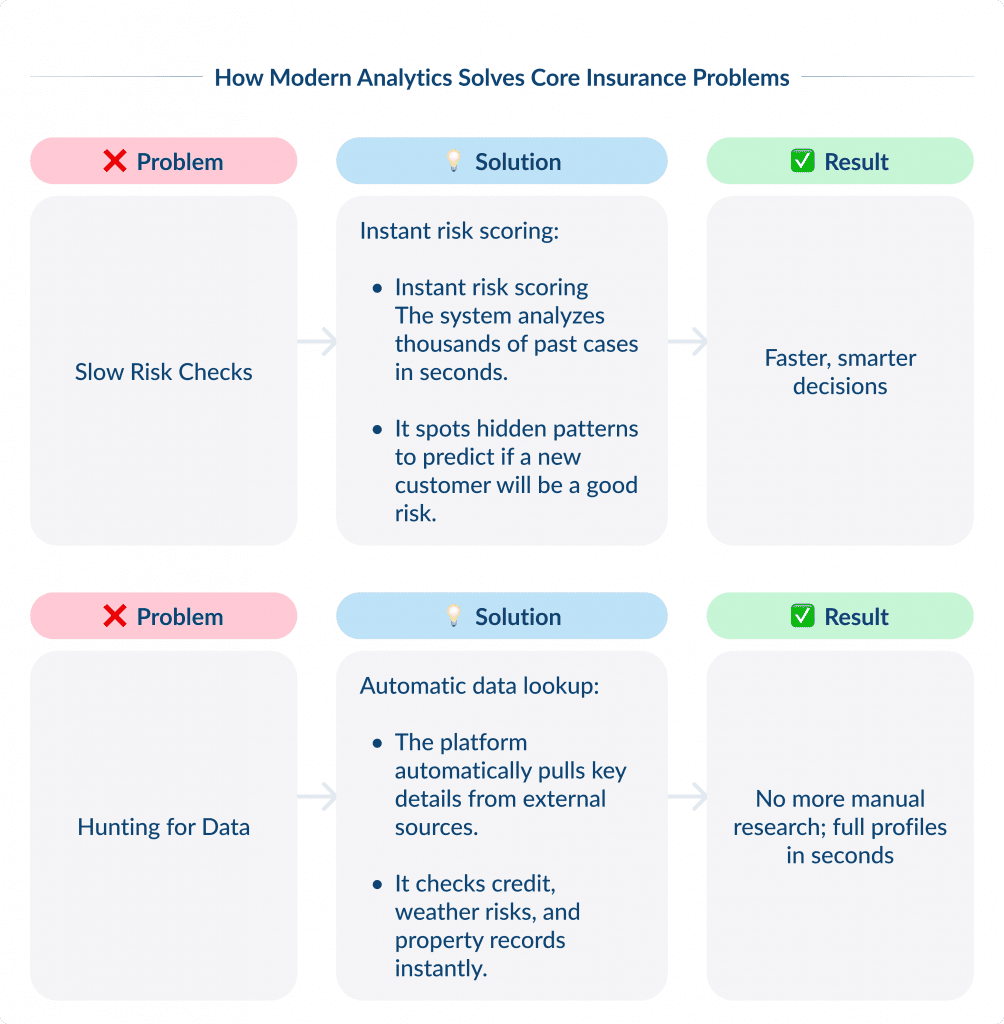
The transformation happens because analytics delivers visibility and actionable insights across the insurance lifecycle.
These capabilities sound impressive in theory, but how do they work in practice? Let’s look at a real-world example.
Case Study: Turning Incident Data into Actionable Intelligence
Sometimes the best way to understand how data analytics transforms insurance operations is to see it in action. Here’s a project that shows what happens when you take years of scattered incident data and turn it into a system that actually helps people make decisions.
In 2010, venues across the United States, performing arts centers, sports arenas, and convention halls, were tracking incidents the same way they had for decades: spreadsheets, paper forms, and email chains. When someone got injured, when property was damaged, when security responded to a situation, someone would fill out a form. That form would go into a file somewhere.
This approach had obvious limitations. The first one is that historical data was trapped in formats that made data analysis nearly impossible. Then, patterns that might reveal systemic issues remained invisible because no one had time to manually review thousands of individual incident reports. And when insurance renewals came around, assembling a complete picture of loss experience meant hunting through files and hoping nothing got missed.
The venues knew they had valuable data. They just had no practical way to use it.
We partnered with a company that saw the opportunity to change this. They had deep experience in venue management and understood that these organizations actually needed something straightforward that fit into existing workflows.
This incident record software development project took six months with a three-person team. The challenge was figuring out how to migrate years of historical data from spreadsheets into a new system without losing anything. It was also important to create a platform that is flexible enough to serve a performing arts center in Dallas and a sports arena in Seattle while remaining scalable.
The developed platform handles the complete incident lifecycle:
- Incident tracking. Document what happened, when, where, and who was involved. The interface guides users through capturing the essential details without overwhelming them with unnecessary fields.
- First responder actions. Log what actions were taken, upload photos from the scene, and attach relevant documents. Everything related to an incident lives in one place instead of being scattered across emails and shared drives.
- Automatic notifications. When an incident is logged, the system automatically sends reports to relevant stakeholders: risk managers, insurance contacts, and facility leadership. No one has to remember to forward information or worry that someone got left off the distribution list.
- Comprehensive reporting. This is where the analytics value becomes clear. Instead of manually reviewing individual incidents, users can see patterns across time, location, incident type, or any other dimension. Which areas of the venue see the most incidents? What types of incidents are increasing? How quickly are first responders typically arriving on scene?
Why This Matters for Insurance
From an insurance perspective, this type of system changes the underwriting equation. When a venue can present comprehensive incident data with clear trend analysis, underwriters can price risk more accurately. When organizations can demonstrate that they are actively managing safety based on data insights, they become less attractive risks.
The venues benefit from potentially better rates and terms. And the insurers benefit from better risk selection and fewer surprises during the policy period. It is one of those situations where better data creates value for everyone involved.
Several lessons from this project apply broadly to insurance analytics:
- User adoption matters more than features. The most sophisticated analytics are worthless if people do not use the system. We focused relentlessly on making data entry fast and intuitive because we knew that if logging incidents felt burdensome, people would find ways to avoid it.
- Migration is harder than it looks. Moving unstructured data from spreadsheets into a structured database required careful planning. Spreadsheets are flexible, which also means they are inconsistent. And standardizing years of varied formats without losing information took significant effort.
- Customization and scalability are in tension. Every venue wanted the system configured slightly differently. Building something flexible enough to accommodate various needs while maintaining a single codebase that we could support required constant balancing.
That is what analytics looks like in practice: taking information that already exists, making it accessible and usable, and enabling better business decisions as a result.
Getting Started: Choosing Your Analytics Path
Before diving into implementation details, insurers need to answer a fundamental question: should we build custom analytics capabilities, buy an off-the-shelf solution, or partner with a specialized provider?
Build vs. Buy vs. Partner
Building in-house makes sense when:
- You have unique data sources or workflows that commercial solutions can’t accommodate
- You have existing data science and engineering teams with capacity
- Your competitive advantage depends on proprietary analytics capabilities
- You need complete control over algorithms and intellectual property
The challenge: building takes 18-24 months minimum, requires ongoing maintenance, and demands specialized talent that’s expensive and hard to retain.
Buying commercial software works when:
- Your analytics needs are standard (fraud detection, risk scoring, claims triage)
- You want faster time-to-value (3-6 months typical)
- You lack internal data science expertise
- You’re comfortable with vendor dependency
The challenge: commercial solutions may not fit your specific workflows, and integration can still be complex.
Partnering with specialists offers a middle path:
- Custom solutions tailored to your specific needs
- Faster than building entirely in-house (6-12 months typical)
- Access to specialized expertise without permanent headcount
- Ongoing support and evolution of capabilities
The challenge is that selecting the right dedicated development team to hire is critical, and you’ll still need internal resources to manage the relationship and own the data strategy.
Regardless of which path you choose, successful analytics implementation requires:
- Data infrastructure baseline: You need accessible data, even if it’s not perfectly clean. If your data is completely siloed in legacy systems with no APIs or export capabilities, you’ll need to address that first.
- Executive sponsorship: Analytics initiatives that succeed have C-suite champions who allocate budget, remove roadblocks, and drive adoption across departments.
- Clear use cases: Start with specific problems you’re trying to solve (reduce claims processing time by 40%, improve underwriting hit ratio by 15%) rather than vague goals like “become more data-driven.”
- Change management capacity: Your teams need to actually use these tools. That requires training, ongoing support, and sometimes workflow redesign.
- Data governance framework: Even basic analytics raises questions about data privacy, security, and regulatory compliance. You need policies for how data is collected, stored, accessed, and protected, especially given regulations like GDPR and CCPA.
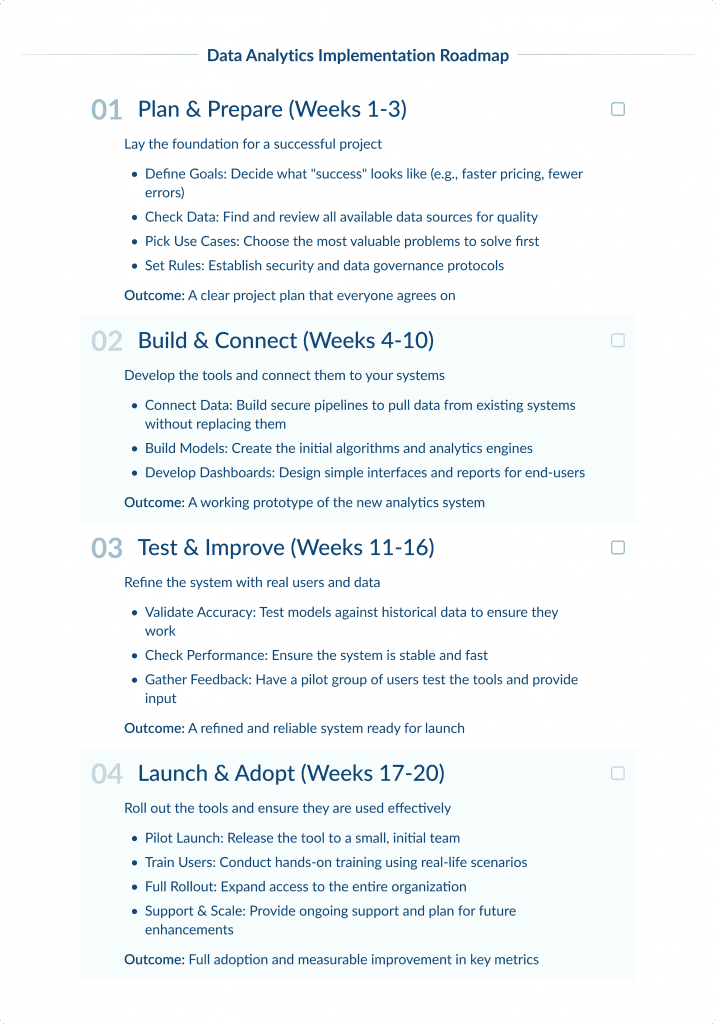
What Data Analytics Implementation Looks Like
Most insurers we work with expect analytics implementation to be a long, disruptive project. In reality, when the process is structured, it moves faster and with far less friction than teams anticipate.
A typical timeline runs 12–20 weeks, depending on data maturity and the number of systems involved. The early stage focuses on the Agile discovery phase:
- clarifying business goals
- auditing data sources
- choosing the most impactful use cases so the project stays focused and avoids scope creep.
The biggest challenge is almost never the technology, but the integration. Many carriers still have underwriting, policy, and claims data that are spread across aging core systems, spreadsheets, and departmental tools.
To avoid delays, we map all available data early and build lightweight connectors or APIs that don’t require replacing existing systems. In our recent projects, this approach helped teams start using dashboards and predictive models weeks before the full integration work was finished.
Another point leaders worry about is change management. You don’t want to roll out analytics tools your teams can’t or won’t use. That’s why adoption is built into the process from day one. We involve underwriters, insurance agents, claims managers, or actuaries early, validate insights with them, and train them on real scenarios from their own workflows. When people see that the data helps them close submissions faster or cut repetitive tasks, adoption happens naturally.
Another popular question from our clients is when they will see a return on their investments.
ROI usually begins to show within the first quarter post-launch. Quick wins like automated customer data ingestion, faster claims triage, or clearer risk scoring deliver measurable improvements before the advanced models even mature. As the data stabilizes and teams rely on it daily, the longer-term impact becomes visible:
- higher underwriting accuracy
- lower loss ratios
- more predictable operations & more.
Conclusion: A Clear Path Toward Data Analytics in Insurance
Five years ago, advanced analytics in the insurance industry was a nice-to-have. Today, it’s table stakes. Your competitors are already using it for faster quoting, claims management, more accurate detection of fraudulent claims, predictive modeling, and delivering better customer experiences.
The good news is that you don’t need to overhaul your entire tech stack to get there. Most probably, you already have valuable data. It’s just trapped in systems that don’t work together.
That’s exactly what a strong analytics infrastructure does, and it’s exactly the kind of friction it removes.
With the right partner, you can start small and build a scalable analytics foundation without disrupting your daily operations. If you’re exploring how data analytics tools can help your business growth, let’s connect to discuss the key benefits and potential bottlenecks of this decision for your team.