Restaurant Loyalty App Development: Features, Integrations, and Cost
- Created: Jul 10, 2026
- 22 min

Senior Mobile Developer
When most people hear about restaurant loyalty app, they picture a digital punch card with something like Buy nine coffees, the tenth is free.
Restaurant loyalty app development in 2026 is an entirely different animal. A good restaurant loyalty program connects rewards, customer data, ordering, and communication into one system that knows who your customer is and what they order. The points are (almost) the least interesting part.
But there’s the catch, though: there’s no single right way to build an app for your restaurant customer loyalty program. What a single independent restaurant needs looks nothing like what a growing chain needs. And a franchise’s requirements are different again from a delivery-first brand or a food-tech platform. So before we get into features and architecture, I thought I’d mention that the right product depends entirely on how your business runs, not on what’s trending.
Core Components of a Rewards Platform
If you’re short on time, here’s the checklist version. A solid restaurant loyalty app should have:
- Customer profile – who they are, beyond just a phone number.
- Rewards wallet – points, balances, redeemable perks, all in one place.
- Points or visit-based logic – the actual math behind earning and spending.
- POS integration – so rewards sync with what’s happening at checkout.
- Online ordering integration – because a lot of “visits” now happen through an app or website.
- Personalized offers – based on what someone really orders.
- Push notifications – timely, not spammy.
- Analytics – so you can see what’s working in your own restaurant loyalty program.
- Fraud controls – because wherever there are points, someone will try to game them.
We’ll walk through each of these in detail below.
What Is a Restaurant Loyalty App?
A restaurant loyalty app is software that tracks customer behavior (things like visits, orders, spending) and turns that data into rewards that bring people back. That’s not as simple as it sounds. The app needs to recognize a customer, remember what they do, and respond to it in a way that feels useful rather than generic.
A loyalty app is not a discount tool. Take something like Groupon: it hands out a discount code tied to a deal, not to a person. The code doesn’t know who’s redeeming it, doesn’t remember if you’ve used a dozen similar deals before, and doesn’t adjust based on what you actually order. It just needs to be valid and unredeemed. That’s a perfectly fine tool for what it does, but it’s not building any relationship with the customer.
A loyalty app, on the other hand, is built around identity. It connects a customer’s profile to their actual purchase history. Dunkin’ Rewards is a good example of this in practice. Members earn a flat rate of points per dollar no matter how they pay, and a separate status tier rewards people for visiting often rather than spending big in one go. Both mechanics are grounded in the same idea: the app is watching real behavior and building rewards around that pattern.
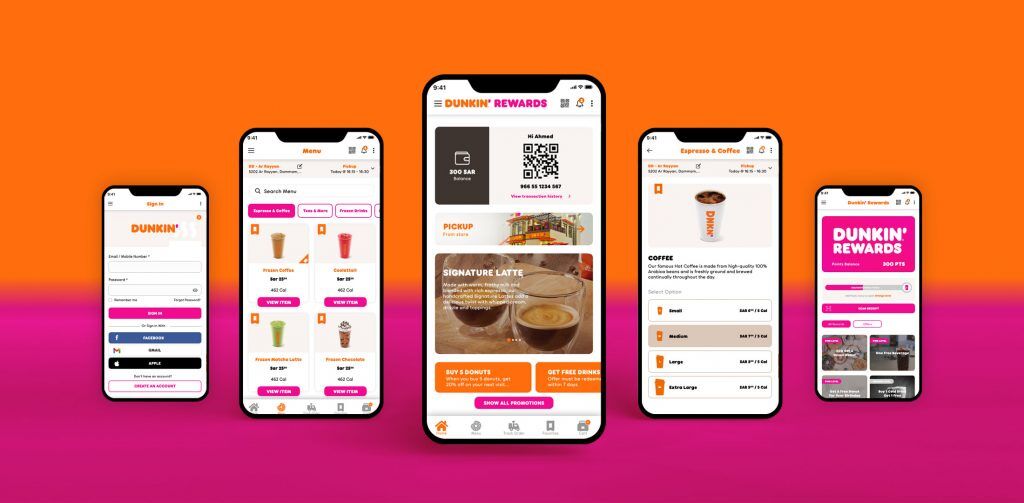
image source: international.dunkindonuts.com
That connection is also why a loyalty app can’t live in isolation. If it doesn’t talk to your POS system, your online ordering platform, or however customers actually place orders, it’s just tracking points nobody can redeem in real life.
The rewards only matter if they’re linked to the systems where the ordering, paying, and identifying actually happen. Otherwise, you’ve built a nice-looking app that runs parallel to your business instead of inside it.
Restaurant Loyalty App vs Loyalty Module vs CRM
These three terms are used almost interchangeably, which causes a lot of confusion during planning to build custom software for restaurant operations. They’re not the same thing and here is how they differ:
- A basic loyalty module is usually a feature bolted onto a POS system. Think of a points tab that shows up at checkout. It’s fast to turn on and requires no separate app, but it rarely does much beyond tracking a balance.
- A standalone loyalty app is its own product, built specifically around rewards and customer engagement, and it can go much deeper with things like segmentation, personalized offers, and richer notifications.
- A CRM with loyalty features flips the priority: the core purpose is managing customer relationships and data across the business, with loyalty as one layer on top.
- A branded restaurant app with loyalty built in combines ordering, loyalty, and brand presence into a single customer-facing product.
| Solution | Main purpose | Customer-facing app | Data depth | Suitable for |
|---|---|---|---|---|
| Basic loyalty module | Track points at checkout | No, usually built into POS | Shallow, mostly balances | Single location, simple rewards |
| Standalone loyalty app | Drive engagement and repeat visits | Yes | Moderate to deep, depending on build | Restaurants wanting a dedicated loyalty experience |
| CRM with loyalty features | Manage customer relationships and data | Sometimes, often admin-facing | Deep, full customer history and segmentation | Chains and businesses focused on long-term customer data |
| Branded restaurant app with loyalty | Combine ordering, brand, and rewards | Yes | Moderate to deep | Brands wanting one app for everything |
Choosing one of these solutions doesn’t automatically replace the others. A restaurant chain might run a CRM in the background while its customer-facing loyalty lives in a branded app that talks to it. The main thing is that the combination must fit how the business operates. Here’s more about restaurant tech stack in 2026: what’s worth adding and what you can drop down.
Common Restaurant Loyalty Models
These are the most widespread loyalty models restaurants use for guest engagement:
- Points-based rewards are the most familiar: spend money, earn points, redeem them later.
- Visit-based rewards count how often someone comes in, regardless of spend. These are useful for businesses where average order size varies a lot.
- Digital stamp cards are the simplest version of visit-based logic, just digitized.
- Tiered rewards give bigger perks to your most frequent customers, which can boost engagement but also adds complexity to manage.
- Referral rewards turn existing customers into a small acquisition channel.
- Personalized offers move beyond one-size-fits-all rules and respond to what a specific customer actually orders.
- Subscription programs ask customers to pay upfront for ongoing perks. Thats a different relationship than earn-and-redeem.
- Gamification, including badges, challenges, and milestones, adds a layer of fun but works best as an addition to a solid loyalty foundation.
| Loyalty model | How it works | Benefits | Limitations | Suitable for |
|---|---|---|---|---|
| Points-based | Earn points per purchase, redeem for rewards | Familiar, flexible, easy to explain | Can feel generic without personalization | Most restaurant types |
| Visit-based | Rewards tied to number of visits, not spend | Simple to understand and track | Doesn’t account for order value | Cafes, quick-service spots |
| Digital stamp cards | Digitized version of “buy X, get one free” | Very easy to implement and explain | Limited flexibility, little data depth | Single-location, simple use cases |
| Tiered rewards | Higher spend or visits unlock better perks | Encourages frequent customers to spend more | More complex to design and manage | Chains with loyal repeat customers |
| Referral rewards | Existing customers earn perks for bringing new ones | Low-cost acquisition channel | Needs fraud safeguards | Growing brands, delivery-first businesses |
| Personalized promotions | Offers built around order history and behavior | Higher relevance, better engagement | Requires more data and system integration | Businesses with rich customer data |
| Subscriptions | Customers pay recurring fee for ongoing perks | Predictable revenue, strong retention | Requires clear, consistent value | Established brands with loyal base |
| Gamification | Badges, challenges, milestones layered on rewards | Adds engagement and fun | Works best as an addition, not a base | Brands wanting extra engagement layer |
Essential Functionality for Modern Retention Software
Below, I explore the main features a restaurant customer loyalty app should have to cater to both clients’ needs and business objectives. That’s a balance we strive for at SpdLoad when building custom restaurant loyalty software.
Customer Profiles and Account Management
Everything in a loyalty app for restaurants starts with the customer portal. It sounds basic, but this is the foundation everything else is built on.
Sign-up should be quick. Nobody wants to fill out a ten-field form to earn coffee points, so most successful apps ask for the minimum: name, phone or email, maybe a birthday. Along with sign-up comes consent. The customer should know what data is collected and how it’s used. This is important both legally and for trust.
From there, the profile grows. It holds preferences (dietary needs, favorite items), visit history (when and how often someone comes in), and order history (what they actually buy). For businesses with more than one location, the profile needs to work across all of them.
And because people lose phones, switch numbers, and forget passwords, account recovery needs to be simple and reliable.
None of this needs to be complicated. But it does need to be consistent because the profile is the thread that connects every other feature in this list.
Rewards Wallet
If the customer profile is the foundation, the rewards wallet is the part customers actually look at. It’s where the relationship becomes visible: here’s what you’ve earned, here’s what you can do with it.
A good wallet shows a clear points balance and a list of available rewards. Expiration dates matter too, both to create some gentle urgency and to keep the numbers on the business side manageable.
Redemption should be simple: a customer shouldn’t need a tutorial to use their own points (offline redemption is a good add-on).
A visible reward history builds trust since people like being able to check that a redemption actually went through. And behind the scenes, promo rules determine which rewards apply when, so the wallet reflects whatever campaign or offer is currently live.
The wallet is a small piece of the system. But it’s often the only part customers interact with directly, so it’s worth designing with real care.
Referral and Gamification Features
These features aren’t essential to a functioning loyalty app, but they add a layer of engagement that can extend how long customers stay interested.
- Referral codes let existing customers earn something for bringing in new ones. It’s a low-cost way to grow, since the recommendation is coming from someone the new customer already trusts.
- Challenges (“order three different dishes this month”) give people a small goal to chase.
- Badges and reward milestones mark progress in a way that feels a bit like a game rather than a transaction.
- Leaderboards can work well in the right context (a coffee shop with a strong regular crowd, for instance), but they’re not a fit everywhere.
Customer Feedback
Feedback features often get treated as an afterthought in loyalty apps, but they’re closely tied to the same goal: understanding customers well enough to keep them coming back.
- Post-visit surveys are the most direct way to hear from customers right after an experience, while it’s still fresh.
- Review requests encourage people to share their experience publicly, which helps with both reputation and an honest signal about what’s working.
- Service recovery matters just as much. When a customer flags a bad experience, having a clear process to respond quickly can turn a complaint into a reason to trust the business more.
- Feedback segmentation, or simply grouping responses by location, order type, or customer tier, helps a business spot patterns instead of reacting to one comment at a time.
Push Notifications and Messaging
A restaurant loyalty platform can have a beautifully designed rewards wallet and a smart rules engine underneath it, but none of it matters if customers forget the app exists. That’s what notifications are for.
- Reward reminders nudge someone to use points before they expire, which helps both the customer and the business.
- Birthday rewards are a small, low-effort gesture that tends to land well. People notice when a business remembers.
- New menu announcements give customers a reason to come back and try something.
- Reactivation campaigns target people who haven’t ordered in a while, gently pulling them back before they forget the brand entirely.
- Order-related messages (confirmations, ready-for-pickup alerts) aren’t really marketing tools, but they’re part of the same messaging system and worth including.
Email and SMS still have a place here, but mostly as complementary channels rather than the main event.
The Core Architecture: Designing the Rules Engine
This is the part customers never see, but it’s arguably the most important piece of the whole system.
The rules engine is where all the logic behind your restaurant loyalty program app lives. It includes the decisions about how points get earned, how they get spent, and what happens in the edge cases that always come up in real life. Here are a few things that must go there:
- Earning rules define how points accumulate: per dollar spent, per visit, or some mix of both.
- Redemption rules define what those points can buy and under what conditions.
- Excluded products – maybe alcohol or gift cards don’t earn points.
- Location-specific promotions – a deal that only runs at certain branches.
- Campaign periods double points during a slow month.
- Reward caps – limiting how much a single customer can earn or redeem in a given window, which also helps prevent abuse.
There’s also one more essential piece: manual adjustments. Sometimes a points calculation goes wrong, or a manager needs to make something right for a frustrated customer. Without a way to manually adjust a balance, staff are stuck explaining a system error instead of just fixing it.
The rules engine should be designed with room to grow, because the moment you run your first promotion or open a second location, you’ll need more flexibility than a fixed set of hardcoded rules can offer.
Personalized Offers
I want to be clear about something upfront: personalization doesn’t have to mean complex AI personalization for restaurant apps or machine learning. Sometimes it’s as simple as noticing patterns and acting on them.
For example, an offer built around order history might just mean recommending a discount on someone’s most-ordered item.
Grouping people into customer segments, like regulars, occasional visitors, big spenders, lets you tailor messaging without needing a model for every individual.
Reaching out to inactive users with a “we miss you” offer is one of the more reliably effective moves in loyalty marketing, and it doesn’t require any restaurant marketing automation software to set up.
Highlighting someone’s favorite categories keeps offers relevant instead of random. Slow-hour promotions can shift traffic to quieter parts of the day. And location-specific offers let a business run something local without it looking like a mismatched, one-size-fits-all campaign.
The more advanced version of personalization with predictive modeling and real-time recommendation engines absolutely has its place, and we’ll get to where that fits later on. But it’s not a prerequisite.
POS and Online Ordering Integration
Everything starts with customer identification – recognizing who’s making a purchase, whether that’s a phone number entered at checkout, a scanned app code, or an account linked to an online order.
From there, points accrual needs to happen automatically and accurately, calculated the moment a purchase goes through rather than added manually later. Redemption works the same way in reverse: a customer should be able to use their rewards right at checkout, without a staff member needing to call someone or check a separate system.
Behind the scenes, the app needs access to purchase history so personalization and analytics have something real to work with, and it needs promotion validation (checking that a discount or reward actually applies to what’s in the cart).
Order synchronization keeps everything consistent whether someone orders in-store, through an app, or via a delivery platform. Here’s more on synchronization with the restaurant order management system and why it is essential for any restaurant reward system.
Refund handling matters too. If an order gets refunded, the points earned from it should be reversed too, or the numbers stop making sense.
And for any business with more than one location, multi-location synchronization ensures that a customer’s balance and history look the same at every branch they visit.
Here’s roughly how it flows in practice:
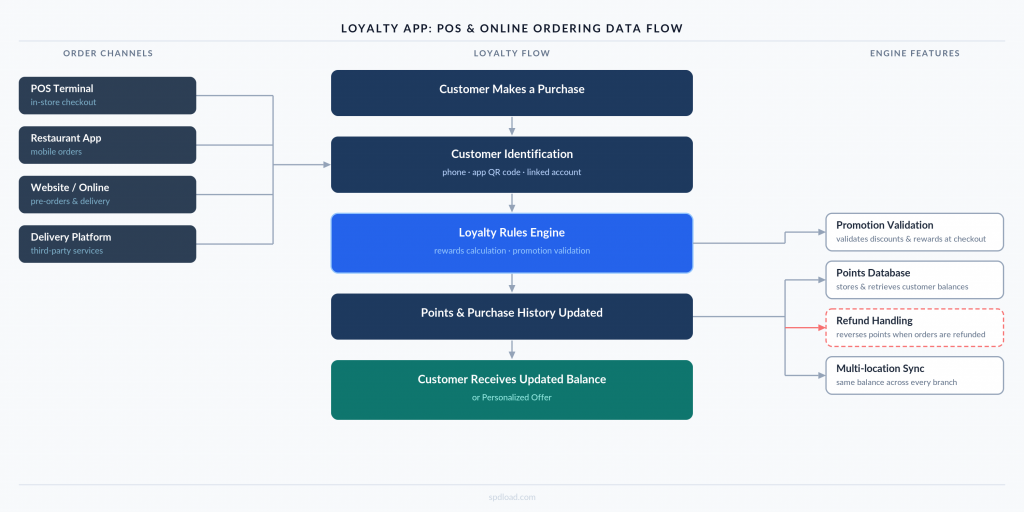
This isn’t meant to be a full guide to POS integration on its own since that’s a deep topic in its own right. But it’s worth understanding this much: if online ordering is part of how customers order, the loyalty app needs to work with it just as smoothly as it works with the POS.
For a closer look at how ordering systems function on their own, our guide to building a food delivery app is a useful next read.
Customer Data, Privacy, and Consent
A loyalty app runs on customer data by design, and that’s what makes personalization possible. But that also means privacy and consent should be built into the core of the product.
Here’s how we approach it when building customer loyalty software for restaurants:
We start with first-party data. That’s information a business collects directly from its own customers. This is more valuable and more trustworthy, and it’s also the kind of data customers are more comfortable sharing, since they know exactly where it’s going. That said, it still requires clear user consent since customers should understand what’s being collected and why.
Then, we also pay attention to data minimization. We make sure the system collects what’s actually needed to run the program.
Customers should also have real customer control over their own information: the ability to view what’s stored, update it, and request account deletion when they want out.
On the business side, role-based permissions limit who on staff can see or edit customer data, which matters both for security and for basic accountability.
For businesses operating in or serving customers in the EU, GDPR considerations come into play. This is an area where the details genuinely matter and get complex quickly — we’re not going to attempt legal advice here, and neither should your development team. If your restaurant business handles customer data at any real scale, it’s worth having a qualified compliance specialist review your approach before launch.
Beyond the legal side, secure storage of customer data is a good practice we implement. And it’s worth remembering that privacy-friendly personalization is entirely possible: a business doesn’t need to collect excessive data to make offers feel relevant. Often, a customer’s own order history is more than enough.
Loyalty Metrics That Matter
Before building any mobile application, clarify which of these metrics you’re trying to measure with your restaurant rewards program software:
| Metric | What it measures | Why it matters |
|---|---|---|
| Repeat purchase rate | How often existing customers come back and buy again | Core indicator of whether loyalty is actually driving return visits |
| Visit frequency | How often a customer visits over a given period | Shows whether engagement is increasing or fading over time |
| Reward redemption rate | The share of earned rewards customers actually use | Low redemption may mean rewards aren’t appealing or aren’t easy to use |
| Average order value | How much customers spend per visit or order | Reveals whether loyalty offers are encouraging larger orders, not just more frequent ones |
| Customer lifetime value (CLV) | Total value a customer brings over their relationship with the business | Connects loyalty efforts to long-term revenue, not just a single transaction |
| Reactivation rate | How many inactive customers return after a reactivation campaign | Measures whether win-back efforts are actually working |
| Active loyalty members | How many enrolled customers are actively using the program | Distinguishes real engagement from simple sign-up numbers |
| Churn rate | How many customers stop engaging over time | Early warning sign for problems in the experience or the offer |
The thread connecting all of these is that the product needs to be built to measure real business outcomes. It’s easy to celebrate a big sign-up number in the first month and lose sight of whether those same customers are still active six months later.
The features covered earlier, specifically, the rules engine, personalized offers, and notifications, all exist to move these specific numbers.
Fraud Prevention and Reward Abuse
Wherever there’s a system that gives out something valuable, someone will eventually try to game it. That’s just how loyalty programs work in practice. And it’s a lot easier to design fraud controls from the start than to bolt them on after a problem shows up.
Here are some common ways loyalty programs get abused:
- Duplicate accounts: a customer signing up multiple times to claim a new-customer bonus repeatedly, or to reset a capped reward.
- Fake referrals: referring yourself through a second account or a friend’s phone to collect a referral bonus that was never really earned.
- Repeated redemptions: using the same reward or promo QR code more times than intended, whether through a bug or a customer actively looking for a loophole.
- Refund abuse: earning points, redeeming a reward, then refunding the original purchase, ending up with a reward that was never actually paid for.
How to keep this in check:
- Role-based access: limiting who can issue manual adjustments and how large those adjustments can be.
- Audit logs: a clear, permanent record of who did what and when, so any issue can be traced back and understood.
- Suspicious activity monitoring: even something as simple as flagging accounts with unusual redemption patterns catches most problems before they become expensive.
Project Scope: MVP vs Advanced AI-Driven Capabilities
One of the more common mistakes in this space is trying to build everything at once.
| MVP features | Advanced features |
|---|---|
| Customer accounts | AI-assisted personalization |
| Basic points or visit logic | Advanced segmentation |
| POS integration | Predictive reactivation |
| Reward wallet | Omnichannel campaign automation |
| Basic notifications | Multi-location campaign logic |
| Analytics dashboard | Advanced fraud monitoring |
The MVP column covers what most restaurants need to launch something useful. That’s a complete, functional loyalty program.
The advanced column is where things get more sophisticated:
- AI-assisted personalization and advanced segmentation make sense once you have enough customer data and volume for them to add real value.
- Predictive reactivation (anticipating which customers are at risk of churning before they go quiet) is a meaningful upgrade, but it needs solid historical data to work from.
- Omnichannel campaign automation and multi-location campaign logic matter most for chains coordinating promotions across many locations at once.
- Advanced fraud monitoring becomes more worthwhile as reward volume grows and the potential cost of abuse grows with it.
Start with the MVP, get it running well, and let real usage data tell you which advanced features are worth adding next.
Single-Site vs Franchise Operations
A loyalty app built for one restaurant and one built for a chain are different in both scale and structure. A few things that work simply for a single location get genuinely complicated the moment a second one opens:
| Aspect | Single-location | Multi-location |
|---|---|---|
| Reward rules | One straightforward set of earning and redemption rules | Often varies by branch – a promotion at one location, a sign-up bonus for a new one |
| Shared balances | Not really a concept, there’s only one ledger | Needs a single source of truth so points work the same no matter which branch a customer visits |
| Franchise-exclusive offers | Not applicable | Franchise owners may want some control over their own promotions within one shared program |
| Customer profiles | Tied to a single location by default | Needs to follow the customer across branches rather than resetting each time |
| Promotions | Managed at one level | Needs both a chain-wide view and a location-specific view |
| Analytics | One dashboard, one set of numbers | Needs to work at two levels: leadership view and individual branch view |
| Access levels | Owner can reasonably see everything | Usually tiered. Location managers see their own data, broader controls stay with a smaller group |
| Brand consistency | Naturally consistent, since there’s only one experience | Has to be deliberately maintained so every branch feels the same to a customer |
Build, Buy, or Customize?
Once the features and models are clear, the real decision is how to get there. There are several paths, and each comes with a different trade-off between speed, cost, and how well it fits the business.
Option #1: Buy
A built-in POS loyalty module is usually the fastest and cheapest option, since it’s already part of the system a restaurant is likely using.
The trade-off is limited flexibility. It does what it does, and customizing beyond that is often not possible.
Third-party loyalty software offers more features than a basic POS module, with faster setup than building from scratch, but it means adapting the business to fit someone else’s product rather than the other way around.
A white-label solution sits in between. It’s a pre-built platform with some room to brand and configure it, which can be a reasonable middle ground for businesses that want more than an off-the-shelf module without the cost of a fully custom build.
Option #2: Customize
A branded restaurant loyalty app goes further, giving a business its own dedicated app experience built specifically around its rewards program.
And a custom loyalty platform, or a custom CRM and loyalty integration layer, is the most involved option. It’s built entirely around a specific business’s workflows, data, and growth plans, rather than adapted from a generic template.
Option #3: Build
Custom development tends to make sense in a few specific situations:
- A business has outgrown what off-the-shelf tools can offer.
- It needs deep integration across several systems that don’t talk to each other out of the box.
- The loyalty model itself is unusual enough that generic software can’t represent it well.
- Data ownership and long-term flexibility matter more than getting something live quickly.
For a single-location restaurant just getting started, a built-in module or third-party tool is often the more sensible starting point. For a chain managing multiple locations and with a genuine need to own its customer data, custom development is the only option that truly fits.
For a broader sense of how this decision fits into the rest of a restaurant’s technology, our guide to restaurant mobile app development is a useful read, since a loyalty app rarely exists in isolation from the rest of a restaurant’s software.
Budgeting & Development Cost Drivers
Before getting into I get into the main cost drivers, I would like to point out that this section won’t include specific price ranges. Numbers like that vary too much based on region, team, and scope to be meaningful without context.
That said, the factors that shape cost are consistent across most projects. These include:
| Cost factor | What drives the cost |
|---|---|
| Platform choice | Building for iOS, Android, and web all at once costs more than starting with one or two platforms and expanding later |
| Loyalty model | A simple points system is far less involved than a program combining tiers, referrals, and personalized offers |
| POS integration | Ranges from straightforward to genuinely complex, depending on which POS system is in use and how open its API is |
| CRM integration | Adds scope on top of POS work, especially when connecting to an existing CRM rather than building fresh |
| Online ordering integration | Similar to CRM integration, more involved when linking to multiple existing ordering systems |
| Notifications | Adds moderate complexity, especially as messaging logic gets more targeted |
| Customer segmentation | Moderate complexity, particularly if segmentation needs to go beyond simple categories |
| Fraud controls | Can be lightweight or fairly involved, depending on how much monitoring and manual review the business wants built in |
| Multi-location support | Adds real cost since it touches nearly every other feature: rules, profiles, analytics, and access all need to work differently at scale |
| Analytics | Can be a simple dashboard or a deeper reporting layer, depending on how much the business wants to track and act on |
| UX/UI design | Quality matters, especially for a customer-facing app that needs to feel simple to use |
| Data migration | Relevant if a business is moving from an existing system rather than starting fresh |
| QA | Matters more than it might seem, since a loyalty app touching money and rewards needs to be tested thoroughly before launch |
| Maintenance | Not a one-time cost, an ongoing part of running the product well after launch |
Cost follows scope, and scope follows the decisions made earlier in this guide: which loyalty model, how many integrations, whether it’s single- or multi-location. If you get those decisions right, it makes any cost conversation with our development team far more productive.
Practical Examples from SpdLoad Projects
It’s one thing to talk about engagement mechanics in the abstract, and another to see how they play out in a real product. Below, I share two examples from our practice of building solutions for HoReCa.
Customer Engagement and Verified Reviews
First is this review app we’ve developed for one of our HoReCa clients: 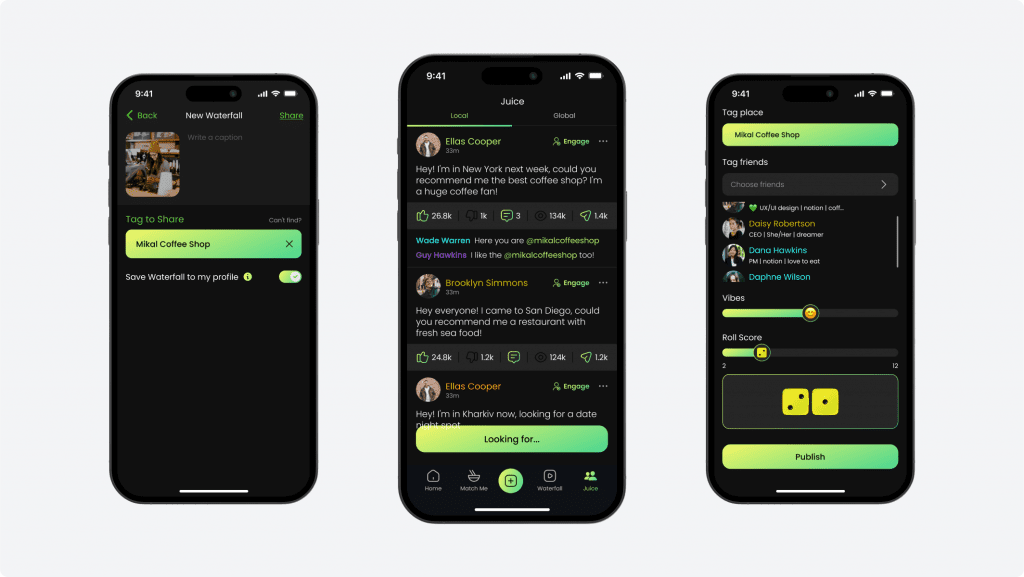
Even though it wasn’t built as a loyalty app, this restaurant reviews app case study is still a valuable reference I would like to highlight.
What made it interesting to build was the two-sided nature of it: a customer-facing app for leaving reviews and a separate business web application for the restaurant side to manage them. We layered in gamification and real-time interactions, plus a way to verify that a review actually came from someone who’d visited. That last part turned out to matter a lot: it’s the difference between a review system people trust and one they scroll past.
I bring this project up here because the mechanics behind it, engagement, trust, verification, are the same muscles a loyalty app needs to flex.
Personalization and Food Discovery
The second one is closer to the personalization side of things: an AI-based restaurant recommendation platform we built to help people discover restaurants based on their own preferences. 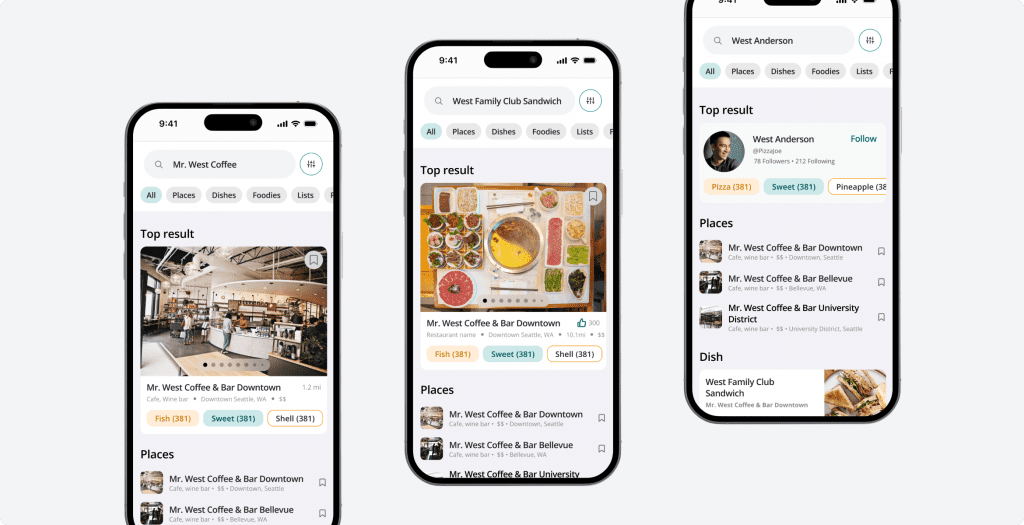
The core of it was user profiles feeding into an AI layer that enriched the data and generated recommendations. Nothing groundbreaking conceptually, but the execution mattered a lot. Keeping API costs under control at scale, caching results so the app stayed fast, tuning performance so recommendations didn’t lag behind the rest of the experience, that’s where most of the real engineering work went.
Again, not a loyalty app. But if you’re picturing what “personalized offers” could look like once you’re ready for something more advanced than segment-based rules, this project is a fair preview of what that build entails.
Implementation Checklist
Use this as a working checklist while planning your loyalty app. Check off each item as your team makes the decisions before the development starts.
- Define business goals
Write down what you want the app to move (repeat visits, retention rate, average order value, churn, reactivation). Pick one or two priorities.
- Select loyalty mechanics
Choose the model (points, visits, tiers, referrals) that fits your business. Decide this before design and development stages.
- Map customer identification flows
Sketch out how a customer gets recognized at every touchpoint: in-store at the register, through the app, via delivery.
- Define POS and ordering integrations
List every system the loyalty app needs to connect to. Confirm with your POS and ordering providers what their APIs support.
- Separate MVP and advanced features
Draw a hard line between what’s needed to launch and what can wait.
- Define consent and privacy requirements
Decide what data you’ll collect, why, and how customers can control or delete it. Loop in a compliance specialist here.
- Select business metrics
Pick the specific numbers that will tell you if the program works (repeat purchase rate, redemption rate, whatever matches your goals from step one).
- Add fraud-prevention logic
Build in audit logs, role permissions, and basic monitoring.
- Test redemption scenarios
Walk through cases such as refunds, expired points, duplicate accounts, and a customer redeeming at a different location than where they earned the points. Fix what breaks.
- Launch gradually and improve based on data
Start with a smaller rollout if you can (one location, a limited group of customers). Watch how people use it, then adjust before scaling up.
Conclusion
A restaurant loyalty app is only as useful as the connections behind it. Rewards on their own don’t do much, and the real value comes from linking those rewards to customer data and to how the restaurant actually operates day to day, from the POS to online ordering to the way offers get personalized.
And custom development isn’t the right choice for everyone. It makes sense specifically when standard loyalty tools don’t match how a business actually runs, when the integrations are too complex, the loyalty model too particular, or the need for data ownership too important to hand off to a generic platform.
If you’re weighing these decisions for your own restaurant business, contact us to talk through the specifics with a team that builds this kind of software regularly.